
A Preschool Read-Aloud Shelf for Gratitude, Giggles, and Better Thanksgiving Conversations
Compare 12 read-alouds for ages 3–5 across gratitude, counting, turkey humor, shared meals, traditions, and history—with age labels and preview notes.
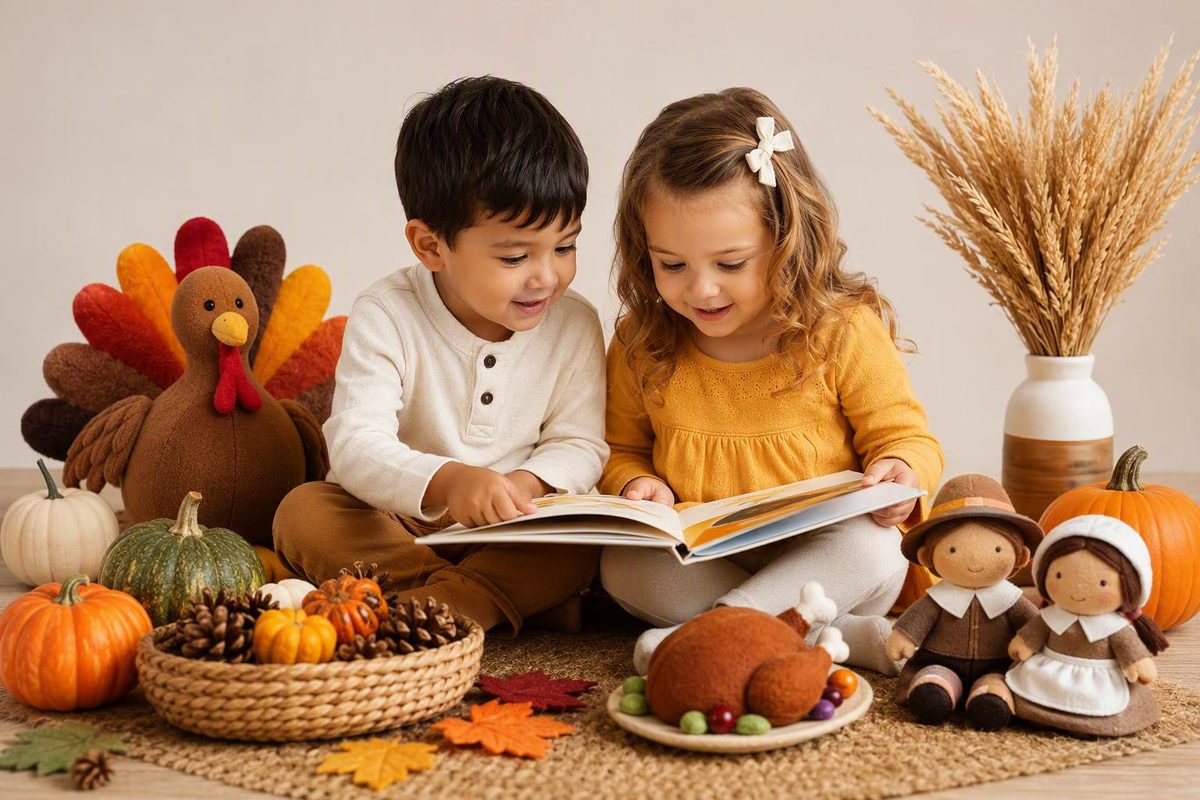
The most useful Thanksgiving books for preschoolers are not all retellings of the holiday’s origin. For ages three to five, build a shelf that mixes brief gratitude stories, counting and rhyme, funny turkey adventures, shared-table books, varied family traditions, and an older-preschool parade pick. Match the book to the group’s listening needs, and preview turkey-peril plots and historical narratives before reading aloud.
12 Thanksgiving read-alouds at a glance
| Book and age label | Theme and holiday fit | Engagement feature | Preview note |
|---|---|---|---|
| I Am Thankful by Sonali Fry — ages 2–51 | Gratitude in a diverse classroom; Thanksgiving-specific | Rhyming text and concrete examples of appreciation | Do not confuse it with Sheri Wall’s book of the same title. |
| I Am Thankful by Sheri Wall — ages 3–52 | Three families expressing gratitude; Thanksgiving-specific | Sparse rhyming text | Check the author before borrowing or ordering. |
| The Crayons Give Thanks — ages 2–51 | Appreciation expressed by familiar and new characters; Thanksgiving-specific | Heartfelt ideas mixed with humor | Preview the examples you may want to discuss. |
| Five Silly Turkeys by Salina Yoon — ages 2–51 | Turkey-themed counting; Thanksgiving-specific | Counting, rhyme, humor, and sensory elements | Decide whether children will count, echo, or move before starting. |
| Around the Table that Grandad Built — ages 3–72 | Food, family, and gratitude; Thanksgiving-adjacent | A cumulative shared-table concept | Invite family connections without assuming every child celebrates Thanksgiving. |
| The Blue Table — ages 3–62 | A family preparing for a feast; Thanksgiving-adjacent | Visual focus on preparation and anticipation | It is not explicitly a Thanksgiving story. |
| Bear Says Thanks — preview by group3 | Friendship, contribution, and a shared meal; Thanksgiving-adjacent | Bear worries that he has nothing to bring | Preschool lists recommend it, but do not provide a formal age label. |
| A Turkey for Thanksgiving — ages 3–62 | A turkey invited to dinner; Thanksgiving-specific | Humorous misunderstanding | Preview the turkey-as-dinner setup for sensitive listeners. |
| Turkey Trouble by Wendi Silvano — preview by group3 | A turkey tries to avoid becoming dinner; Thanksgiving-specific | Disguises, prediction, and invention | Preschool lists recommend it without a formal age label; preview the threatened-animal humor. |
| Fry Bread — ages 3–62 | Food, family, Indigenous community, and identity; Thanksgiving-adjacent | Rich language, a recipe, and an author note | It is not a Thanksgiving origin story; adults may wish to read the longer note separately. |
| Duck for Turkey Day — ages 4–82 | Families serving culturally varied holiday meals; Thanksgiving-specific | A concrete comparison of family food traditions | Use as an older-preschool or preview-first choice. |
| Balloons Over Broadway — ages 4–82 | Tony Sarg and the Macy’s Thanksgiving Day Parade; Thanksgiving-specific | Bright art, puppetry, biography, and parade engineering | The informative text may be dense for some preschool listeners. |
The clearest age-labeled choices across the preschool span are I Am Thankful by Sonali Fry, The Crayons Give Thanks, and Five Silly Turkeys, all listed for ages 2–5.1 Duck for Turkey Day and Balloons Over Broadway begin at age four, placing them in the older-preschool or preview-first category.2
These labels come from publishers or editorial recommendation pages. They are useful starting points, not guarantees that a book’s language, subject, humor, or listening demand will suit every child. This guide compares those documented labels and features; it does not present the books as independently classroom-tested.
Short, rhythmic, and interactive choices
For younger listeners or groups that need frequent chances to join in, begin with a book whose structure supports simple participation.
I Am Thankful by Sonali Fry, illustrated by Alessia Girasole, is an ages 2–5 rhyming story about a diverse classroom sharing what its members appreciate.1 The classroom setting makes it easy to pause for one or two concrete connections without turning the read-aloud into a long round in which every child must answer.
I Am Thankful: A Thanksgiving Book for Kids by Sheri Wall, illustrated by Holly Clifton-Brown, is a separate book for ages 3–5.2 It follows three families and uses sparse rhyming text, making it a practical choice when you want a concise story followed by conversation. Because the titles are identical, confirm the author and cover before placing a hold or buying a copy.
Five Silly Turkeys by Salina Yoon combines counting, rhyme, humorous illustrations, and sensory elements for ages 2–5.1 Children might show each number on their fingers, echo a repeated phrase, or make one simple turkey motion. Pick one invitation instead of layering several directions over the story.
The Crayons Give Thanks is also labeled for ages 2–5.1 Returning and new crayon characters express appreciation through sincere and funny moments, offering a familiar-character route into a gratitude discussion.
Quick choice
- Choose I Am Thankful by Sheri Wall for sparse rhyme and a concise read-aloud.
- Choose Five Silly Turkeys for counting and sensory participation.
- Choose The Crayons Give Thanks when familiar characters can open a gratitude conversation.
- Choose I Am Thankful by Sonali Fry for rhyme and a classroom-centered view of appreciation.
These distinctions are more useful than assigning exact reading times. The pace will vary with the edition, the reader’s style, and how often children pause to comment.
Gratitude, family, and the shared table
Books about preparing, contributing, and gathering make thankfulness visible without relying on a First Thanksgiving narrative.
Around the Table that Grandad Built by Melanie Heuiser Hill, illustrated by Jaime Kim, celebrates food, family, and gratitude for ages 3–7.2 Its shared table creates an opening to discuss how food can carry memories or connect people.
Total Preschool’s suggested prompt: “Is there a food that is important to your family? What makes it important?”
The Blue Table by Chris Raschka, recommended for ages 3–6, follows a family preparing for a feast.2 It is Thanksgiving-adjacent rather than explicitly about the holiday, making it useful for discussing preparation and anticipation across many kinds of gatherings.
Total Preschool’s suggested prompt: “What job could you do to help prepare for a meal?”
Bear Says Thanks centers on Bear, his friends, and a shared meal. Friends arrive with food while Bear worries that his cupboard is empty and he has nothing to contribute. That problem can shift the conversation from what someone owns to the different ways a person can participate.
Total Preschool’s suggested prompt: “What can someone contribute if they do not bring food?”
Choose Around the Table that Grandad Built for a family-food conversation, The Blue Table for preparation and anticipation, or Bear Says Thanks for friendship and contribution. With Bear Says Thanks, the premise is a more useful selection signal than the number of recommendation lists on which it appears.
For a no-purchase extension, give each child paper and crayons and invite them to draw a food or tradition important to their family. “Important to your family” leaves room for children who do not celebrate Thanksgiving, celebrate it differently, or prefer to share another gathering or everyday tradition.
Funny turkey stories—with a content note
Turkey comedies invite prediction, dramatic voices, and absurd ideas. They also often depend on the possibility that a turkey will become dinner, which some children may find funny and others may find upsetting.
A Turkey for Thanksgiving by Eve Bunting, recommended for ages 3–6, builds humor around a misunderstanding: a turkey is invited to Thanksgiving dinner.2 The setup gives children room to wonder what “a turkey for Thanksgiving” means and revise their predictions as the story unfolds.
Turkey Trouble by Wendi Silvano follows a turkey disguising itself as different farm animals to avoid becoming Thanksgiving dinner.3 Before each disguise is revealed, pause and ask what Turkey might try next. After reading, children can draw or describe another disguise using paper and crayons.
Preview both books with the particular child or group in mind. A threatened-animal premise can feel very different from a gentle gratitude story, even when the ending and illustrations are playful. For listeners who dislike that tension, try The Crayons Give Thanks or either age-labeled I Am Thankful title instead.
Turkey Trouble appears on preschool recommendation and marketplace lists, but visibility, sales, ratings, and repeated inclusion do not establish whether its humor will suit a particular group.
Books that broaden the Thanksgiving table
Fry Bread: A Native American Family Story is written by Kevin Noble Maillard and illustrated by Juana Martinez-Neal. It should not be presented as a Thanksgiving origin story.
The book includes a recipe and an author note. The picture-book text can anchor a preschool read-aloud, while an adult may prefer to read the longer historical note separately before deciding what context to share.
Total Preschool’s suggested prompt: “What can make a food meaningful besides how it tastes?”
Duck for Turkey Day by Jacqueline Jules, illustrated by Kathryn Mitter, is recommended for ages 4–8 and depicts families serving culturally varied Thanksgiving meals.2 Because its range begins at four, preview its language and listening demands before using it with a mixed three-to-five group.
Total Preschool’s suggested prompt: “What different dishes do you notice, and how can families celebrate the same holiday in different ways?”
Together, these books loosen the idea that every meaningful meal must feature the same foods. One focuses on food within Native family and community life; the other shows families bringing their own dishes to Thanksgiving. Neither book represents every Indigenous experience or every family tradition.
If your purpose is to introduce contemporary Wampanoag life, choose a resource specifically identified and historically reviewed for that purpose rather than asking this book to fill that role.
Parades, Pilgrims, and the history books to preview carefully
Balloons Over Broadway by Melissa Sweet is an ages 4–8 picture-book biography about puppeteer Tony Sarg and the Macy’s Thanksgiving Day Parade.2 Its art and behind-the-scenes subject may appeal to children interested in balloons, puppets, making, and parades.
The informative text may be dense for some preschool listeners. Consider sharing selected pages or pausing to discuss one idea at a time rather than assuming it will work as a quick whole-group read.
Parade books require a listening-demand check. Books about Pilgrims, the Mayflower, or the First Thanksgiving require a historical-framing check as well. Before reading one aloud, ask:
- Does the story give Wampanoag people agency? They should appear as people making decisions, not as anonymous background helpers.
- Does it repeat an unsupported invitation story? Be wary of the familiar claim that the Wampanoag simply arrived as invited guests at a friendly feast.
- Does it acknowledge diplomacy, land, or the wider colonial context? A preschool book cannot explain everything, but it should not replace history with a costume pageant.
- Does it rely on stereotypes? Look closely at clothing, speech, labels, activities, and whether Native people appear only in the past.
The Smithsonian’s National Museum of the American Indian explains that English records do not support the familiar invitation narrative. Its “First Thanksgiving” inquiry says Massasoit and 90 men came to investigate the settlement, remained, hunted, and contributed food. It places the gathering within diplomacy and Wampanoag monitoring of the settlers rather than presenting it as a simple celebration of English arrival.
That broader correction does not establish whether any individual picture book is historically accurate. A preschool recommendation list may include Pete the Cat: The First Thanksgiving, for example, but a recommendation alone is not a title-specific historical review.
If you cannot verify a historical book’s framing, choosing something else is purposeful rather than evasive. Gratitude, hospitality, contemporary families, harvest, food traditions, and the Thanksgiving parade can support a seasonal shelf without asking a simplified origin story to carry the theme.
Turn one read-aloud into a simple preschool activity
A book extension does not need to become a separate lesson. These low-preparation editorial suggestions use common supplies and can follow the story immediately.
| Book | Brief activity | Supplies |
|---|---|---|
| Five Silly Turkeys | Hold up fingers and count down or up as the turkeys appear. | None |
| Turkey Trouble | Draw a new disguise and explain how it might help Turkey. | Paper and crayons |
| Bear Says Thanks | Brainstorm non-food ways a person can contribute to a gathering. | Paper or board; marker |
| Around the Table that Grandad Built | Draw a food that matters to your family and dictate one sentence about it. | Paper and crayons |
| Either I Am Thankful title | Ask, “What made you smile today?” and draw the answer. | Paper and crayons |
These prompts are not tested interventions or guarantees that a particular skill will develop. Keep the extension brief, accept dictated answers when drawing or writing becomes frustrating, and let children pass rather than requiring a public statement of gratitude.
Total Preschool’s Thanksgiving activity guide offers additional crafts, songs, counting, gratitude, and fine-motor ideas for ages three to five. If a book leads to cooking, tasting, or handling real ingredients, check children’s allergies and follow your classroom, program, or family food-handling rules.
The simplest choice rule is to start with rhyme or counting when participation is the priority, choose gratitude and shared-table stories when you want conversation, and use turkey comedies when the group enjoys playful peril. Preview every historical narrative carefully. A thoughtful Thanksgiving shelf does not need a simplified origin story: contemporary books about appreciation, family, food, hospitality, parades, and varied traditions can carry the theme with warmth and plenty to discuss.
-
Brightly assigns ages 2–5 and documents the listed features for these three books in its Thanksgiving picture-book recommendations. ↩↩↩↩↩↩↩
-
These publisher age ranges and book descriptions are reported in Children’s Lit Love’s Thanksgiving recommendations. ↩↩↩↩↩↩↩↩↩↩↩↩↩↩
-
The premises and preschool-list inclusion are documented by Turner Tots and Pocket of Preschool. ↩↩↩