
6 Low-Prep Activities for Kids, With Easy Ways to Adapt
Try six preschool activities for kids ages 3–5, with simple materials, clear steps, learning opportunities, and easier or more challenging options.
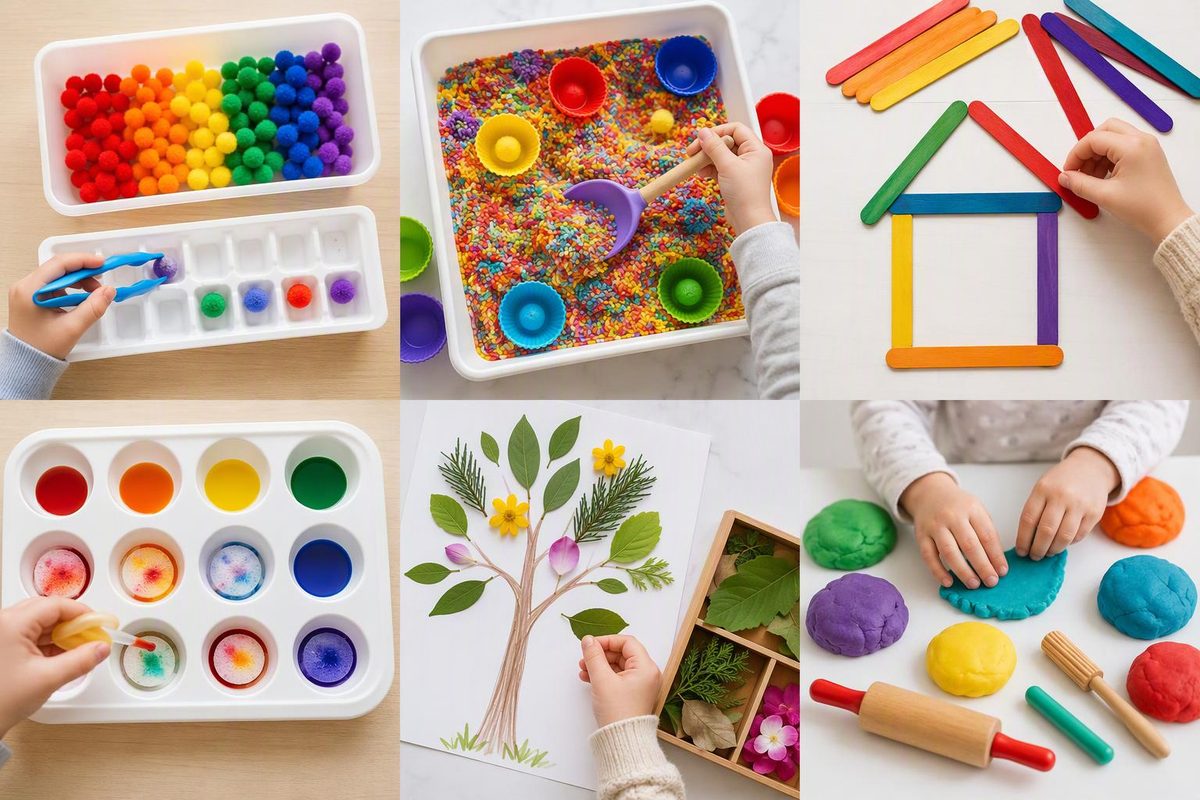
Choose one activity that fits the space, supplies, and interest you have today. These activities for kids ages three to five offer chances to sort, count, move, tell stories, create, and solve problems—without a worksheet or an adult-made result to copy.
The simpler and more challenging options are starting points, not age tests. NAEYC recommends adjusting activities to individual children and combining meaningful choices with adult guidance that extends their interests. Its teaching guidance supports this flexible approach.
Pick an activity
| Activity | Learning opportunity | Setup and cleanup |
|---|---|---|
| Block sorting | Comparing and grouping | Blocks and two trays; dry cleanup |
| Tear-and-arrange collage | Using both hands and making art choices | Paper, crayons, optional glue; scraps to collect |
| Movement mirror | Observing and copying movements | Clear space; no supplies |
| Pretend delivery shop | Matching one object to one request; counting | Blocks and paper order cards; dry cleanup |
| Three-object story | Pretend play and storytelling | Three toys; dry cleanup |
| Build a bridge | Testing and changing a design | Blocks, including a long flat piece, and a toy vehicle; dry cleanup |
Before setting out supplies: Check toys for damage and follow the age guidance and safety information on their packaging. Choose large, intact pieces rather than beads, buttons, or other small loose items, especially if a child mouths objects or younger siblings share the space. Head Start advises checking open-ended materials for choking hazards, mouthing, and smooth edges, with close adult monitoring. See its loose-parts guidance.
1. Sort blocks into groups
Materials: Several large blocks in two different colors; two shallow trays or clear spaces on a table.
Set up and play: Place the blocks between the trays. Put one block in each tray to suggest a grouping, such as red blocks here and blue blocks there. Invite the child to place another block. If they choose a different rule, ask them to show you how it works rather than correcting it immediately.
Learning opportunity: Noticing shared features and deciding what belongs together. Head Start specifically suggests sorting open-ended materials by shape, size, color, or other features. Its guidance also recommends math talk during play.
- Simplify: Offer fewer blocks and demonstrate one match.
- Extend: Sort the same collection another way. “First we used color. What else could we notice?”
- Checkpoint: Ask, “What makes these a group?” Accept pointing, demonstrating, or an explanation in the child’s home language.
2. Tear and arrange a paper collage
Materials: Plain and colored paper, crayons, and an optional child-appropriate glue stick.
Set up and play: Put a large background sheet on the table. Show how one hand holds a paper strip while the other pulls to make a tear. Let the child tear pieces, move them around, and decide whether to glue them down. Offer crayons for adding lines or marks; the arrangement does not need to represent anything.
Learning opportunity: Holding and pulling with two hands, positioning pieces, and making visual choices.
- Simplify: Make a small starter tear or offer pre-torn pieces to arrange without glue.
- Extend: Invite the child to overlap pieces, make a path, or describe a story about the arrangement.
- Checkpoint: “Would you like to move anything before you glue it?”
Safety: Use labeled supplies intended for children and supervise their use. Keep art materials out of mouths and wash hands afterward. “Non-toxic” does not mean edible; the CPSC Art and Craft Safety Guide cautions that unintended use can still be harmful. Keep the glue-stick cap with the adult and collect paper scraps after play.
3. Play movement mirror
Materials: Clear space where each person can move without touching furniture or another person.
Set up and play: Face the child and make one slow movement: lift your hands, roll your shoulders, or open and close your palms. Invite them to copy you. After a few movements, swap roles so the child leads and you follow.
Learning opportunity: Watching another person, matching an action, and taking turns as leader.
- Simplify: Use one repeated hand movement while seated.
- Extend: Try a two-movement sequence or copy at different speeds.
- Checkpoint: Pause between actions so the follower has time to respond.
Keep movements comfortable and within each participant’s reach. Avoid balancing challenges, jumping, or rapid spinning in a small indoor space. Watching or choosing the next movement is also a way to join in.
For more group options, browse these low-prep morning meeting games.
4. Run a pretend delivery shop
Materials: Large blocks, paper, a crayon, and a tray.
Set up and play: Draw an order card with one large dot. Ask the child to deliver one block to the customer—you or a toy. Make another card with two dots, spaced far enough apart to place one block beside each. Invite the child to match the blocks to the dots before moving the order onto the tray.
Learning opportunity: Matching each mark to one object and exploring how counting connects to a quantity.
- Simplify: Stay with one-dot orders and deliver together.
- Extend: Try orders with three to five dots. Count the blocks together, then ask, “How many are in this order?”
- Checkpoint: If the count and objects get out of step, move each block into a separate space as you count. Keep it a shop game, not a speed test.
The child can switch roles and draw orders for you. No real money or food is needed.
5. Tell a three-object story
Materials: Three large, age-appropriate toys, such as a vehicle, an animal, and a block.
Set up and play: Place the toys where the child can reach them. Begin with a small event: “The animal found this block in the road.” Ask, “What happens next?” Let the child move the objects, speak for them, or show the action without words.
Learning opportunity: Using objects in pretend play, connecting events, and communicating an idea.
- Simplify: Offer two toys and narrate what the child does: “The car stopped beside the animal.”
- Extend: Invite a problem and a solution: “The road is blocked. What could they try?”
- Checkpoint: Follow the child’s version rather than steering toward a particular ending.
6. Build a bridge for a toy
Materials: Large building blocks, including a long flat block to span two supports, and a toy vehicle.
Set up and play: Place two short block supports on a firm surface. Invite the child to choose a long block that might span the gap. Move the vehicle across slowly, then discuss what stayed up or shifted. Let the child change the supports or the top piece and try again.
Learning opportunity: Comparing lengths, testing stability, and changing a design after observing it.
- Simplify: Put the supports close together and offer one suitable top block.
- Extend: Ask whether a different vehicle can pass underneath. Change one feature at a time and test again.
- Checkpoint: “What changed when you moved that support?”
Keep structures low, with hands and faces away from falling pieces. Build on a tabletop or accessible tray if floor play is uncomfortable.
Keep the next round manageable
In a classroom, duplicate a small supply set for pairs rather than making everyone wait for one turn. At home, put out only the materials for the chosen activity. Offer pointing, gestures, home-language responses, or adult help with moving pieces when useful.
If an activity holds interest, bring its materials out for another round instead of adding a new challenge immediately. NAEYC recommends revisiting materials and experiences, as well as reducing or increasing complexity to suit the child. Returning to familiar play is part of its guidance, not a reason to rush toward a harder task.