
12 Valentine Art Activities That Leave Room for Preschoolers’ Ideas
Plan 12 open-ended Valentine art activities with simple materials, skill connections, easy adaptations, inviting prompts and practical safety checks.
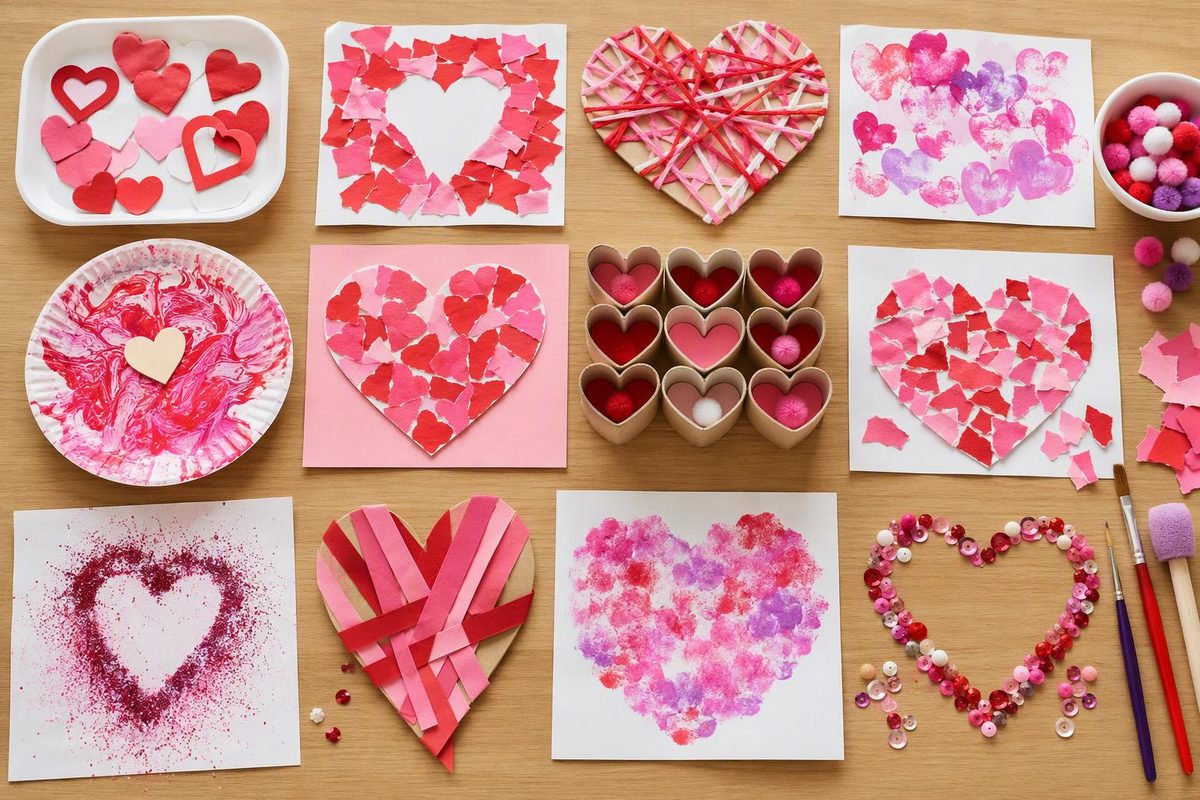
These Valentine art activities use hearts, warm colors, friendship and kindness as starting points—not templates children must copy. Most need only paper, washable paint, crayons, glue or recycled materials and take a few minutes to set up.
An NAEYC educator article describes process-focused art as child-led and open-ended, without a sample to copy or one correct result. It also notes opportunities to compare, predict, plan, talk and use small hand movements while creating (NAEYC).
Choose an activity that fits the day
| Activity | Main action | Mess | Adult preparation |
|---|---|---|---|
| Tape-resist hearts | Brush and reveal | Medium | 5–10 minutes |
| Heart-print laboratory | Press and compare | Medium | 5 minutes |
| Symmetry squish paintings | Fold and press | Medium | Minimal |
| Scraped-color hearts | Pull and blend paint | Medium | 5 minutes |
| Crayon-resist messages | Draw and wash | Low–medium | Minimal |
| Yarn-pull paintings | Pinch and pull | Medium | 5 minutes |
| Torn-paper collage | Tear and arrange | Low | Minimal |
| Sticky-window collage | Place and reposition | Low | 5–10 minutes |
| Loose-parts heart designs | Arrange and revise | Low | 5 minutes |
| Valentine dough studio | Roll and build | Low | Minimal |
| Friendship mural | Reach and collaborate | Medium | 5 minutes |
| Valentine tool painting | Test different tools | Medium–high | 5 minutes |
1. Tape-resist heart paintings
Materials: Sturdy paper, painter’s tape, washable paint, brushes or sponges
Make one large tape heart or several intersecting heart outlines on the paper. Children paint across, around and inside the taped areas. When the paint is dry, an adult or a child who can manage the task peels away the tape to reveal the lines.
Skill opportunity: Brush control, cause and effect, visual planning Simplify: Tape the paper to the table and offer one wide brush. Extend: Invite children to predict which painted areas will connect after the tape comes off.
2. Heart-print laboratory
Materials: Washable tempera paint, shallow trays, large paper, heart-shaped sponges or cardboard tubes bent into heart shapes
Set out two or three printing tools rather than demonstrating a finished picture. Let children press, twist, overlap or drag each tool. Ask, “What changes when you press lightly or firmly?”
Skill opportunity: Hand pressure, comparison, pattern exploration Simplify: Use a large sponge with an easy-to-grasp clothespin handle. Extend: Compare prints made with thick and thin layers of paint.
3. Symmetry squish paintings
Materials: Paper folded in half, washable paint, spoons or squeeze bottles
Open the paper and add a few small paint drops on one side. Fold it, press from the center toward the edges, then open it. The result may resemble a heart, wings or something entirely different; let the child decide what they see.
Skill opportunity: Two-hand coordination, prediction, color mixing Simplify: An adult adds the paint while the child presses. Extend: Try different paint placements and compare the opened designs.
4. Scraped-color hearts
Materials: Large paper hearts, washable paint, a child-size squeegee or an expired plastic gift card with smooth edges
Place small dots of paint on the paper. Children pull the scraper across them to make blended bands and thin trails. Rotate the paper and scrape again if desired.
Skill opportunity: Arm movement, grip, noticing color changes Simplify: Secure the heart with removable tape. Extend: Pair this with a more focused preschool color-mixing activity.
5. Crayon-resist Valentine messages
Materials: White or light crayons, heavy white paper, washable watercolor paint, wide brushes
Children cover the paper with crayon lines, hearts, letter-like marks or drawings. Brush watercolor over the page to make the waxy marks stand out. An adult can write down a child’s dictated message after the paper dries, but a message is optional.
Skill opportunity: Mark-making, early writing interest, observing how materials interact Simplify: Use chunky crayons and a wide brush. Extend: Invite children to include a recognizable letter from their name.
6. Yarn-pull paintings
Materials: 8- to 10-inch lengths of thick yarn, washable paint, folded paper, shallow dishes
Dip most of a yarn length in paint, leaving a clean end to hold. Lay the painted yarn in loops on one half of the paper, fold the other half over it, press and pull the yarn out by its clean end. Open the paper to inspect the trails. Provide direct supervision and collect the wet yarn as soon as each pull is complete.
Skill opportunity: Pinching, pulling, anticipation Simplify: Use one thick cord and one paint color. Extend: Layer a second pull in a contrasting color after the first dries.
7. Torn-paper friendship collage
Materials: Large paper, colored paper scraps, glue sticks
Invite children to tear paper into any shapes they need, then arrange the pieces before gluing. Offer Valentine colors alongside other colors so each child can choose a personal palette.
Skill opportunity: Coordinating both hands, arranging shapes, making choices Simplify: Begin tears at the paper’s edge or provide a mix of pre-torn and whole pieces. Extend: Add fabric scraps, wide ribbon or pieces of recycled gift wrap.
8. Sticky-window heart collage
Materials: Clear contact paper, painter’s tape, large pieces of colored tissue paper
An adult cuts and secures a large contact-paper heart with the sticky side facing outward. Children place, remove and overlap tissue-paper pieces. Cover it with a second sheet of contact paper when finished, then display it away from blind cords.
Skill opportunity: Finger isolation, spatial decisions, observing transparent color layers Simplify: Offer pieces large enough to grasp easily. Extend: Sort the pieces by color or shape before arranging them.
9. Rebuildable loose-parts hearts
Materials: A felt mat or tray, wide ribbon, large fabric shapes, craft sticks and cardboard pieces
Make a heart outline with wide ribbon. Children fill, cross, surround or ignore that outline as they arrange the materials. Leave the pieces unglued so the design can be revised or cleared for another child.
Skill opportunity: Planning, sorting, revising a design Simplify: Offer four or five large pieces on a high-contrast mat. Extend: Ask, “How could you change the design without adding anything?”
10. Valentine dough studio
Materials: Child-use modeling dough, rolling pins, craft sticks, heart cutters and large lids
Instead of asking everyone to cut matching hearts, invite children to roll, pinch, stack, stamp and combine the dough. Hearts can become faces, buildings, pretend food or abstract sculptures.
Skill opportunity: Hand strength, tool use, three-dimensional planning Simplify: Soften the dough and offer a thick rolling tool. Extend: Build a sculpture that stands up or join two dough colors without fully mixing them.
Check ingredient labels when allergies or sensitivities are relevant, particularly if using homemade dough.
11. Collaborative friendship mural
Materials: A long sheet of paper, washable paint or markers
Tape the paper to a table, a child-height wall surface or the floor. Children add lines, shapes and colors wherever space is available. They may work at the same time or revisit the mural during the week.
Skill opportunity: Large arm movement, shared-space awareness, conversation Simplify: Give each child a comfortable section without requiring interaction. Extend: Invite children to connect two areas with a line, road or repeated pattern.
A friendship theme does not require children to name a best friend or make a card for someone. Prompts such as “What helps people feel welcome?” leave room for different family structures, relationships and comfort levels.
12. Valentine tool painting
Materials: Easel or large paper, washable paint, brushes, sponges, rollers, cotton swabs or cardboard combs
Offer two or three tools at a time. Children test the marks each one makes, combine tools or switch colors. A limited palette can suggest Valentine’s Day without requiring a particular picture.
Skill opportunity: Tool control, comparing marks, expressive choice Simplify: Use thick-handled tools and stabilize the paper. Extend: Ask children to find two tools that make very different marks.
Adapt the art station without taking over
Tape sliding paper to the work surface, offer easy-grip or left-handed scissors, and provide tools and collage pieces in different sizes. Head Start recommends these kinds of practical adaptations while keeping open-ended art accessible (Head Start). A child can also point to colors, use a tool instead of touching paint, work standing up or watch before joining.
Useful comments describe rather than judge:
- “I notice three colors overlap here.”
- “You pulled the yarn all the way across.”
- “Tell me about this part.”
- “What would you like to try next?”
Allowing extra time, inviting children to describe their work and commenting objectively are also recommended in Head Start’s creative-art guidance. Do not require a child to explain or give away the finished art.
Safety and setup checks
- Choose washable art materials intended for children and follow their age labels and directions. The CPSC’s Art and Craft Safety Guide recommends children’s products labeled “Conforms to ASTM D-4236” and without cautionary warnings (CPSC).
- Supervise paint, glue, dough and tools; remind children that art materials do not go in mouths.
- Replace buttons, beads, sequins and other small collage pieces with large paper or fabric shapes when children may mouth materials. Head Start advises watching for choking hazards and offering materials in different sizes.
- Use blunt-tip child scissors when a child is ready. Adults should handle craft knives, staplers and the initial cutting of contact paper or thick cardboard.
- Check recycled supplies for sharp edges, staples, residue and personal information before placing them at the table.
- Use smocks and a washable mat, and provide a nearby drying area before children begin.
For projects with a more defined take-home result, try these easy preschool Valentine crafts. To reuse one batch of decorated paper across several days, follow the three-day heart-paper studio.