
8 All About Me Preschool Activities, From Names to Favorite Things
Plan an All About Me preschool theme with eight playful activities, simple materials, skill connections, easy adaptations and a flexible five-day plan.
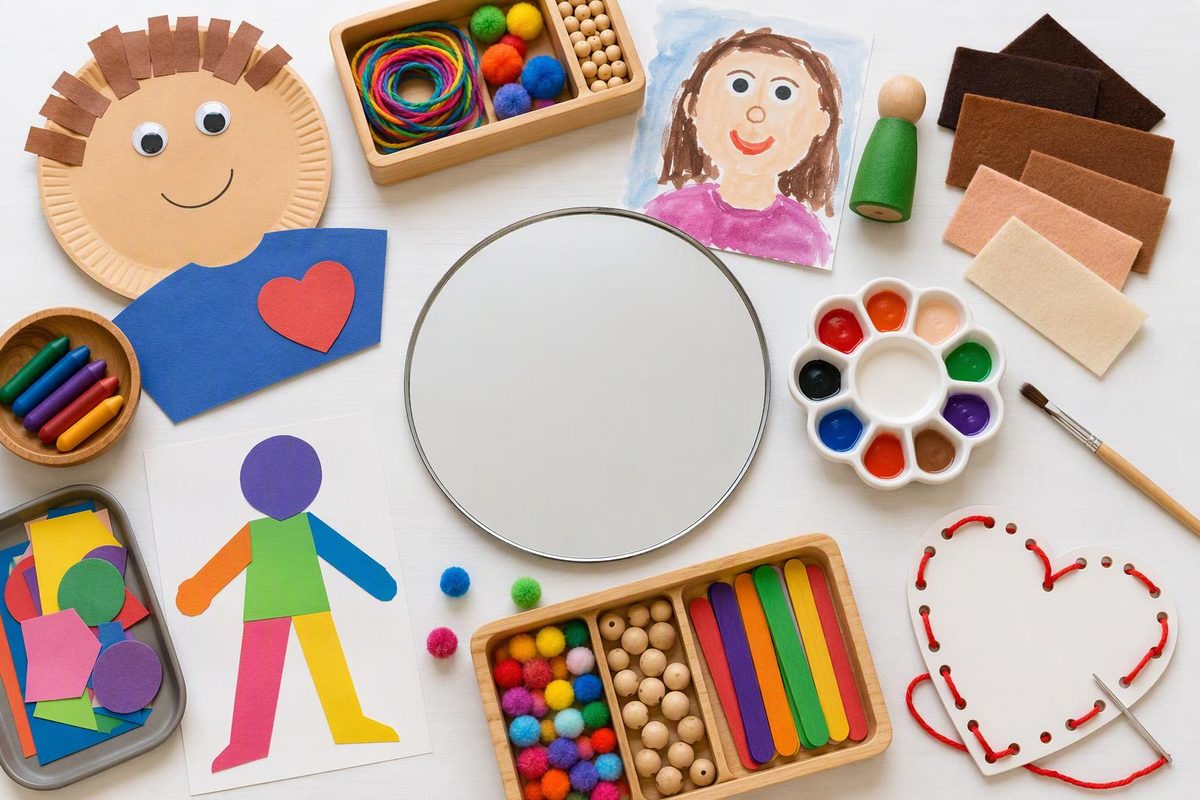
An All About Me theme for preschool can start with a name, a favorite game or a picture of someone a child cares about. Use these eight activities with children ages three to five to explore identity through drawing, movement, conversation and pretend play—not a stack of personal-information worksheets.
Choose by the skill you want to offer: name matching for literacy, a favorites graph for counting, or a puppet conversation for feelings vocabulary. Each activity includes a simpler entry point and an extension; children do not need to complete every option.
Set up a welcoming theme
Ask families how to pronounce and write each child’s preferred name, including names written in another script. Use “people who care for me” rather than requiring every child to describe a mother-and-father household. These choices reflect NAEYC’s guidance on respecting children’s names, family composition, languages and experiences.
Let children speak, point, gesture, draw, use their usual communication system or pass. Keep addresses, birthdays and other identifying details off public displays, and follow your setting’s permissions for photographs.
Reusable supplies: Plain paper, cardstock, crayons in a broad range of skin and hair shades, washable markers, child-use glue sticks, large paper scraps, blocks and a shatter-resistant mirror. No printer or food materials are needed.
Choose age-appropriate supplies and supervise their use. For art materials, look for the AP seal; ACMI advises against giving CL-seal products to children in sixth grade or younger. Leave loose buttons, beads and other small decorations out of these activities.
1. Find my name
Skill opportunity: Recognizing a meaningful written word and matching print.
Materials and setup: Write each child’s name on two large cards, using the family’s preferred spelling. Put one at the child’s place and several matching cards on a nearby table.
Play: Invite children to find the card that matches their model and bring it back. Read the name together, then let the child decorate one card for a cubby or play area. Ask, “What helped you find yours?”
- Simplify: Offer two cards and add a child-approved photograph or personal symbol to both copies.
- Extend: Compare the letters or characters on the two name cards, or copy the name onto a drawing without requiring tracing.
For more entry points, see name activities by skill stage.
2. Make a mirror self-portrait
Skill opportunity: Looking closely, making marks and describing choices.
Materials and setup: Place paper, crayons and a shatter-resistant mirror on a stable table.
Play: Invite the child to look, draw, then look again if they want. Ask, “What would you like to include?” rather than supplying a face outline or correcting missing features. Offer varied colors without assigning one “right” skin shade. Record the child’s description beside the drawing.
- Simplify: Offer large paper and chunky crayons, or let the child direct an adult’s drawing.
- Extend: Add something the mirror cannot show, such as a favorite activity or someone the child loves.
A portrait need not be a realistic likeness. In a NAEYC account of preschool identity work, educators paired children’s drawings with their own words and explored interests, strengths and relationships beyond appearance.
3. Draw my caring people
Skill opportunity: Storytelling and representing relationships.
Materials and setup: Offer paper and crayons. Family photographs are optional, not required.
Play: Ask, “Who would you like in your picture?” Children may draw relatives, caregivers, friends or other important people. Invite a story about something they do together. Write labels only with the child’s agreement, using the relationship words they give you.
- Simplify: Draw one person or dictate a short story without drawing.
- Extend: Add a shared activity, such as reading, gardening or riding the bus together.
Accept the child’s choices without asking them to explain private family circumstances. Offer an imaginary caring-person story if they prefer.
4. Build a favorite-play graph
Skill opportunity: Sorting, counting and comparing quantities.
Materials and setup: Draw three play choices across the bottom of a large sheet—for example, building, drawing and pretend play. Add an “another choice” space. Above each choice, draw a column of equal-size boxes, all starting at the same height. Give each child a paper square sized to fit a box.
Play: Ask, “Which would you like to play today?” Children place one square in the lowest empty box above their choice. Count together, touching each square once. Discuss which columns have more, fewer or the same number.
- Simplify: Use two choices and count one column together.
- Extend: Compare columns: “How many more squares would this one need to have the same number?”
Describe it as today’s choice, not a permanent favorite or a competition. At home, family members can each contribute one square.
5. Give a puppet a feelings story
Skill opportunity: Feelings vocabulary and considering possible responses.
Materials and setup: Fold cardstock into a standing puppet and draw a character on it. Use blocks for a simple scene.
Play: Tell a brief story: “The puppet wanted to build, but the blocks were all being used.” Ask, “How might the puppet feel? What could it say or do?” Act out children’s suggestions, such as asking for a turn or finding another activity.
- Simplify: Offer two possible feeling words and let the child choose either, both or another.
- Extend: Change the situation and discuss how the same character might feel differently.
Keep the story fictional unless a child volunteers a personal connection. Do not require children to announce their own feelings to the group.
6. Lead an ‘I can move’ game
Skill opportunity: Following directions, planning movement and taking turns.
Materials and setup: Clear a space where children can move without bumping furniture or one another.
Play: Model one comfortable action: “I can reach up.” Invite a child to lead the next movement. Others may copy, adapt or watch. Try waving, stretching, rolling shoulders or moving fingers; include seated choices from the start.
- Simplify: Repeat one familiar movement at a time.
- Extend: Let a leader combine two actions, such as “wave, then tap your knees.”
Keep movements within each child’s comfortable range. Do not pull limbs or turn the game into a test of who can move fastest.
7. Open an ‘I can help’ play center
Skill opportunity: Pretend play, explaining a sequence and collaborating.
Materials and setup: Set out familiar play materials: blocks, toy dishes, cloths and picture books.
Play: Ask, “What would you like to show us how to do?” A child might build a bridge, set a pretend table or show how to turn book pages. Invite another child to join as a helper. Ask, “What comes next?”
- Simplify: Offer two jobs or demonstrate the first action.
- Extend: Draw a two- or three-picture instruction card for someone else to follow.
Make room for “I’m learning to…” as well as “I can…” so the center does not become a comparison of abilities.
8. Assemble a child-chosen All About Me book
Skill opportunity: Selecting, sequencing and connecting spoken language with print.
Materials and setup: Gather drawings and loose paper. Fold a large sheet of paper in half to make a cover; tuck selected drawings inside. This keeps the pages rearrangeable without staples or small fasteners.
Play: Let the child choose pages and their order. Offer prompts such as “My name,” “I like to play…” and “People I care about.” Write the child’s words as dictated, then read them back for confirmation.
- Simplify: Fold one sheet in half and add one drawing and one dictated sentence.
- Extend: Invite the child to add labels, attempt writing or dictate a longer story.
Let children decide whether to share their books. Leave unused prompts out rather than filling every page for them.
A flexible five-day plan
| Day | Main invitation | Optional follow-up |
|---|---|---|
| 1: My name | Find my name | Decorate a name card |
| 2: How I see myself | Mirror self-portrait | ‘I can move’ game |
| 3: My people | Caring-people drawing | ‘I can help’ play center |
| 4: My choices and feelings | Favorite-play graph | Puppet feelings story |
| 5: My story | Assemble books | Optional partner sharing |
Leave materials available for revisiting. Notice what each child chooses independently, what support makes participation easier and what they want to explore again. Use those observations to plan the next invitation—not to score how well a child can describe themselves.