
Make a Play Dough Ice Cream Shop Children Can Run
Build a preschool play dough ice cream shop with safe materials, easy setup steps, counting prompts, sensory options, and practical allergy checks.
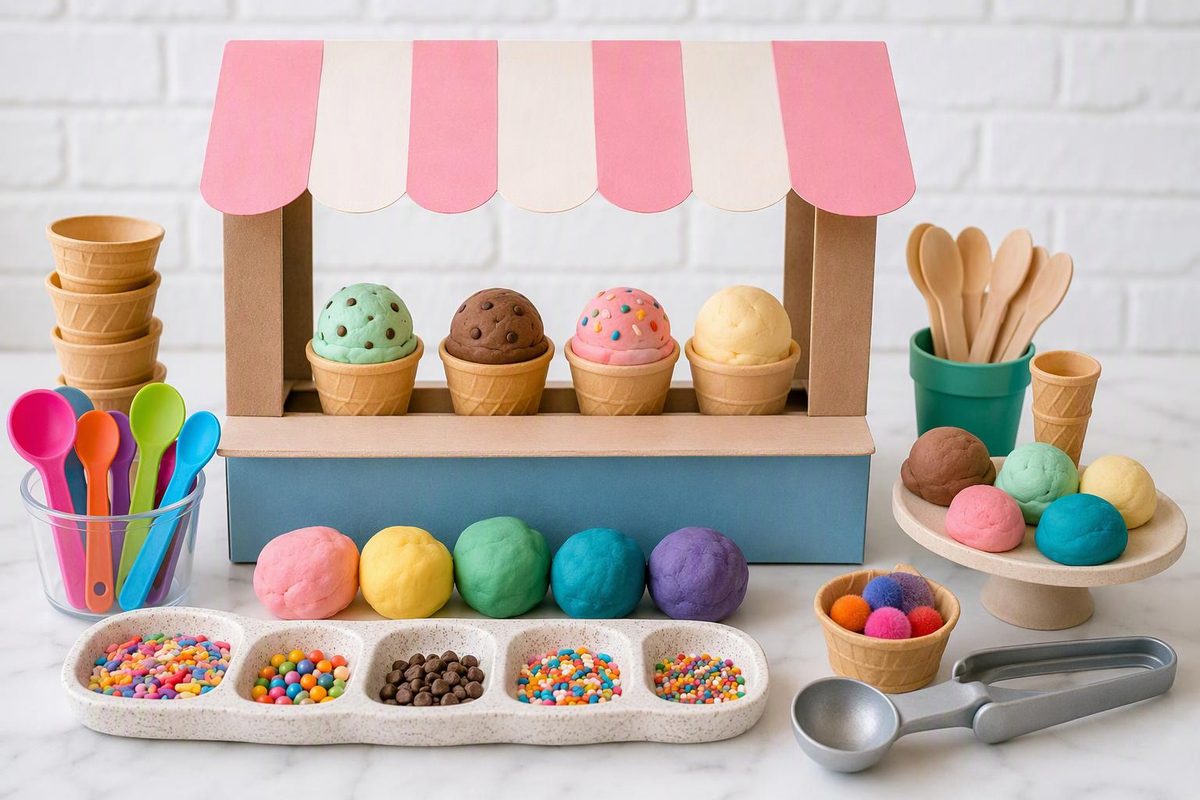
For play dough ice cream, set out soft commercially prepared modeling dough with wide bowls, sturdy spoons and child-friendly scoops. Children can make pretend servings, count scoops and run an ice cream shop without copying a finished model. Treat every creation as pretend food only, and use dough suitable for the children in your group.
Choose a play goal, container and touch option to get a workable setup.
Choose a Play Dough Ice Cream Setup
Select the kind of play you want to support. The recommendation changes immediately.
Source note: Setup figures and adaptations come from the article’s cited NAEYC, Head Start and product-safety guidance.
Use Soft Dough and Unbreakable Tools
A basic ice cream counter needs:
- 2–4 colors of soft, commercially prepared modeling dough
- Sturdy spoons or child-friendly scoops without sharp edges
- Wide, unbreakable bowls or silicone baking cups
- A tray or washable placemat for each work area
- Craft sticks for flattening, cutting and making marks
- Cardstock and tape for adult-made cones, optional
- Scrap paper and thick markers for menus or order cards, optional
- Smocks and a damp cleanup cloth, optional
Skip beads, sequins, pom-poms and other loose “sprinkles.” Children can roll, pinch and flatten toppings from the dough itself. That keeps the setup manageable and avoids adding small loose pieces.
Set Up an Open-Ended Ice Cream Counter
Place each color of dough in its own shallow container and call it a flavor. Familiar names such as strawberry, chocolate and mint work, but children may prefer inventions such as “purple moon” or “rainbow cloud.”
Put bowls and tools beside the dough without displaying a finished sundae for everyone to copy. The activity works best when children can decide what a serving looks like.
For pretend cones, an adult can roll cardstock into wide cone shapes and secure each one with tape before play. Make the opening wide enough to hold a dough ball. Unbreakable bowls are easier for children who are still learning to balance and carry materials.
For a small group, divide the dough into individual portions before play begins. Children spend less time waiting, and returning each color to its container is easier.
Make Scoops, Toppings and Pretend Orders
- Explore the tools. Let children press a spoon or scoop into the dough. Model action words such as press, twist, scrape, lift and release.
- Make a serving. A child can scoop from a larger piece or roll a ball between two hands. Place one or more scoops in a bowl or cardstock cone.
- Add dough toppings. Roll thin coils for sauce, flatten a small circle for a cookie or pinch larger pieces for pretend fruit. A topping does not need to resemble real food.
- Open the shop. One child orders while another prepares the serving. Useful prompts include “What would you like?”, “How many scoops?” and “Would you like another flavor?”
- Change roles. Children can be customers, servers, menu makers or delivery workers. A child who does not want to touch the dough can take orders or move bowls on a tray.
- Close and clean. Return reusable dough to its labeled containers according to the product directions. Discard dough that is dirty, wet or mixed with material that should not be stored.
Scooping Supports Several Kinds of Learning
Squeezing, rolling, pressing and manipulating tools let children move their hands and fingers in different ways. NAEYC describes these play dough actions as supporting hand strength, dexterity and eye-hand coordination. It also identifies play dough as a useful material for symbolic play, conversation, comparison, counting and sorting (NAEYC).
The ice cream shop brings those opportunities into one play area:
- Hand use: Grip a scoop, steady a bowl, roll a ball and flatten a topping.
- Early math: Count scoops, compare larger and smaller servings, or sort dough by color.
- Language: Name flavors, explain an order and use sequence words such as first, next and last.
- Pretend play: Use dough as a symbol for food and negotiate roles with another player.
There is no need to turn the shop into a quiz. A comment such as “You put two scoops in that bowl” introduces number language while leaving control of the play with the child.
For another no-tasting way to explore a food theme, try these picture and pretend-play food games.
Adjust the Shop for Sensory and Counting Needs
Reduce the Sensory Demand
Offer one color of very soft dough, one wide bowl and a sturdy spoon. Pre-roll several large balls if removing dough from a firm block causes frustration.
A child can point to a flavor, hold the bowl, carry a tray or use a tool instead of touching the dough. Head Start recommends following children’s sensory cues and offering tools or gloves as alternate ways to participate (Head Start).
Match Scoops to Small Quantities
Make order cards showing one, two or three large dots. The server places the matching number of scoops in the bowl. Keeping the quantities small helps children count each object once.
For a simple pattern invitation, ask for a two-color serving such as pink–brown–pink. Prompt with “What could come next?” rather than correcting the arrangement.
Add Child-Made Menus
Let children dictate flavor names while an adult writes them on a menu. Children who want to make their own marks can add a price, a flavor symbol or the first letter of a name.
The menu gives the customer and server something concrete to discuss. It does not need realistic pictures, conventional spelling or actual prices to support the pretend shop.
Keep Pretend Dough Separate From Food
Check the product’s package guidance and supervise throughout. Play dough is not food. Poison Control states that Play-Doh brand compound is not intended to be eaten and can present a choking hazard; it advises watching children so they do not put it in their mouths (Poison Control).
Ask families about known allergies before selecting messy-play materials, and follow each child’s health plan, as Head Start recommends. Play-Doh brand compound and many other store-bought play doughs contain wheat, and other craft materials may contain allergens (Kids With Food Allergies). Choose a suitable alternative rather than assuming that a product is allergen-free.
Do not substitute raw cookie dough or an uncooked flour-and-water mixture. The FDA advises against letting children use raw dough or raw-flour “play clay” because flour can carry disease-causing bacteria even when children do not intentionally eat it (FDA).
Use smooth, unbreakable tools in good condition. Check mechanical scoops for pinch points and replace them with plain spoons when needed. Keep real food outside the play area so children can distinguish pretend play from snack time, and have them wash their hands when play ends.