
Playful Ways to Explore Food Without Making Children Taste It
Choose an original food-picture game, see its supplies and steps, and adapt matching, sorting or pretend shopping for your group. No tasting required.
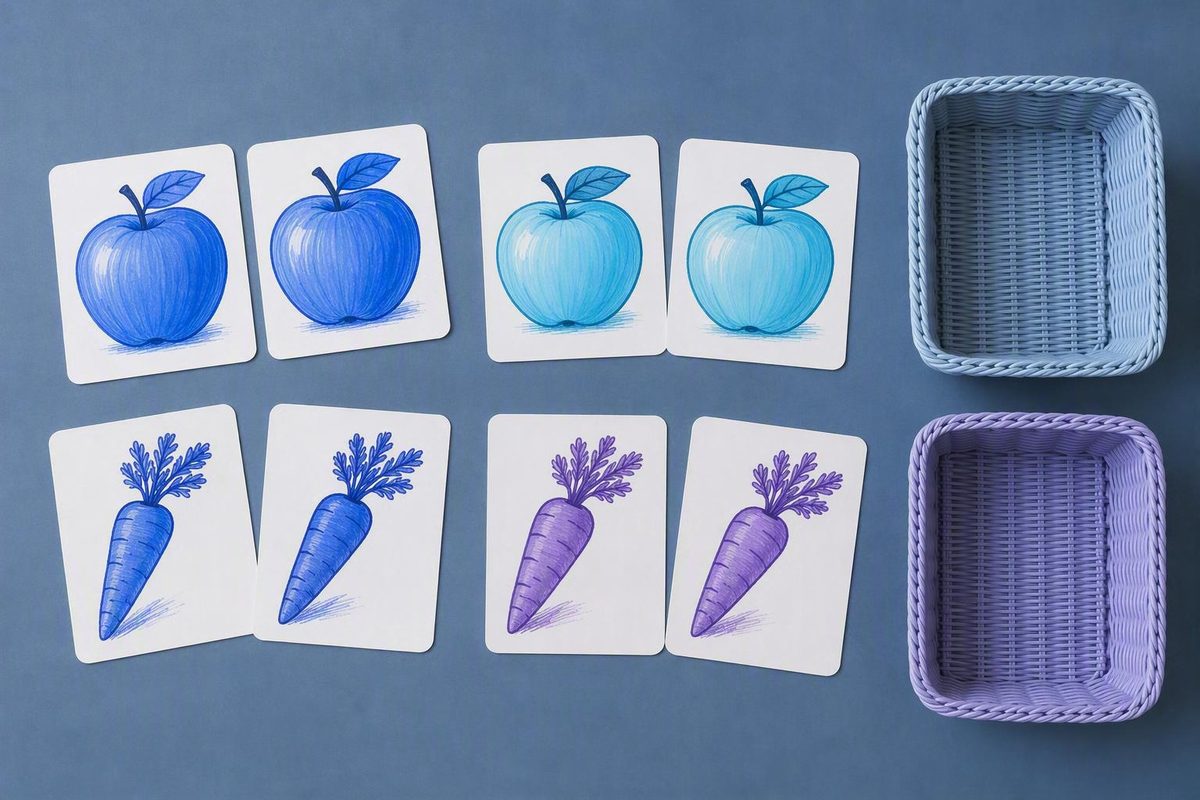
Kid food games can use pictures and pretend groceries for matching, counting, describing, and role-play. Start with three to six large picture cards and one simple task. The eight original activities below need no tasting or food preparation.
Choose a game to see its supplies and three steps. Open “All Eight Games” to compare the activities or use the instructions without JavaScript.
Pick A Food-Picture Game
Adult-guided play with pictures or suitable pretend food. No tasting or food in mouths is needed.
Grocery Pair Match
Supplies: Three to six pairs of large food picture cards.
- Set out three matching pairs of large food pictures. Name each food together.
- Turn the cards face down. Take turns revealing two cards.
- Keep a matching pair; turn different pictures back over. Add more pairs when wanted.
All Eight Games
Grocery Pair Match
Supplies: Three to six pairs of large food picture cards.
- Set out three matching pairs of large food pictures. Name each food together.
- Turn the cards face down. Take turns revealing two cards.
- Keep a matching pair; turn different pictures back over. Add more pairs when wanted.
Sort My Basket
Supplies: Food pictures and two baskets.
- Choose two labels, such as Round and Not Round. Place a basket under each.
- Pick one food picture and decide where it fits.
- Ask what clue helped. A picture that fits both can start a conversation.
Market List
Supplies: Three-picture shopping list and pretend groceries.
- Draw a shopping list with three food pictures.
- Find one matching pretend food or picture for each item.
- Check the list and count the basket together. Swap shopper and helper roles.
What Changed?
Supplies: Three large food cards.
- Lay out three food pictures and name them.
- Cover the pictures with a cloth, then remove one.
- Uncover the pictures and ask which one is missing. Let the child hide one next.
Garden Or Tree?
Supplies: Pictures of clearly identified produce and their plants.
- Choose pictures of familiar produce and matching plants, such as an apple tree and a carrot plant.
- Match each food to its plant picture.
- Talk about where it grows: on a tree, above ground or under the soil. Check the plant if unsure.
Describe And Find
Supplies: Food pictures.
- Spread out four large food pictures.
- Give two visible clues, such as yellow and curved.
- Find a picture that fits. Accept more than one answer when the clues allow it.
Pretend Cafe
Supplies: Picture menu and pretend food.
- Make a small picture menu from familiar foods.
- The customer orders two items; the server finds the matching pictures.
- Check the order together, then switch roles.
Food Picture Pattern
Supplies: Repeated cards.
- Lay out apple, banana, apple, banana pictures.
- Ask which picture comes next and how the child knows.
- Continue the pattern, then let the child create a new one.
Original games for adult-guided play. Use large, age-appropriate materials. Background: USDA preschool food exploration.
Choose the task before adding more materials
| What you want to practice | Start here | Make it easier |
|---|---|---|
| Matching identical pictures | Grocery Pair Match | Keep three pairs face up |
| Explaining a sorting rule | Sort My Basket | Use two clearly labelled baskets |
| Following a short list | Market List | Begin with one pictured item |
| Remembering what was there | What Changed? | Hide one of two pictures |
| Connecting produce with plants | Garden Or Tree? | Offer two matching plant pictures |
| Describing visible features | Describe And Find | Give one clue and two choices |
| Taking turns and counting orders | Pretend Cafe | Use a menu with three items |
| Continuing a repeating pattern | Food Picture Pattern | Start with apple, banana, apple, banana |
These are activity ideas, not age-based assessments. Adjust the number of cards and length of play for the children participating. A child can point, use eye-gaze or communication symbols, draw, observe, or take a helper role instead of speaking or handling props.
Run one short round
Prepare. Draw or reuse large pictures of familiar foods. Select materials suitable for the children and your setting; small counters are unnecessary. For matching, make two copies of each picture. For pretend shopping, draw a short list and use a basket or tray.
Model. Demonstrate one turn: “These pictures match,” or “You asked for two apples; let’s count them.” Keep the first task small enough that children can see every choice.
Let the child choose. Swap roles, accept reasonable answers, and follow a new idea when it still fits the task. An apple picture might belong in both “round” and “fruit”; explaining the choice can be more useful than enforcing one answer. Use shape, labels, and examples alongside color so sorting does not depend on color recognition alone.
Stop or simplify. If the rules become confusing, reveal the cards, remove choices, or return to free pretend play. You do not need to finish every activity or turn it into a test.
For another observation activity, use the five-senses preschool theme with pictures and visible features. Keep guesses about taste or texture separate from what a child can actually observe.
Add a garden or classroom connection
The USDA’s Grow It, Try It, Like It! preschool kit uses garden, food, story, and exploration themes. The games on this page are original picture-based activities, not a reproduction of that curriculum or evidence that play changes eating habits.
For the plant-matching game, choose clearly identified produce and a picture of its plant. An apple grows on a tree; a carrot’s edible root grows below the soil. Avoid treating “tree,” “plant,” and “underground” as mutually exclusive scientific categories: a tree is a plant, and different parts of a plant grow above and below ground.
In a classroom, put one game at a small-group station. Rotate shopper and helper roles or let one child describe a card while others find a match. A picture menu can support a pretend cafe without ingredients, cooking equipment, or a real meal.
For children ready for a different sorting task, the USDA’s Discover MyPlate resources are designed for kindergarten. Preschool adaptations can use fewer cards and concrete visible features; mastering formal food-group labels is not a requirement for these games. Seasonal pumpkin activities provide another theme for the same matching and describing skills.
Keep eating separate from active play
Use pictures or appropriate pretend food by default. No game requires tasting, and participation should remain successful when nothing is eaten.
If a snack follows, pause the game. Have children sit upright, keep the setting calm, and watch them throughout eating. Food preparation, shape, size, and texture affect choking risk; the CDC’s choking guidance identifies hazards such as uncut grapes, nuts, and hard raw pieces. Follow the child’s established allergy and feeding guidance when choosing food.
Avoid blindfolded tasting, speed-eating contests, mouth-based searches, and eating while moving around. Pictures also let children explore a theme without direct contact with ingredients. Choose cards, toys, and craft materials according to your setting’s rules and each child’s needs.
Can food games help a picky eater?
They offer a way to encounter food names and pictures without pressure to eat. They do not guarantee that a child will accept new foods or broaden their diet. Do not bargain for bites, hide a tasting challenge in the game, or treat watching as failure.
If a child has an allergy, swallowing difficulty, feeding disorder, or medically restricted diet, these activities do not replace individualized guidance. Keep the game focused on play and use the family’s or care setting’s existing plan.
How can I tell whether a game is useful?
Watch the task rather than the time spent: can the child find a pair, explain a sorting choice, follow a picture list, or take a pretend order? If the answer is unclear, reduce the number of choices and try one example together. A short, enjoyable round is enough.