
A Playful, Safety-Conscious Pumpkin Week for Ages 3–5
With adult preparation and supervision, one carefully managed pumpkin can prompt observation, counting, language, testing, art, movement and pretend play.
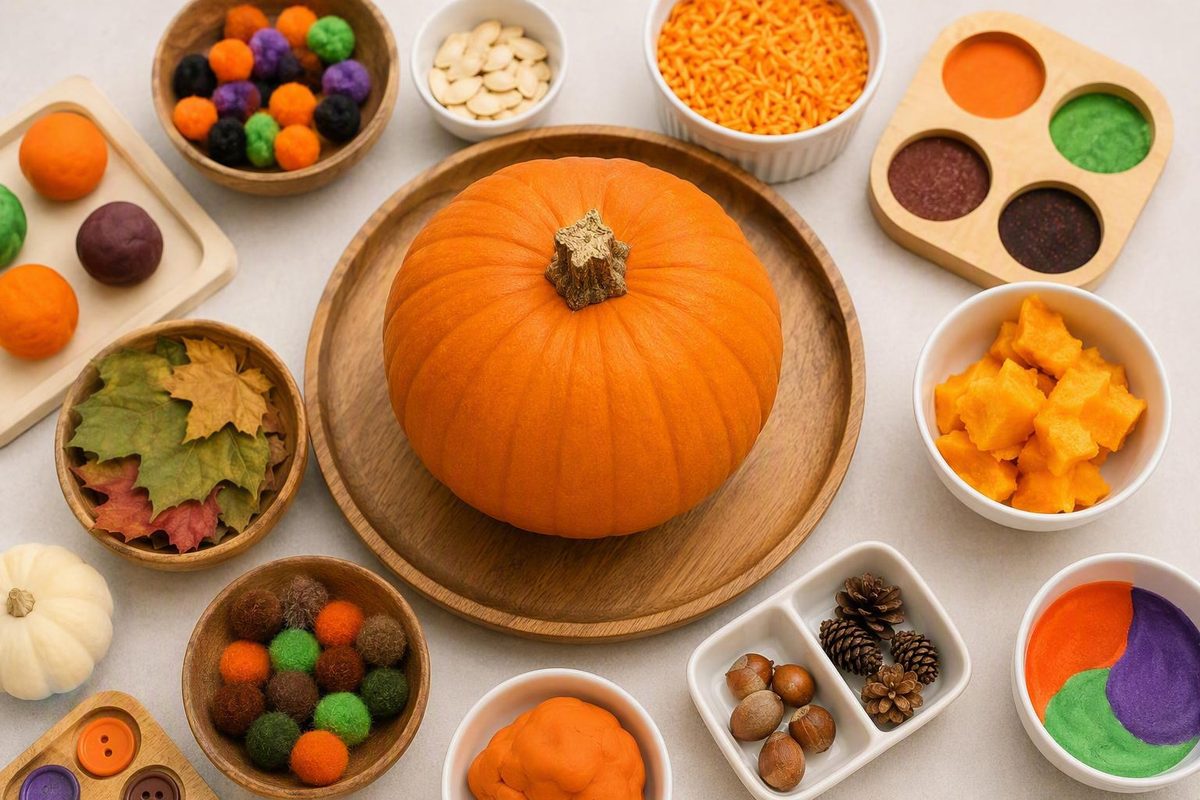
Pumpkin activities for preschool can be practical, adaptable, and purposeful. One pumpkin can support observation, counting, language, science, art, construction, movement, and pretend play without requiring children to carve it or adults to buy a stack of commercial printables.
Start with one observable learning goal. A child might describe a texture, match three objects to a numeral, make and check a prediction, arrange pictures in sequence, or revise a bridge after testing it. Then adapt the materials and participation method for mouthing behavior, hand control, communication, sensory preferences, and prior experience.
The 15 activities below are standalone choices. Each includes a specific objective, ordinary materials, participation alternatives, and relevant supervision notes.
How to choose the right pumpkin activity
Useful options include washing and describing a pumpkin, comparing sizes, counting large objects, hunting for letters, testing sink or float, sequencing the life cycle, building a bridge, decorating without carving, and creating a pretend pumpkin patch.
Start with the children in front of you rather than a rigid age label. Children of the same age may need different materials, directions, or levels of adult support. Consider:
- Whether a child mouths play materials
- Hand strength, grasp, and coordination
- Comfort with wet, sticky, scented, or unfamiliar textures
- How the child communicates, including words, gestures, pointing, eye gaze, or picture choices
- Experience with counting, numerals, matching, letters, and group routines
- Available adult supervision
- Whether the setting permits water, paint, food, or movement play
Choose one objective rather than trying to complete every activity. For example:
- Match one to three objects to a numeral.
- Use or indicate two descriptive words.
- Make a prediction and compare it with an observation.
- Arrange three objects by width.
- Change one part of a structure after testing it.
Activity chooser
The preparation labels distinguish activities that need only ordinary materials from those requiring an adult to fill a water tub, organize a movement lane, or cut a pumpkin.
| Activity | Primary goal | Suggested format | No-carve or adult preparation | Mess | Small parts |
|---|---|---|---|---|---|
| 1. Pumpkin Washing Station | Observation and vocabulary | One child or supervised center | No-carve; adult water setup | Moderate | Not needed |
| 2. Look, Compare, and Measure | Comparison and measurement | One child or small group | No-carve; simple setup | Low | Optional |
| 3. No-Carve Pumpkin Art | Representation and patterns | One child or art center | No-carve; adult selects materials | Low to moderate | Optional |
| 4. Count and Fill | Quantity matching | One child or center | No-carve; simple setup | Low | Optional |
| 5. Pumpkin Size Sort | Ordering and comparison | One child or small group | No-carve; simple setup | Low | Not needed |
| 6. Pumpkin Letter Hunt | Symbol matching | Individual turns or small group | No-carve; adult hides cards | Low | Not needed |
| 7. Pumpkin Vocabulary Basket | Descriptive language | One child or center | No-carve; simple setup | Low | Optional |
| 8. Pumpkin Life-Cycle Sequence | Sequencing | Small or whole group | No-carve; adult makes four cards | Low | Not needed |
| 9. Pumpkin Sink or Float | Prediction and observation | Closely supervised small group | No-carve; adult water setup | Moderate | Not needed |
| 10. Explore the Inside | Anatomy observation | Closely supervised small group | Adult cutting required | High | Seeds require assessment |
| 11. Build a Pumpkin Bridge | Testing and revision | One child or small group | No-carve; stable building area | Low | Optional |
| 12. Large-Object Transfer | Transfer or sorting | One child or center | No-carve; simple setup | Low | Not needed |
| 13. Pumpkin Playdough Faces | Spatial language and representation | One child or center | No-carve; simple setup | Low | Optional |
| 14. Pumpkin Roll and Soft-Pin Bowling | Controlled rolling or counting | Individual turns | No-carve; controlled lane required | Moderate | Not needed |
| 15. Pretend Pumpkin Patch and Market | Vocabulary and social routines | Center or larger group | No-carve; dramatic-play setup | Low | Optional |
Observation, decorating, vocabulary, and playdough invitations can work one-on-one or in centers. Interior exploration and water testing are better suited to closely supervised small groups. Dramatic play can accommodate more children when roles and pathways are clear. Rolling requires a controlled indoor or outdoor lane rather than an open classroom.
Common supplies include pumpkins, paper, markers, adult-selected decorating materials, blocks, large counters, playdough, a shallow tub, towels, scoops, brushes, and picture or numeral cards. Published pumpkin-theme collections similarly organize activities across art, dramatic play, construction, literacy, math, science, and movement (Pre-K Printable Fun’s theme overview).
Printables are optional. Use hand-drawn cards instead of downloads, ordinary blocks instead of specialty counting cubes, string or paper strips instead of linking chains, and photographs or quick sketches instead of commercial picture sets.
Safety rules before the pumpkins come out
No pumpkin activity is universally safe for every child or setting. The supervising adult must consider the materials, children, environment, and available support.
Except for the CDC choking guidance cited below, many precautions in this guide are conservative editorial controls, not validated standards for pumpkin activities. Programs should apply their own health, sanitation, allergy, product-safety, and supervision policies.
Keep tool-based preparation adult-only. Cutting, carving, drilling, heating, stapling, and similar preparation should be completed by an adult away from children. Remove knives and other preparation tools before children approach an opened pumpkin. Preschool activity guidance also assigns pumpkin cutting to the adult and recommends removing the knife before exploration (Nini Printables’ activity guidance).
Assess small and easily mouthed materials. Recurring examples include pumpkin seeds, whole corn kernels, beans, rice, candy, pom-poms, plastic gems, golf tees, beads, detachable toy pieces, and miniature counters. Calling an item a craft material does not prevent a child from putting it in their mouth.
The CDC identifies whole or chopped seeds and whole corn kernels as potential food choking hazards for young children. It also advises adults to pay close attention to what children put in their mouths and to watch children continuously while they eat (CDC choking-hazard guidance).
When small parts are inappropriate, substitute:
- Full-size blocks
- Oversized paper circles
- Large laminated shapes
- Fabric squares or stuffed fabric pumpkins
- Adult-held picture cards
- Large containers that children can point to, count, or move
Close supervision is not a reason to retain an unsuitable object for a child who mouths materials.
Keep food separate from craft and investigation materials. As a conservative classroom precaution, do not serve pumpkins, seeds, or other foods that have contacted paint, glue, fragrance, sensory fillers, classroom water, shared craft tools, or uncontrolled work surfaces. If tasting is planned, manage the food and utensils separately.
Any optional tasting should take place with children calm, seated, and continuously supervised. Prepare food in a form appropriate to the individual child and follow the program’s allergy, health, sanitation, and food-handling requirements. This article is not medical or food-safety advice.
Manage water as a supervised activity. Use a shallow container, place towels beneath it, limit participation to a number the adult can actively observe, and address spills promptly. These are conservative setup recommendations rather than evidence-based water-depth or group-size standards.
Control rolling activities. The adult should select a manageable pumpkin, establish a clear one-way lane, use plastic cups or soft pins, and apply a roll-only rule. Children should not throw pumpkins or carry one they cannot comfortably manage. These are editorial risk controls, not validated standards for pumpkin weight, lane length, or age.
Use neutral materials when needs are unknown. A fragrance-free, food-free version avoids introducing optional scents or edible fillers. Adults should review product labels and their setting’s policies before using paint, dough, soap, spice, scented materials, or food. This is a conservative default, not a claim that a particular labeled product is safe for every child.
Three no-carve activities with a real pumpkin
These activities preserve the pumpkin’s exterior, making them useful early in a multi-day theme or whenever carving is inappropriate.
Activity 1: Pumpkin Washing Station
Materials
- Intact pumpkin or gourd
- Shallow tub
- Small amount of water
- Sponge or soft brush
- Towels
Place the tub on a stable surface with towels underneath. Invite children to wash, turn, and inspect the pumpkin. Introduce words naturally: stem, skin, smooth, bumpy, round, and heavy.
Observable objective: Describe or indicate at least one visible or tactile property.
Prompts
- “What do you notice?”
- “How does this side feel different?”
- “Where is the stem?”
- “What changed after you brushed away the dirt?”
Supervise the water throughout the activity and address spills promptly. A child who does not want to touch the water can observe, select a tool for an adult, direct a partner, or point to a picture representing smooth or bumpy.
Activity 2: Look, Compare, and Measure
Materials
- One or more pumpkins, gourds, or pumpkin pictures
- Blocks
- String
- Paper strips
- Marker and paper
Compare height or width using nonstandard units. Children might build a block tower beside a pumpkin, wrap string around its widest part, or place two pumpkins side by side. They can then order pumpkins or pictures by one selected attribute.
Observable objective: Make and explain one comparison.
Prompts
- “Which looks wider?”
- “What could we use to check?”
- “Where should this pumpkin go in the order?”
- “What did the blocks help us find out?”
Keep conclusions tied to what was observed. Weight would need to be checked with an appropriate scale rather than inferred from appearance.
If only one pumpkin is available, compare it with paper pumpkin outlines.
Activity 3: No-Carve Pumpkin Art
Materials
- Intact pumpkin
- Large paper features
- Removable stickers
- Playdough
- Adult-selected paint and brushes, if appropriate
- Protective work-surface covering
Invite children to make a face, repeated pattern, scene, or abstract design. Do not require everyone to copy an adult model.
Observable objective: Choose and place materials to represent an idea or create a repeated pattern.
Prompts
- “Tell me about your design.”
- “What would you like to add or change?”
- “Which part repeats?”
- “How could you make that piece stay in place?”
One activity publisher suggests both washable and acrylic paints for pumpkin decorating, but that does not establish that either option is universally washable, non-toxic, allergen-free, or suitable for every setting (Autumn Harvest Pumpkins’ decorating suggestions). The adult must evaluate the specific product and protect clothing and surfaces.
For a no-paint version, use playdough, large paper features, or reusable stickers. Exclude glitter, gems, or other detachable decorations when ingestion is a concern.
Treat a decorated classroom pumpkin as a craft object rather than food. It may later be opened for nonfood observation if appropriate, but it should not automatically become an edible ingredient.
Five pumpkin math and language activities
These activities provide practice with a specific counting, comparison, matching, vocabulary, or sequencing task. They should not be presented as proof of broad mathematical or literacy development.
Activity 4: Count and Fill
Draw a large open pumpkin on paper, make a paper pocket, or use a clean open-top prop. A child rolls a die or selects a numeral and places the corresponding quantity of objects “inside.”
Use blocks, large paper circles, or fabric pieces when seeds and miniature counters are unsuitable.
Observable objective: Match a small quantity to a numeral or die pattern.
Starting with one to three objects can simplify the task when appropriate (Nini Printables’ counting guidance). A child may point while an adult moves each object or place the objects independently.
- Small-part-free: Use full-size blocks or large fabric shapes.
- No-printer: Draw numerals or dot patterns on cards.
- Challenge: Compare two filled pumpkins or combine two small groups and count the total.
Activity 5: Pumpkin Size Sort
Provide real pumpkins, gourds, photographs, or paper cutouts that differ clearly in height or width. Select one attribute before sorting so children are not organizing by several qualities at once.
Observable objective: Arrange three items and explain or indicate the chosen order.
Model words such as taller, shorter, wider, and narrower. If a child says one pumpkin is heavier, treat that as a prediction unless its weight has been measured.
- Small-part-free: Use full-size pictures, paper shapes, or real pumpkins.
- No-printer: Draw three pumpkins with clearly different dimensions.
- Challenge: Sort once by height and again by width, then discuss why the order changed.
Activity 6: Pumpkin Letter Hunt
Write large letters on paper and place them in visible, physically accessible locations. Each child finds a letter and completes one designated match.
Depending on readiness, the task might be:
- Match identical uppercase letters.
- Match an uppercase letter with its lowercase form.
- Find letters from the child’s name.
- Match a letter with a beginning-sound picture.
Pumpkin literacy activities published for preschool settings use this progression from identical-letter matching to uppercase–lowercase and beginning-sound work (Pocket of Preschool’s literacy ideas).
Observable objective: Complete one specified letter or sound match.
- Small-part-free: Use large paper cards.
- No-printer: Write letters with a thick marker on reused paper.
- Challenge: Find two pictures beginning with the selected sound or locate the letter in environmental print.
A child can also direct a partner by pointing, choosing between two cards, or using eye gaze.
Activity 7: Pumpkin Vocabulary Basket
Pair an intact pumpkin with photographs or safe, large related objects. Introduce stem, seed, skin, pulp, vine, smooth, bumpy, round, and heavy through conversation rather than rapid-fire testing.
Observable objective: Use or indicate at least two relevant words.
A child might point to the stem, choose between smooth and bumpy cards, gesture for round, or direct an adult to a photograph.
- Small-part-free: Use the intact pumpkin and large pictures without loose seeds.
- No-printer: Draw simple pictures or take photographs.
- Challenge: Combine two words in a description, such as “bumpy skin” or “round pumpkin.”
Instead of correcting every response immediately, repeat useful vocabulary naturally: “Yes, you found the short brown stem.”
Activity 8: Pumpkin Life-Cycle Sequence
Make four large pictures representing:
- Seed
- Sprout
- Flower
- Pumpkin
Children arrange the pictures, retell the sequence through words or gestures, and reconsider the order after discussion. This four-stage sequence also appears in published preschool pumpkin resources (Preschool Packets’ pumpkin discovery activity).
Observable objective: Place the four represented stages in the intended sequence.
- Small-part-free: Use large cards on a table or floor.
- No-printer: Draw a seed, green sprout, flower, and pumpkin.
- Challenge: Dictate a caption for each card or act out the sequence.
The cards simplify a more complex biological process. The objective is to arrange the represented stages, not demonstrate complete scientific understanding.
Three pumpkin science and STEM investigations
These investigations focus on predictions, observations, descriptions, tests, and revisions. One classroom trial is an experience with one object under particular conditions, not proof that a child understands an entire scientific concept.
Activity 9: Pumpkin Sink or Float
Materials
- Small intact pumpkin selected by the adult
- Clear, shallow tub
- Water
- Towels
- Paper and markers
Ask each child to make or indicate a prediction. Place the pumpkin in the water, observe what happens, and record the result with a drawing or group chart.
Observable objective: Make a prediction and compare it with the observed result.
Prompts
- “What do you think will happen?”
- “How can you show your prediction?”
- “What did we observe?”
- “Was the result the same as your prediction?”
A correct prediction is not required. The useful action is comparing the initial idea with the observed result.
One trial establishes what happened with that pumpkin, container, and water setup. Do not turn the result into an untested rule about every pumpkin.
Use the water-management precautions described earlier. Children can participate without touching the water by placing a prediction card, watching the test, or drawing the result.
Activity 10: Explore the Inside
Materials
- Classroom pumpkin not intended for eating
- Tray
- Spoons or tongs
- Magnifiers
- Optional suitable gloves
- Large anatomy pictures or a sealed observation bag
An adult cuts open the pumpkin away from children, completes all knife work, and removes the knife before presenting the tray. Children can observe the skin, pulp, strands, and seeds with tools or gloved hands.
Observable objective: Identify or describe two visible pumpkin parts.
Touch-free participation might include:
- Looking through a clear sealed bag
- Examining photographs
- Watching an adult hold a sample
- Using a spoon or tongs
- Recording the group’s observations
- Selecting labels or descriptive cards
Keep loose seeds contained. Replace them with photographs or oversized paper representations when mouthing or choking concerns apply.
Do not serve any part of this classroom investigation. If cooking or tasting is planned, use food ingredients managed separately under the setting’s applicable procedures.
Activity 11: Build a Pumpkin Bridge
Materials
- Blocks
- Cardboard strips
- Large craft materials
- Lightweight mini pumpkin or pretend pumpkin selected by the adult
- Stable building surface
Invite children to build a bridge or platform that supports the pumpkin. Test the structure, observe what happens, and revise the design.
Observable objective: Make one purposeful design change after testing.
Prompts
- “What happened?”
- “Which part moved?”
- “What could make it stronger?”
- “What will you change before the next test?”
A child might widen the base, add a support, shorten the span, or choose a lighter test object.
Stabilize the building area and arrange materials to reduce impacts on hands and feet. Use a fabric or plastic pumpkin if a real one may be damaged or is too heavy for the structure. Published block-center guidance similarly favors pretend pumpkins near hard blocks because impacts can damage real pumpkin skin (Pocket of Preschool’s block-center guidance).
Document the first design, what happened during testing, and the change made. Revision—not immediate success—is the central observable action.
Four sensory, movement, and pretend-play ideas
Sensory play does not require a bin filled with rice, beans, seeds, or gems. The central action can be transferring, sorting, pressing, rolling, building, or pretending with larger materials.
Activity 12: Large-Object Transfer
Materials
- Two stable containers
- Large blocks, fabric pumpkins, or oversized paper balls
- Child-safe tongs or scoops, if appropriate
Invite children to move a selected number of objects between containers or sort them by one visible attribute.
Observable objective: Transfer a chosen number of objects or sort them by one attribute.
Seeds, chickpeas, rice, gems, pom-poms, and similar fillers are unnecessary for this objective. Children can use their hands, a two-handed scoop, or partner assistance if tongs create a barrier.
Possible variations include:
- Move three orange objects.
- Sort fabric pumpkins by size.
- Place round objects in one basket and non-round objects in another.
- Copy a short color pattern with large blocks.
Activity 13: Pumpkin Playdough Faces
Attach playdough features to a sturdy pumpkin picture, model, or intact pumpkin. Children can follow a spatial direction or make and describe their own face.
Observable objective: Follow one simple spatial direction or create and describe a face.
Directions might include:
- “Put one eye above the mouth.”
- “Place the nose between the eyes.”
- “Add something beside the stem.”
Offer larger dough pieces, adaptive handles, or a partner who rolls and flattens the dough. A child may direct placement without touching the material. When sensory or allergy information is unknown, an unscented, nonfood alternative is a conservative default.
Activity 14: Pumpkin Roll and Soft-Pin Bowling
Arrange a clear, one-way lane with plastic cups or soft pins. The adult selects a manageable pumpkin, and children roll rather than throw it toward the pins.
Observable objective: Control the direction of a roll or count the pins that fall.
Participation options include:
- A seated, floor-level roll
- A two-handed partner push
- A shorter lane
- A ball decorated to resemble a pumpkin
- An adult resetter so children do not enter the lane during another turn
Treat that as something to observe, but end the activity if the space cannot keep bystanders outside the lane. The lane and roll-only controls are conservative editorial precautions, not evidence-based specifications for distance, weight, or age.
Activity 15: Pretend Pumpkin Patch and Market
Materials
- Intact or pretend pumpkins
- Baskets
- Paper signs
- Toy scale
- Large play money
- Register or box
- Paper and markers
Create a harvest market without requiring Halloween imagery. Children can take roles such as grower, shopper, cashier, sign maker, or delivery helper.
Observable objective: Use theme vocabulary or complete a simple social routine involving choosing, counting, weighing, or exchanging.
A routine might be:
- Choose a pumpkin.
- Bring it to the cashier.
- Count out two large paper coins.
- Place the pumpkin in a basket.
- Say, sign, or indicate “thank you.”
The market can invite vocabulary, mark-making, counting, comparison, and cooperative play, but do not expect every child to demonstrate every outcome in one session.
Add an optional construction area with blocks and local pumpkin-patch photographs for inspiration. Pumpkin dramatic-play examples commonly use pumpkins, baskets, scales, signs, and registers (Pre-K Printable Fun’s dramatic-play ideas). Use pretend pumpkins near hard blocks if repeated impacts could damage real ones.
Adaptations for different preschoolers and settings
Adapt by readiness and access needs rather than assigning every three-, four-, or five-year-old the same task.
For emerging counters
- Work with one to three objects.
- Let the child point while an adult moves each object.
- Use matching dot patterns before numerals.
- Count only the objects successfully transferred.
A child ready for more can match numerals, compare two groups, combine small quantities, or explain how the count was checked.
For letter work
Progress from:
- Matching identical symbols
- Matching uppercase and lowercase forms
- Finding letters in a name
- Matching letters with beginning-sound pictures
Do not advance the task solely because of age. Keep the objective clear enough that the child understands what constitutes a match.
For children who mouth materials
Remove small objects. Replace them with blocks, large paper circles, fabric pieces, oversized cards, or adult-held pictures. Close supervision does not make seeds, beads, rice, or miniature counters appropriate for a child who mouths them.
For tactile avoidance
Offer suitable gloves, spoons, tongs, brushes, sealed observation bags, photographs, or a no-touch role. A child can predict, record, choose a tool, direct a partner, or point to visual options. Do not require direct contact with pulp, sticky dough, fragrance, or wet materials.
For limited hand strength or control
- Stabilize bowls, paper, and building bases.
- Use large handles and objects.
- Permit two-handed tools.
- Place nonslip material beneath containers.
- Let a partner roll dough or hold a card.
- Offer choosing, counting, directing, and describing roles.
For mobility differences
Bring materials to a stable table or accessible floor-level surface. Shorten the rolling lane, permit a seated push, and keep pretend-market routes clear. Cashier, recorder, predictor, sign maker, and customer roles can be completed from one position.
For visual or communication access
Use high-contrast cards, simple pictures paired with real objects, tactile outlines when appropriate, gestures, modeled vocabulary, and visual choices. These are practical participation options, not validated interventions for a particular disability.
Choose a workable group format
- One child: Vocabulary, reversible art, counting, or playdough
- Closely supervised small group: Water testing, measurement, bridge building, or interior exploration
- Independent or lightly supported center: Only when the materials and children’s readiness permit
- Whole group: Life-cycle storytelling, vocabulary demonstration, a prediction chart, or market-role introduction before hands-on turns
No universal group-size limit is established here. The adult should choose a format that can be actively supervised in the particular setting.
Use low-cost substitutions
- Hand-drawn cards for printables
- String for linking chains
- Blocks for counting cubes
- Kitchen tongs for specialty tweezers, when suitable
- Paper pumpkins for real pumpkins
- A ball or stuffed fabric pumpkin for movement play
- Reused bags or boxes for market baskets and registers
Document specific observations instead of making broad developmental judgments. Useful records include a photograph of an ordered set, a dictated description, a prediction, a counted quantity, a sorting choice, or before-and-after pictures of a revised bridge.
A five-day plan using one pumpkin
This schedule is an editorial planning sequence, not a validated pumpkin-storage, sanitation, or food-safety protocol. Cutting comes last because the earlier activities require an intact pumpkin.
Day 1: Wash and observe
Set up the Pumpkin Washing Station. Examine the intact pumpkin and introduce descriptive vocabulary. Finish with a group drawing. Children can contribute a line, texture mark, label, dictated sentence, or pointing choice.
Possible objective: Each child describes or indicates one visible or tactile property.
Day 2: Compare, measure, and test
Measure height or width with blocks, string, or paper strips. Record one comparison. Then conduct the sink-or-float investigation in a closely supervised group.
Possible objective: Make a prediction and compare it with the observed result.
Dry the pumpkin and address water around the activity area before moving on.
Day 3: Decorate reversibly
Use removable paper features, reusable stickers, or playdough. If the same pumpkin will be opened later, do not apply paint, glue, fragrance, or materials that cannot be completely removed.
Use the decorated pumpkin as a prompt for a letter hunt, vocabulary conversation, or group story.
Possible objective: Place materials to represent an idea and dictate or indicate one detail about it.
In this sequence, “not craft-treated” means that the pumpkin has not been painted, glued, scented, punctured, or otherwise permanently altered. Even if all removable decorations are taken off, the classroom pumpkin remains a nonfood observation object.
Day 4: Build, pretend, or roll
Choose one:
- Test the pumpkin on a supervised bridge.
- Place it in a pretend harvest market.
- Roll it through a controlled lane toward soft pins.
Avoid impacts likely to puncture or seriously damage the pumpkin.
Possible objective: Revise one structural feature, complete one market routine, or control the direction of one roll.
Day 5: Explore the inside
An adult opens the classroom pumpkin away from children and removes all cutting tools. Present selected material in a tray, sealed bag, or adult-held sample.
Children can use tools, photographs, gloves, visual choices, or recorder roles. Direct contact is optional.
Possible objective: Identify or describe two visible pumpkin parts.
An adult should decide before each reuse whether the pumpkin remains appropriate for the next nonfood classroom activity, applying the setting’s sanitation procedures. This guide does not promise a particular usable life or provide mold, refrigeration, or disposal thresholds.
Do not turn the classroom-handled pumpkin into food. If tasting or cooking is planned, use separately managed ingredients and follow the setting’s health, allergy, sanitation, choking-prevention, and food-handling procedures.
Before each activity, check:
- Have I chosen one observable objective?
- Have I prepared large-material substitutions?
- Which steps are adult-only?
- Have I identified small-part, water, tool, and movement concerns?
- Is there a non-touch or non-speaking participation option?
- What one response will I record?
Frequently asked questions
What are the easiest no-carve pumpkin activities for preschool?
Pumpkin washing, exterior observation, size comparison, nonstandard measurement, sticker decorating, paper-feature faces, playdough faces, and a pretend pumpkin market are among the simplest options.
For a low-mess setup, place an intact pumpkin on a towel with paper, blocks, string, or large vocabulary cards. Ask children to describe it, compare its height with a block tower, or add removable paper features. No carving, specialty printable, or small counter is necessary.
Which pumpkin activities are appropriate for three-year-olds?
Choose according to readiness rather than age alone. A three-year-old might participate in washing an intact pumpkin, describing its exterior, matching one to three large objects, sorting clearly different pictures, adding large paper features, or completing one step in a pretend-market routine.
Simplify the directions, use large materials, and present one action at a time. Remove small parts for children who mouth objects, offer no-touch participation, and reserve water or interior exploration for actively supervised groups.
What can I use instead of pumpkin seeds and other small counters?
Use full-size blocks, large paper circles, fabric squares, oversized laminated shapes, paper cups, stuffed fabric pumpkins, or adult-held picture cards. The substitute needs to preserve the action—counting, matching, transferring, or sorting—not resemble a real seed.
For example, a child can place three blocks on a pumpkin drawing, move two fabric pumpkins between baskets, or match a numeral with a large card displaying the same number of dots.
Can preschoolers eat pumpkin seeds during an activity?
Do not treat whole pumpkin seeds as a default preschool snack. The CDC lists whole or chopped seeds as potential choking hazards for young children and recommends developmentally appropriate food preparation, calm seated eating, and continuous supervision (CDC guidance on choking prevention).
Never serve seeds used for crafts or classroom investigations. If food is part of a separate activity, follow the child’s medical guidance and the setting’s allergy, food-safety, and choking-prevention procedures.
How can I use one pumpkin for several preschool activities?
Keep it intact for activities requiring an unbroken exterior. A practical order is:
- Wash and describe it.
- Compare and measure it.
- Conduct a supervised sink-or-float test.
- Decorate it with fully removable materials.
- Use it for a bridge test, pretend market, or controlled roll.
- Have an adult open it for a final nonfood anatomy investigation.
Assess it before each reuse, avoid unnecessary punctures and hard impacts, and do not promise that it will remain usable for a particular number of days. A classroom-handled or craft-treated pumpkin should not automatically become food.
A successful pumpkin theme does not require carving, expensive printables, or a different pumpkin every day. Select one activity that matches one observable goal, remove unsuitable small materials before play begins, and offer more than one way to participate. With appropriate adult preparation and supervision, one carefully managed pumpkin can prompt observation, counting, language, testing, construction, art, movement, and pretend play.