
24 Gentle, Hands-On Ways to Learn and Play This Halloween
Four movement options need only clear space and spoken directions. Compare all 24 by setup, cleanup, adult help, small parts, food materials and space.
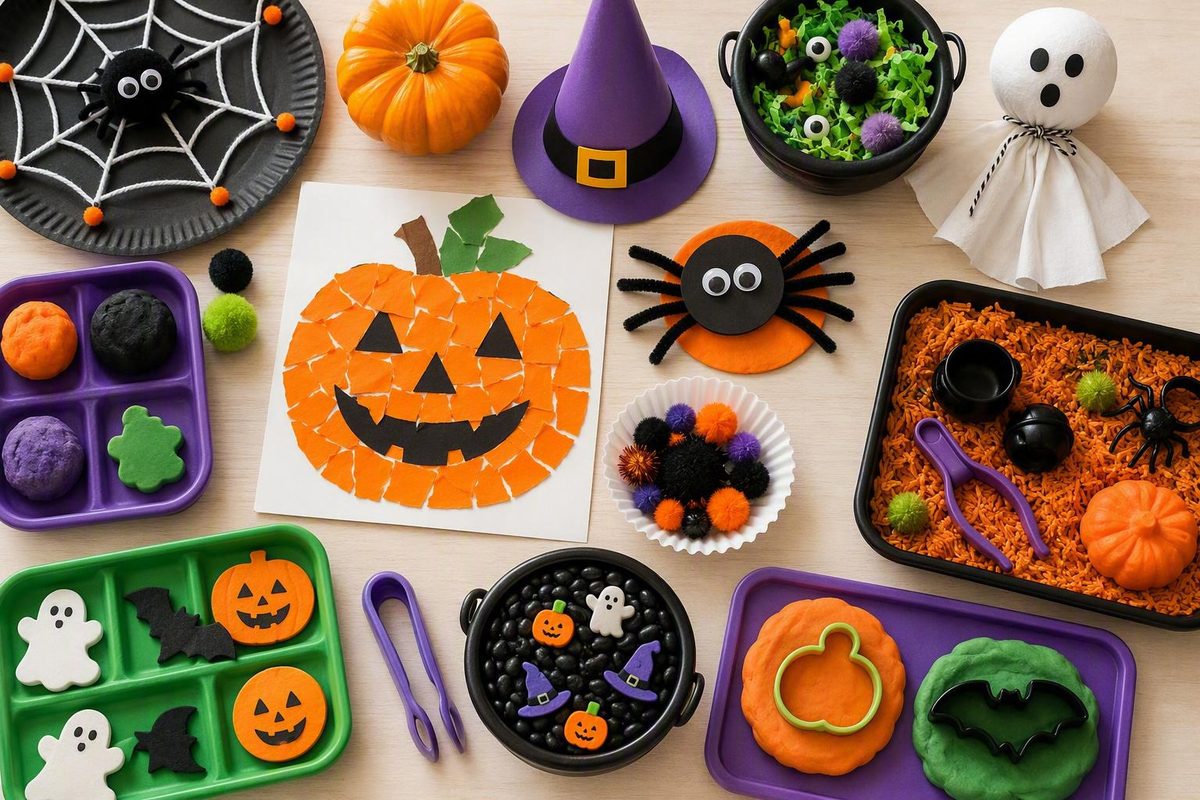
Preschool Halloween can be playful without being frightening, complicated, or dependent on paid printables. These 24 Halloween activities for preschoolers use familiar materials for movement, art, literacy, math, observation, sensory exploration, and pretend play.
Each activity identifies what children can practice, not what it guarantees they will learn. Select and adapt ideas according to each child’s demonstrated readiness, your setting, and the supervision available.
Editorial note: This guide synthesizes practitioner and institutional guidance from the sources cited throughout. The activities are not presented as individually tested by this publication, and the setup, cleanup, and adult-help descriptions are editorial estimates based on the listed materials and directions.
How to choose a preschool Halloween activity
Begin with the simplest idea that fits your space and materials. Friendly pumpkins, ghosts, bats, cats, nighttime animals, and silly creatures make a gentle default. If your group does not celebrate Halloween—or a child dislikes the theme—substitute leaves, apples, harvest colors, clouds, or woodland animals.
Quick comparison of all 24 activities
Filter definitions
- NO PRINTER: Everything can be drawn or cut by hand.
- NO EATING: The activity does not require children to eat candy or other food.
- NO FOOD MATERIALS: The listed version does not use real pumpkins or other edible materials. This is the relevant filter for settings where food may not be used even for art or sensory play.
- NO SMALL PARTS: The listed version can use large materials throughout. This is not a universal safety endorsement; inspect materials for the children participating.
- LOW MESS: Usually requires no more than collecting materials or routine wiping. It is an editorial cleanup category, not a guarantee.
- SMALL SPACE: Can work at a table or in a compact clear area.
- DIRECT SUPERVISION: An adult stays actively engaged rather than monitoring from elsewhere.
Editorial planning estimates: “Quick setup” means arranging readily available materials; “advance preparation” means an adult must cut, punch, build, or freeze something beforehand. Adult help is described as low, moderate, or continuous according to the directions—not as a measured rating.
| # | Activity | Category and principal practice | Suggested setting | Setup | Cleanup | Adult help | Water, tools, food materials, or small parts |
|---|---|---|---|---|---|---|---|
| 1 | Pumpkin Patch Pickers | Movement; following cues | Whole group | None | None | Low–moderate | None |
| 2 | Spider Stretch | Movement; copying positions | Group or individual | None | None | Moderate | None |
| 3 | Magic Wand Movement | Movement; positional words | Group or small space | None | None | Moderate | None when fingers are used |
| 4 | Friendly Creature Moves | Movement; imitation and choice | Whole group | None | None | Low–moderate | None |
| 5 | Monster Print Trail | Movement; route following | Open floor | Quick | Collect paper and tape | Moderate | Paper must be secured flat |
| 6 | Pumpkin Shape Collage | Art; shapes, gluing, optional cutting | Table or art center | Quick or advance cutting | Scraps and glue | Moderate–high | Scissors if offered |
| 7 | Ghost Stamping | Art; stamping and placement | Table or art center | Quick | Paint and tool washing | Moderate | Washable paint and cleanup water |
| 8 | Torn-Paper Pumpkin | Art; tearing and gluing | Table | Quick | Scraps and glue | Moderate | Torn pieces may become small |
| 9 | Paper-Plate Spider-Web Lacing | Fine motor; threading | One-to-one or small group | Advance hole punching | Store cord | Continuous | Cord; adult preparation tools |
| 10 | No-Carve Pumpkin Decorating | Art; mark-making and design | Table or outdoors | Quick | Markers, stickers, or paint | Moderate | Real pumpkin is an edible material; large stickers only |
| 11 | Pumpkin Name Match | Literacy; name and letter matching | One-to-one or center | Advance paper preparation | Collect paper letters | Moderate | Loose paper pieces, made large |
| 12 | Trick-or-Treat Bag Letter Match | Literacy; letter matching | Small group or center | Quick | Collect cards | Moderate | Loose cards, made large |
| 13 | Skeleton Letters | Literacy; letter formation | Table or center | Quick | Collect materials | Moderate | Cotton swabs unless replaced |
| 14 | Pumpkin Beginning-Sound Bag | Literacy; oral sound play | Small group | Quick | Return objects | High | Household objects; inspect size |
| 15 | Large-Object Witches’ Brew | Math; counting quantities | Individual or small group | Quick | Return blocks and bowl | Moderate | Bowl and large manipulatives |
| 16 | Feed the Friendly Monster Colors | Math; sorting | Center or small group | Advance container decorating | Return materials | Low–moderate | Containers and large manipulatives |
| 17 | Bat Counting Mats | Math; quantity matching | Teacher-supported center | Quick | Return blocks | Moderate | Large blocks |
| 18 | Candy-Corn Color Patterns | Math; repeating patterns | Table or center | Quick | Return blocks | Moderate | Connecting blocks must be assessed for size |
| 19 | Pumpkin Investigation | Science and sensory; observing | Small group | Quick; adult opening optional | Pulp, tools, and surface cleaning | Continuous | Real pumpkin, adult cutting tool, pulp, loose seeds |
| 20 | Wash the Pumpkin | Sensory; washing and describing | One-to-one or small group | Quick | Water and wet surfaces | Continuous | Water and real pumpkin |
| 21 | Frozen Pumpkin Rescue | Science; observing melting | One-to-one or small group | Advance freezing | Water and tray | Continuous | Water and ice |
| 22 | Pretend Trick-or-Treating | Dramatic play; routines and turns | Small or whole group | Quick | Return props | Moderate | Large tokens; costume items optional |
| 23 | Costume Shop | Dramatic play; sorting and language | Center | Advance clothing inspection | Return clothing | Moderate–high | Fit, vision, fasteners, trailing fabric |
| 24 | Pretend Pumpkin Patch | Dramatic play; sorting and cooperation | Center or open floor | Quick | Return props | Moderate | Real pumpkins are edible materials; paper alternatives available |
Useful filters
- NO PRINTER: All 24 activities.
- NO EATING: All 24 activities can be run without candy or food consumption.
- NO FOOD MATERIALS: 1–9 and 11–23, except that Activity 19 requires a real pumpkin. Activities 10, 20, and 24 become food-material-free when paper, cardboard, or washable model pumpkins replace real ones.
- NO SMALL PARTS: 1–7, 10 with large decorating materials, 15–17, and 20–24. Activity 19 qualifies only when the pumpkin stays intact or an adult removes and contains all seeds and loose material before children participate.
- LOW MESS: 1–5, 9, 11–18, and 22–24.
- SMALL SPACE: 3, 6–18, 19, and 21–23.
- DIRECT SUPERVISION: 6 when scissors are used; 9; 10 if an adult cuts the pumpkin; 14; and 19–21.
These filters describe the formats listed here. They do not replace inspection of materials, individual readiness assessment, or attentive adult involvement.
Match the task to readiness, not age alone
Children between three and five vary in their comfort with scissors, letter matching, counting, lacing, dice, and directions containing several steps. Watch what a child can already do with support. A child who does not recognize numerals can use dot cards; one who is not ready to cut can arrange pre-cut pieces.
Use modest objectives: an activity may practice counting, matching, cutting, tracing, threading, describing, or turn-taking. Completing it does not guarantee improved development, literacy, motor ability, or school readiness.
Use a simple safety framework
- Stay actively involved whenever water is present, including shallow containers. Keep towels ready and address spills promptly. A pediatric therapy provider likewise warns against leaving children unsupervised during pumpkin washing in its Halloween activity guidance.
- Keep knives and sharp pumpkin-carving instruments with adults. A capable adult should perform every cut; children can draw designs or use a blunt spoon after the cutting tool has been removed. This follows Las Palmas Del Sol Healthcare’s pumpkin guidance.
-
Treat direct supervision of cords and child scissors as a conservative rule in this guide. Assess whether each child can follow stop directions and use the material only as demonstrated.
-
Closely supervise crafts containing small pieces; a parenting craft guide specifically advises close supervision when materials such as loose googly eyes are used. Replace beads, candy, dried rice, beans, seeds, pom-poms, miniature toys, erasers, cotton swabs, and loose googly eyes when children mouth objects.
- Use large paper shapes, full-size blocks, fabric squares, sponges, or other large washable materials instead.
- Make sensory participation optional. Offer gloves, brushes, spoons, tongs, a sealed clear container, or observation from a comfortable distance. A child does not need to touch a texture to participate.
Five movement activities with little or no equipment
These games invite gross-motor practice, listening, imitation, and choice. They are not treatments for motor difficulties. Clear the floor, demonstrate the action, and let children choose a comfortable alternative.
The first four movement sequences are adapted from the movement ideas in PreKinders’ Halloween theme guide.
1. Pumpkin Patch Pickers
Labels: NO PRINTER · NO EATING · NO FOOD MATERIALS · NO SMALL PARTS · LOW MESS
Space: A clear group area or personal standing space.
Adult directions:
- “Squat and pick a pumpkin.”
- “Carry it to the wagon.”
- “Roll it gently.”
- “Scoop out the pumpkin” with large stirring motions.
Easier: Demonstrate one action at a time. Children may perform the motions while seated.
Harder: Give a sequence such as, “Pick, carry, then roll.”
Observe: Does the child respond to one cue or remember a short modeled sequence?
2. Spider Stretch
Labels: NO PRINTER · NO EATING · NO FOOD MATERIALS · NO SMALL PARTS · LOW MESS
Space: Enough room to move without touching another person.
Adult directions: Invite children to crawl like spiders, reach an arm across the body as though stretching a web, lift a leg as though climbing, and curl into a resting spider.
Easier: Use standing or seated reaches—high, across, and low—without crawling or one-leg balancing.
Harder: Combine positions: “Crawl, reach across, then curl up.”
Observe: Which positions can the child copy comfortably? Does the child pause when the direction changes?
3. Magic Wand Movement
Labels: NO PRINTER · NO EATING · NO FOOD MATERIALS · NO SMALL PARTS · LOW MESS · SMALL SPACE
Space: A personal standing or seated spot.
Adult directions: Use an index finger as the default wand. Point high, low, or beside the body; draw circles and zigzags in the air; then jump or spin if comfortable.
Avoid straws and sticks when the group cannot manage them safely.
Easier: Offer two contrasting prompts, such as high and low.
Harder: Combine a position and action: “Draw a circle low, then jump.”
Observe: Can the child distinguish two positional cues or follow a two-part direction?
4. Friendly Creature Moves
Labels: NO PRINTER · NO EATING · NO FOOD MATERIALS · NO SMALL PARTS · LOW MESS
Space: An uncluttered movement area.
Adult directions: Float like a friendly ghost, flap like a bat, roll gently like a pumpkin, or tiptoe like a cat.
Easier: Let each child choose one comfortable action.
Harder: Ask children to invent and name a movement for a silly creature.
Inclusive choice: Substitute a bird, rabbit, bear, or other familiar animal if a Halloween character feels scary.
Observe: Can the child match a named creature to a movement or explain a choice?
5. Monster Print Trail
Labels: NO PRINTER · NO EATING · NO FOOD MATERIALS · NO SMALL PARTS · LOW MESS
Materials: Large paper footprints and sturdy tape.
Space and setup: Place a short route on an uncluttered floor. As a conservative setup rule, secure each paper flat and stop if anything shifts or curls.
Adult directions: Ask children to walk, hop, or tiptoe from print to print. Keep participants spaced apart.
Easier: Make a shorter path, use walking only, or give stationary prompts beside the trail.
Harder: Alternate actions by color or position.
Mobility option: Point to successive prints and perform a seated arm movement at each one.
Observe: Can the child follow the route, stop on a cue, or change actions?
Five easy Halloween art and fine-motor projects
Good preschool art leaves room for decisions. Children can choose colors, positions, expressions, and how much of a surface to cover rather than copying one adult model. Different finished products are expected.
6. Pumpkin Shape Collage
Materials: Large orange paper pumpkin; large paper circles, squares, and triangles; glue stick or glue sponge; marker; optional child scissors and bold cutting lines.
Setup and setting: Pre-cut shapes for a table activity, or draw bold lines on paper strips for children who are ready to cut.
Child steps: Arrange a face, glue the pieces, name shapes if desired, and count how many of each appear.
Adult role: Discuss choices without directing the design. Stay directly involved when scissors are used.
Readiness cue: The child can keep scissors directed toward the work, open and close them intentionally, and follow the setting’s tool rules.
Simpler: Provide a few large pre-cut shapes and allow arrangement without glue first.
Extension: Compare two collages or ask, “How many triangles did you use? How do you know?”
Cleanup: Return unused shapes, close glue, collect scraps, and wipe the table.
The activity practices arranging, gluing, optional cutting, shape recognition, and counting.
7. Ghost Stamping
Materials: Dark paper, washable white paint, ghost-shaped cookie cutter or large sponge, shallow paint tray, work tray, smock, and damp cloth.
Setup and setting: Put a small amount of paint in the tray and place the paper on a larger tray at an art table.
Child steps: Dip the cutter or sponge lightly, press it onto the paper, lift, and repeat. Add marker faces after drying if desired.
Adult role: Demonstrate pressing rather than sliding and help manage excess paint without controlling placement.
Readiness cue: The child can keep the tool in the work area and use it without throwing or mouthing it.
Simpler: Offer one large sponge and a small paint area.
Extension: Make a pattern or compare overlapping and separate prints.
Non-paint option: Stamp or draw with plain water on a chalkboard and watch the marks disappear.
Cleanup: Move work to a drying area, wash reusable tools, wipe the tray, and clean hands.
Ghost-shaped cutters dipped in white paint on dark paper are suggested in this preschool Halloween planning guide.
8. Torn-Paper Pumpkin
Materials: Large pumpkin outline on sturdy paper or cardboard, wide orange paper strips, glue stick or glue sponge, and green paper or marker.
Setup and setting: Place paper strips and glue within reach at a table. Keep pieces large enough for the children participating.
Child steps: Tear or crumple orange paper, arrange the pieces, and glue them onto the outline.
Adult role: Show how two hands can pull in opposite directions. Accept uneven pieces and incomplete coverage.
Readiness cue: The child is willing to use both hands or another method to separate and place paper. Tearing is optional.
Simpler: Start small tears along the edges or provide adult-torn pieces.
Extension: Add a second color, create sections, or compare larger and smaller pieces.
Cleanup: Collect scraps for another collage and wipe away glue.
Because torn pieces can become small, this activity should not be treated as inherently free of small-part concerns.
9. Paper-Plate Spider-Web Lacing
Labels: DIRECT SUPERVISION
Materials: Sturdy paper plate, adult-operated hole punch, short length of thick cord with a secured end, and marker.
Setup and setting: An adult punches widely spaced holes. Use the activity one-to-one or with a small, closely supervised group.
Child steps: Push the cord through one hole, pull it partway, and choose another hole to create crossing lines.
Adult role: Stay beside the child. In this guide, cords are kept away from the neck and body, and the activity ends if the child cannot follow the handling rule.
Readiness cue: The child can use cord only as demonstrated and respond to a stop direction.
Simpler cord-free option: Draw lines between holes or glue wide paper strips across the plate.
Extension: Number a few holes and follow a short sequence if numeral matching is familiar.
Cleanup: Account for and store cords immediately; recycle scraps.
10. No-Carve Pumpkin Decorating
Materials: Real pumpkin or washable model pumpkin, washable markers, large stickers, washable paint, brushes, and a tray or table covering.
Setup and setting: Place the pumpkin on a stable table or outdoor surface. Protect the area if using paint.
Child steps: Draw lines or faces, add large stickers, or paint an original design.
Adult role: Hold a rolling pumpkin steady and ask open questions such as, “What expression did you choose?”
Readiness cue: The child can work with a stable pumpkin and keep markers, stickers, or brushes in the designated area.
Simpler: Offer one marker or a small selection of large stickers.
Extension: Decorate two sides with different moods or create an autumn pattern.
Food-material-free option: Use a cardboard pumpkin, an orange box, or a washable model.
Cleanup: Cap markers, wash brushes and hands, collect sticker backings, and protect painted work while it dries.
Young children should not handle knives or sharp pumpkin-carving instruments. Healthcare guidance recommends drawing designs while a capable adult performs any cutting; see its pumpkin-carving safety advice.
Four playful Halloween literacy activities
These ideas use names, letters, objects, and conversation rather than worksheets. Keep the choices manageable and accept pointing, gestures, approximations, or one-word answers.
11. Pumpkin Name Match
Materials: Handwritten name card, large paper pumpkins, and marker.
Setup: Write one letter from the child’s name on each pumpkin.
Directions: Let the child study the name card, find matching letters, and place the pumpkins in order.
Easier: Use the first letter and one or two contrasting choices.
Extension: Let the child study the model, turn it over, and reconstruct part of the name.
Language prompts: “Which letter comes first?” “What do you notice?” “How did you decide?”
Emerging-language options: Point to two choices, trace a letter in the air, or hand the adult the next letter.
Observe: Does the child match a familiar letter or reconstruct part of the name?
12. Trick-or-Treat Bag Letter Match
Materials: Paper bag, several large handwritten letter cards, and a hand-drawn alphabet mat.
Setup: Put a small set of familiar letters in the bag. Beginners do not need the entire alphabet.
Directions: Draw one card, look at or name the letter, and place it on the matching letter.
Easier: Use letters from the child’s name and only two or three choices.
Extension: Ask for a word beginning with the letter, while accepting a modeled answer or picture choice.
Language prompts: “What lines or curves do you see?” “Which looks the same?”
Emerging-language options: Match silently, point, or choose between two adult-named letters.
Observe: Can the child match one familiar letter consistently?
13. Skeleton Letters
Materials: Large capital-letter outlines and full-length cotton swabs or wide white paper strips.
Setup: Draw one or two large letters rather than the entire alphabet.
Directions: Lay the “bones” over the lines, turning them to fit.
Easier: Begin with a mostly straight-line letter and use wide paper strips.
Extension: Remove the outline and arrange a familiar capital letter from memory.
Language prompts: “Which piece needs to turn?” “Is this line long or short?”
Small-part substitution: Use wide paper strips whenever cotton swabs are unsuitable for a child who mouths objects.
Observe: Does the child align materials with part of an outline or distinguish two letter shapes?
14. Pumpkin Beginning-Sound Bag
Labels: DIRECT SUPERVISION
Materials: Pumpkin bucket or paper bag and familiar classroom or household objects assessed as sufficiently large.
Setup: Choose objects with clearly different names, such as a cup, sock, book, brush, or block.
Directions: A child removes an object, names it or hears the adult name it, and notices the first sound: “Book starts with /b/.”
Easier: Present two objects with noticeably different initial sounds and focus on listening.
Extension: Find two objects beginning with the same sound or sort a few objects into two groups.
Language prompts: “What did you find?” “How do we use it?” “Do sock and cup start the same way?”
Emerging-language options: Offer picture choices, model the word, accept a gesture, or let the child point.
Observe: Does the child notice that two names begin differently or identify a matching pair with support?
Four counting, sorting, and pattern activities
Numeral recognition and accurate counting are separate tasks. A child may count three objects correctly without recognizing the written numeral 3. Supply dots or a matching collection when the numeral is unfamiliar.
Each activity can be used one-to-one, with a small group taking turns, or in a teacher-supported center. For groups, duplicate large materials or assign roles such as card holder, object collector, and checker.
15. Large-Object Witches’ Brew
Objective: Practice counting objects into a container.
Materials: Large bowl, full-size blocks or fabric squares, and hand-drawn recipe cards showing dots, pictures, or numerals.
Setup: Begin with recipes requiring one to three objects.
Directions: Show a recipe and ask the child to place the matching quantity in the bowl, touching or moving each item while counting.
Easier: Draw one-to-one spaces and place one block on each space.
Extension: Combine two colors or compare two recipes.
Large-part substitution: Use large sponges or rolled fabric rather than pom-poms, candy, beads, seeds, or miniature toys.
Observe: Can the child give one object to each space or produce the requested small quantity?
16. Feed the Friendly Monster Colors
Objective: Sort consistently by one attribute.
Materials: Large open containers decorated with friendly faces and large blocks or fabric pieces in matching colors.
Setup: Give each container a clear color cue and a wide opening.
Directions: “Feed” each monster pieces of the matching color.
Easier: Use two strongly contrasting colors and sort alongside the child.
Extension: Suggest another sorting rule, such as material or size, using an appropriate object set.
Large-part substitution: Use full-size blocks, cloth squares, or sponges instead of beads or pom-poms.
Observe: Does the child maintain one sorting rule across several objects?
17. Bat Counting Mats
Objective: Match a quantity to a dot card or numeral.
Materials: Paper or cardboard mats with hand-drawn numerals, large blocks as pretend bats, and optional dot cards.
Setup: Prepare only the quantities appropriate for the child.
Directions: Place the corresponding number of “bats” on each mat.
Easier: Use dots and place one block on each dot.
Extension: Compare two mats: “Which has more? Which has fewer? How could we check?”
Large-part substitution: Use full-size blocks or large paper bats rather than small counters.
Observe: Can the child match a quantity to a dot model or familiar numeral?
18. Candy-Corn Color Patterns
Objective: Copy or continue a repeating color pattern.
Materials: Orange, yellow, and white connecting blocks assessed as large enough for the children using them, plus an adult-made model.
Setup: Begin with an AB pattern, such as orange-yellow-orange-yellow.
Directions: Copy the model or select the next color.
Easier: Use two colors and separate the available choices.
Extension: Try AAB or ABC after the child can continue AB reliably.
Large-part substitution: Use large colored paper cards or fabric squares.
Observe: Can the child continue the repeating unit rather than alternate at random?
This is candy-corn color play. No edible candy is required.
Three supervised pumpkin science and sensory activities
Children can look, describe, compare, predict, scoop, or watch without being required to touch. These versions do not use water beads, dried rice, beans, glitter, miniature spiders, slime, hair gel, balloons, or loose sensory fillers.
19. Pumpkin Investigation
Labels: DIRECT SUPERVISION · OPTIONAL SENSORY CONTACT · REAL FOOD MATERIAL
Materials: One or two intact pumpkins, stable tray, optional magnifier, spoon or scoop, gloves, clear container, and an adult cutting tool stored out of children’s reach.
Outside observation: Examine color, shape, texture, stem, lines, and flat or rounded areas. Compare two pumpkins: Which seems heavier? Which is smoother?
Inside observation: If desired, an adult opens one pumpkin away from children and removes the sharp tool. Before children approach, the adult removes and contains loose seeds. Children who mouth objects should not have access to seeds or loose pieces.
No-small-parts version: Keep the pumpkin intact, or seal a pulp sample in a clear container after the adult has removed and secured the seeds.
Child participation: Use a spoon or scoop to move pulp, wear gloves, inspect a sealed sample, or observe only. An early-learning-center guide similarly suggests gloves or watching first when a child dislikes pumpkin texture in its not-so-spooky sensory guidance.
Observation prompts: “Is it rough or smooth?” “What do you predict is inside?” “How are these pumpkins different?”
A strict no-food-material classroom should choose an exterior-only comparison with washable model pumpkins instead; an inside investigation requires a real pumpkin.
20. Wash the Pumpkin
Labels: DIRECT SUPERVISION · WATER · OPTIONAL SENSORY CONTACT · REAL FOOD MATERIAL
Materials: Pumpkin or washable model, stable shallow container, small amount of water, cloth, large brush, and towels.
Setup: Put the container on a stable washable surface and keep the walking area clear.
Directions: Wipe or brush the pumpkin. Observe where water collects and whether the surface looks different when wet.
Sensory alternatives: Use a dry brush, wear gloves, hold the cloth with a tool, or watch another person wash.
Observation prompts: “Where is the pumpkin rough?” “What happens to the dirt?” “Do you predict it would sink or float?” The prediction can be discussed without performing the test.
Food-material-free option: Wash a large orange block or washable model pumpkin.
Cleanup: Empty the container promptly, dry the object and surrounding surfaces, wash reusable tools, and clean hands.
21. Frozen Pumpkin Rescue
Labels: DIRECT SUPERVISION · WATER · ADVANCE PREPARATION
Materials: One large washable pumpkin-shaped object or large orange block, shallow freezer-safe container, water for freezing, warm—not hot—water, cup or squeeze bottle, tray, and towels.
Setup: Freeze the single large object in a shallow layer of water. Set the ice in a stable tray.
Directions: Pour or squeeze small amounts of warm water over the ice and watch the object loosen.
Adult role: Supervise continuously and manage the water. As conservative rules for this version, adults remove sharp ice fragments and keep striking tools out of the activity.
Do not add: Miniature toys, salt for tasting, hammers, or other striking tools.
Easier: Let the ice sit while children watch and describe the melting.
Extension: Mark the water line or compare what happens in warmer and cooler locations without requiring children to hold the ice.
Observation prompts: “What changes as the ice warms?” “Where is water appearing?” “What do you predict will happen next?”
Cleanup: Discard the water, wash the reusable object and container, and dry the surrounding area.
Three dramatic-play activities for Halloween routines and cooperation
Pretend play can rehearse routines, but adults do not need to script every line. Introduce the setting, support turn-taking, and leave room for children to redirect the story.
22. Pretend Trick-or-Treating
Materials: Paper or cardboard doors, bags or buckets, large paper tokens or blocks, and optional picture cues.
Setup: Place doors around the room without blocking exits or walking routes.
Directions: Model knocking or ringing, waiting, saying “trick or treat,” taking one pretend item, saying thank you, and standing behind the next person. Add a door marked “not participating” and model: “This house is not handing out treats. We can go to the next one.”
Roles: Children may be residents, visitors, helpers, or observers. No one must speak or carry a bag.
Adult prompts: “Whose turn is next?” “What could the resident say?” “What can we do when the door does not open?”
Props: Use large paper tokens or blocks rather than candy and small favors.
Neutral version: Create a neighborhood visit in which children deliver paper leaves or friendly notes.
Pretend trick-or-treating routines—including knocking, waiting, taking one item, thanking the resident, and handling a nonparticipating house—appear in the preschool planning guide cited in the art section.
23. Costume Shop
Materials: Small selection of well-fitting dress-up clothes, hats that do not block vision, baskets or hooks, paper and crayons, and large pretend payment cards.
Directions: Sort clothing, choose and describe an item, draw an order, pretend to pay, work as shopkeepers, and return items.
Adult prompts: “What is the customer looking for?” “How could you sort these?” “Who will use the checkout next?”
Simpler: Offer two clothing choices and one role at a time.
Extension: Add child-made signs or sort items by color, type, or where they are worn.
Neutral version: Call it a clothing or weather shop.
For costumes worn outside, properly fitting garments, unobstructed vision, reflective elements or lights, and adult supervision are recommended in Penn State Health’s Halloween injury-prevention guidance.
24. Pretend Pumpkin Patch
Materials: Real pumpkins children can manage safely or large paper pumpkins, baskets, cardboard displays, large price or picture cards, and paper bags.
Setup: Create a clear route between the field, display, and pretend farm stand. Leave heavy pumpkins where they can be examined without repeated lifting.
Directions: Select pumpkins, carry manageable props, sort them, create a display, operate the stand, or act as customers and farmers.
Adult prompts: “How will you arrange the display?” “Which pumpkin would the customer like?” “How can two workers carry this large paper pumpkin together?”
Simpler: Sort large paper pumpkins by color or size while seated.
Extension: Add hand-drawn shopping lists with pictures or quantities.
Neutral or food-material-free version: Use paper apples, leaves, gourds, or woodland-animal pictures for an autumn farm stand.
Classroom play is not equivalent to real neighborhood trick-or-treating. Preschoolers outside need close adult accompaniment, costumes that fit and remain visible, and adult inspection of treats for allergens and choking hazards, as advised by Penn State Health.
Ready-to-use activity combinations and inclusive adaptations
You do not need to attempt all 24 ideas. A few well-supported activities are more useful than numerous centers that exceed the available supervision.
A balanced short session
Choose three contrasting experiences:
- Movement: Pumpkin Patch Pickers.
- Hands-on learning: Pumpkin Shape Collage, with pre-cut or child-cut shapes selected according to readiness.
- Open-ended art: No-Carve Pumpkin Decorating.
This combination alternates active movement, a structured shape or counting opportunity, and creative choice. Move on when the group is ready rather than assigning an unsupported exact duration.
A teacher-supported small group
Combine:
- Pumpkin Name Match for familiar-letter work.
- Large-Object Witches’ Brew for counting.
- Pretend Trick-or-Treating for language and turn-taking.
Keep the same small group together, limit the materials presented at once, and model each task before inviting choices.
A flexible five-day framework
Use this as a menu rather than a rigid schedule:
- Movement day: Pumpkin Patch Pickers, Spider Stretch, or Friendly Creature Moves.
- Art day: Ghost Stamping, Torn-Paper Pumpkin, or No-Carve Pumpkin Decorating.
- Literacy day: Pumpkin Name Match or Pumpkin Beginning-Sound Bag.
- Math day: Large-Object Witches’ Brew, color sorting, counting mats, or block patterns.
- Observation or dramatic-play day: Pumpkin Investigation, Pretend Trick-or-Treating, Costume Shop, or Pretend Pumpkin Patch.
Repeat a successful activity instead of introducing something new every day.
Theme substitution chart
| Halloween theme | Gentle or neutral substitute |
|---|---|
| Pumpkins | Apples, leaves, gourds, or round orange shapes |
| Ghosts | Clouds, snowflakes, or floating scarves |
| Bats | Nighttime birds or butterflies |
| Monsters | Friendly animals or invented silly creatures |
| Spider webs | Connecting lines, roads, or branches |
| Witches’ brew | Color-mixing soup or harvest stew |
| Trick-or-treating | Neighborhood visiting or delivering cards |
| Costume shop | Clothing or weather shop |
| Pumpkin patch | Autumn farm stand or apple orchard |
Access checklist
Consider whether participation would be easier with:
- Seated movement choices.
- Larger handles, brushes, cards, and manipulatives.
- Fewer objects or choices at once.
- High-contrast paper and materials.
- Picture directions showing one step at a time.
- An adult demonstration before verbal directions.
- A partner who can hold, carry, match, or alternate turns.
- Materials positioned within comfortable reach.
- Pointing, gestures, or one-word responses instead of required sentences.
- Optional rather than required sensory contact.
- Gloves, tools, or a contained sample.
- A quiet observation role before joining.
These are practical adaptations, not validated therapeutic interventions. For individualized support needs, use guidance from the child’s family and relevant professionals rather than assuming one adaptation fits everyone.
Reusable supply list
A useful activity kit can remain simple:
- Construction paper and cardboard
- Washable markers and paint
- Brushes, sponges, and trays
- Glue sticks or glue sponges
- Child scissors for individually assessed use
- Large blocks and fabric squares
- Bowls and stable shallow containers
- Cloths and towels
- Sturdy tape
- Paper plates
- Thick cord for directly supervised lacing
- Real, paper, model, or cardboard pumpkins
Paid printables, laminating, affiliate products, candy, and email-gated downloads are not required. Handwritten cards and child-made props are enough.
Which Halloween activities are safest for a three-year-old who still puts objects in their mouth?
No activity can be identified as universally safest from age alone. Options that avoid the loose small parts listed in this guide include Pumpkin Patch Pickers, Spider Stretch, finger-based Magic Wand Movement, Friendly Creature Moves, and Pretend Pumpkin Patch with oversized paper props.
Use large blocks, fabric squares, sponges, and large paper shapes instead of beads, candy, seeds, dried rice or beans, pom-poms, miniature toys, erasers, cotton swabs, or loose googly eyes. Inspect every material and remain close because a child may still bite, tear, or misuse a large object.
Avoid unattended lacing and any activity containing an item the child attempts to chew or swallow. Treat real pumpkins and other edible materials according to your setting’s allergy, sanitation, cross-contact, and food-use policies.
What are the quickest preschool Halloween activities to set up without a printer?
Pumpkin Patch Pickers, Spider Stretch, Magic Wand Movement, and Friendly Creature Moves require only clear space and spoken directions.
For a quick table activity, write a child’s name on one card and its letters on large paper pumpkins, sort large colored blocks into containers, or decorate a cardboard pumpkin with washable markers. Hand-drawn dots can become a counting mat, while hand-cut paper can become footprints, shapes, or pretend tokens.
How can I make Halloween activities less scary or more sensory-friendly?
Use smiling pumpkins, gentle ghosts, cats, bats, nighttime animals, and silly creatures instead of frightening faces, surprise sounds, gore, or realistic monsters. Let children rename or replace any character.
Reduce sensory load by presenting fewer materials, using predictable steps, and allowing observation before participation. For wet or sticky materials, offer gloves, a spoon, a brush, a sealed container, or a no-touch role. Do not require touching as proof of participation.
Halloween can also be removed entirely: ghosts become clouds, monsters become animals, and witches’ brew becomes color-mixing soup.
Can preschoolers carve pumpkins or use pumpkin-carving tools?
Preschoolers should not handle knives or sharp pumpkin-carving instruments. They can draw a design, paint, attach large stickers, or scoop with a blunt spoon after a capable adult has made the cuts and removed the sharp tool.
Keep the pumpkin stable, supervise the activity, and clean hands and surfaces afterward. Treat opened pumpkin material as sensory material—not food—unless it was prepared and handled specifically for eating.
How can I adapt these ideas for a classroom that does not use food or celebrate Halloween?
All 24 activities can avoid eating, but a strict no-food-material classroom should also replace the real pumpkins in Activities 10, 20, and 24 with paper, cardboard, or washable models. Pumpkin Investigation requires a real pumpkin and should be replaced with an exterior comparison of model pumpkins, photographs, or autumn objects.
For a neutral seasonal theme:
- Turn pumpkins into apples or leaves.
- Turn ghosts into clouds.
- Turn bats into nighttime birds.
- Turn monsters into friendly animals.
- Turn witches’ brew into color-mixing soup.
- Turn trick-or-treating into a neighborhood visit.
- Turn the costume shop into a clothing shop.
- Turn the pumpkin patch into an autumn farm stand.
Choose a small mix that matches the children’s readiness and the adults available to supervise it. One active game, one hands-on learning task, and one open-ended creative choice are enough for a balanced celebration.
A successful preschool Halloween—or autumn theme—does not require frightening decorations, candy, paid printables, elaborate sensory bins, or identical finished crafts. It needs clear choices, adaptable materials, and attentive adults.