
Turn a Gentle Rain Into Preschool Play and Learning
Use puddles, tubs, chalk and rain sounds, with a go-or-no-go safety check, inclusive adaptations, a mini lesson and indoor pivots.
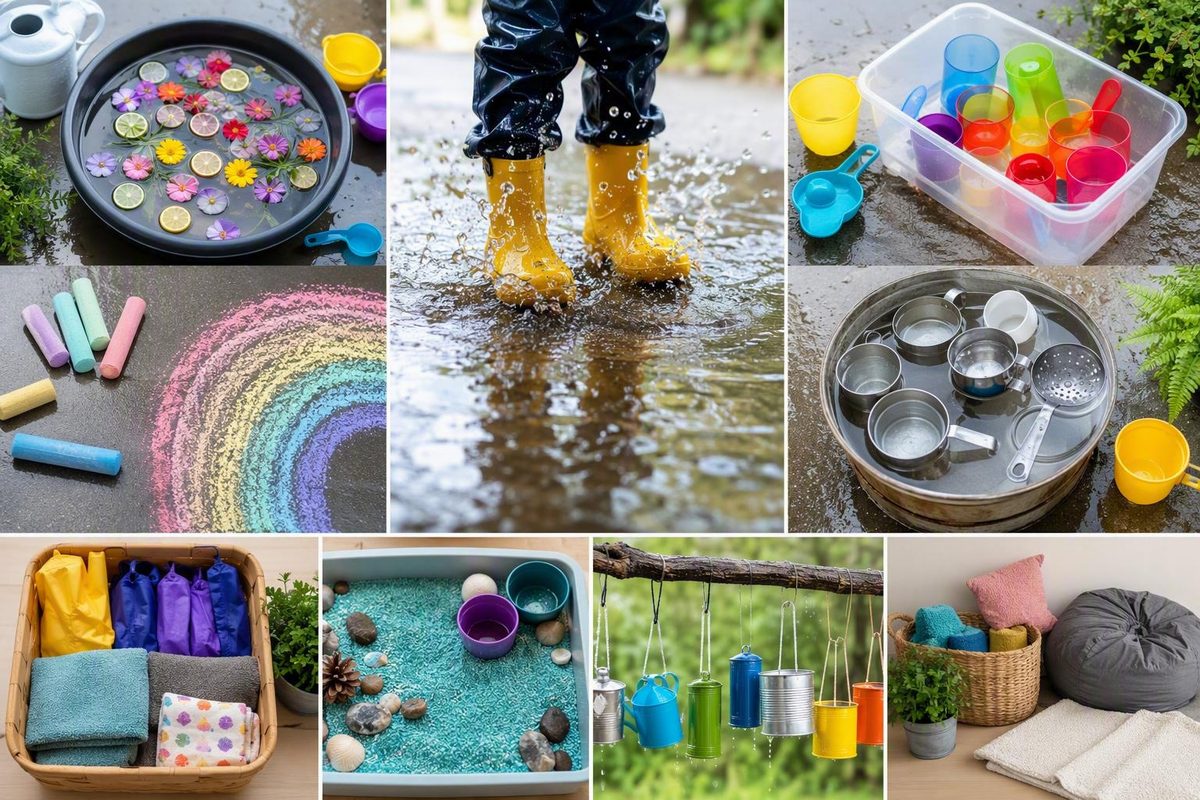
Children can play outside during ordinary gentle rain when an adult first checks the weather, the play area, and each child’s needs.
Move the activity indoors if thunder, lightning, flooding, fast-moving water, high winds, hail, poor air quality, or an unsafe play surface threatens. When a thunderstorm approaches, National Weather Service guidance directs people to enter a substantial building or suitable enclosed vehicle. Review its severe-weather safety rules.
Check the Weather and Play Area First
Use this go-or-no-go check before children dress for outdoor rain play:
- Forecast and alerts: Check the current local forecast, watches, warnings, and nearby sky.
- Conditions: Consider wind, temperature, visibility, changing rainfall, and air quality.
- Drainage: Look for standing water, low areas, runoff, and changing water levels.
- Program requirements: Follow applicable local rules, licensing requirements, and your program’s outdoor-play procedures.
- Children: Consider clothing, mobility, sensory preferences, communication needs, health plans, and individual comfort.
- Exit plan: Choose a stop signal and confirm the quickest indoor route.
Head Start outdoor-safety guidance recommends monitoring weather and air quality, inspecting outdoor areas, using suitable clothing, and following applicable local and licensing requirements. See its outdoor safety guidance.
A weather watch means hazardous weather or flooding is possible. A warning requires immediate action. Do not begin or continue outdoor play when thunder, lightning, flooding, rapidly flowing water, high winds, hail, or another dangerous condition threatens.
Children must not play near storm drains, washes, flooded roads, swollen creeks, flood-prone low areas, or fast-moving runoff. Dangerous water can arrive from rain falling elsewhere, even when nearby rain appears light. National Weather Service flood guidance specifically warns against playing near washes and storm drains after rainfall. Use a shallow tub or basin for boat, pouring, and water-flow experiments instead.
Inspect the play area immediately before children enter it. Avoid:
- Puddles whose depth or location cannot be checked
- Roadside water and areas exposed to vehicle traffic
- Sharp debris, broken branches, glass, or animal feces
- Damaged, unstable, eroded, or excessively slippery surfaces
- Standing water near electrical equipment
- Any place where water is rising or moving
Keep supervision active. Position adults so they can see and hear the children, scan the entire area, keep track of every child, and move closer when an activity involves splashing, tools, or uncertain footing. Adjust assistance for each child’s developmental, mobility, sensory, and communication needs.
Before play starts, establish a clear stop signal—a short phrase, hand signal, whistle, or picture card. Practice stopping, gathering, and following the planned route indoors.
Pack a Simple Rain-Play Kit
Good preparation makes outdoor play more comfortable and the return indoors less chaotic.
Dress children in:
- A rain jacket, waterproof suit, or other suitable outer layer
- Boots with secure, intact soles
- Weather-appropriate layers
- A hood or child-manageable umbrella when appropriate
- Dry socks and a complete change of clothes
Children differ in how they experience wet fabric, hoods, rain noise, mud, and dressing transitions. Allow extra time, explain what will happen, and offer physical or emotional support. No child needs to stand in a puddle or get splashed to participate. Head Start recommends adapting weather play for sensory, mobility, fine-motor, and communication differences. Explore its inclusive weather-play suggestions.
Build a reusable kit from inexpensive, washable, nonbreakable supplies:
- Buckets and shallow tubs
- Cups without sharp edges
- Large spoons, scoops, and long-handled tools
- Measuring cups or other child-friendly measuring tools
- Heavy paper and washable chalk
- Clipboards, paper, crayons, stickers, or pencils
- Large natural objects checked by an adult
- Picture cards for activity choices, “float” and “sink,” or “inside” and “outside”
For the activities in this guide, use intact containers prepared by an adult. Adults should complete any cutting or modification away from children and inspect the finished item before use. Choose large, easy-to-manage materials instead of glass, sharp tools, bungee cords, or uncontrolled small loose parts.
Prepare the indoor return area before going outside. Put towels and dry clothing near the entrance and designate a tub, mat, or bin where wet boots and outerwear can drip.
There is no universal session length or temperature that makes rain play suitable for every child. Continue monitoring the weather and each child’s movement, communication, clothing, and comfort. Return indoors when conditions or comfort change.
Quick Movement and Sensory Activities
These five outdoor rain play activities need little setup. Each can be simplified or extended for the preschoolers present.
| Activity | Materials and setup | Skill and prompt | Hazard and adaptation |
|---|---|---|---|
| 1. Screened-puddle path | Choose one or more shallow puddles with stable footing. Children walk around, step over, stomp in, or jump beside them. | Skill: Compare force, sound, and splash. Prompt: “What changes when you stomp softly or hard?” | Hazard: Slippery footing or an unsuitable puddle. Adapt: Offer a hand, a splash-free route, or a long tool for tapping the edge. |
| 2. Rain listening walk | Follow a short, familiar route. Pause to hear rain on leaves, soil, umbrellas, roofs, and puddles. | Skill: Listen, compare, and describe. Prompt: “Which sound is loudest, softest, fastest, or slowest?” | Hazard: Slick routes or concentrated roof runoff. Adapt: Listen from shelter or use picture choices. |
| 3. Sensory weather walk | Notice wet colors, smells, ripples, droplets, wind direction, and differences from a dry day. | Skill: Observe and recall. Prompt: “What changed since we were here last?” | Hazard: Unknown water or unstable ground. Adapt: Use a paved route, seated viewpoint, or umbrella. |
| 4. Rain songs and movement | Sing a familiar rain song or copy a drizzle-to-heavier-rain rhythm with fingers, hands, and bodies. | Skill: Copy patterns and control movement. Prompt: “Can your fingers make quiet drizzle, then louder rain?” | Hazard: Running on wet ground. Adapt: Move slowly in place while standing, sitting, gesturing, or signing. |
| 5. Nature observation | Look for leaves, birds, worms, snails, droplets, or tracks from an accessible viewing point. | Skill: Notice and describe. Prompt: “What is the animal doing, and what do you notice around it?” | Hazard: Unnecessary wildlife contact. Adapt: Point, photograph, sign, or dictate instead of touching or relocating animals. |
Puddle movement, rain sounds, floating objects, and pretend play can connect children’s actions with questions about water. Keep the learning language concrete: children stomp, listen, compare, predict, or describe. NAEYC provides related examples of puddle movement, music, and inquiry.
Participation does not need to look the same for everyone. One child might make a large splash, another might touch a droplet with a scoop, and another might watch from shelter and select a picture for “loud.” Use accessible routes, stable seating, quieter spaces, reduced splash intensity, visual choices, and additional adult support as needed.
Rain Science With Cups, Puddles, and a Tub
These investigations invite preschoolers to predict, measure, compare, test, describe, and document. Adults manage the equipment and location; children make choices and observe what happens.
| Activity | Materials and setup | Skill and prompt | Hazard and adaptation |
|---|---|---|---|
| 6. Rain gauge | An adult marks and securely positions a stable plastic container. Check it at planned intervals and record the level with marks or stickers. | Skill: Predict, measure, record, and compare. Prompt: “How high do you think the water will reach?” | Hazard: An unstable container or unsafe location. Adapt: Stabilize it and let a child direct an adult recorder. |
| 7. Float-or-sink test | Put a small amount of water in a shallow tub. Test large, nonsharp leaves, bark, sturdy sticks, rocks, or foil. | Skill: Predict and test. Prompt: “Will it float or sink? What happened?” | Hazard: Small or sharp objects and deep containers. Adapt: Use picture cards or long-handled tongs. |
| 8. Contained boat test | Make simple boats from leaves, bark, foil, or waxed paper and test them in a tub or bucket. | Skill: Build, test, compare, and revise. Prompt: “What could help your boat stay up?” | Hazard: Moving runoff. Adapt: Use only a stabilized container and let a child direct an adult helper. |
| 9. One-puddle measurement | Outline one screened puddle with site-appropriate chalk or use a simple measuring tool. Return later to document change. | Skill: Measure, compare, and document. Prompt: “Is the puddle larger, smaller, or the same?” | Hazard: Traffic, runoff, or poor footing. Adapt: Let a child photograph, point to, or dictate the result. |
| 10. Contained water-flow tray | Place a shallow tray at a slight slope. Pour small cups of water and add large barriers or channels. | Skill: Test cause and effect. Prompt: “Where will the water go if we move this barrier?” | Hazard: Spills or alteration of natural drainage. Adapt: Stabilize the tray and use long-handled tools or adult-assisted pouring. |
A rain gauge works best as a repeated question rather than a one-time display. Invite a prediction, observe the level, record it, and compare it with an earlier check or another day. Children do not need to read formal units to notice more, less, or the same.
For float-or-sink tests, present only a few objects at a time. Ask for a prediction before each test, wait for the result, and describe what actually happened: “You predicted sink, but the leaf stayed on top. What should we test next?”
Change one feature at a time in the water-flow tray. Raise one end slightly, move a barrier, widen a channel, or pour from a different point. Empty the tray after the activity instead of leaving standing water or changing the site’s drainage.
Rain Art, Music, and Pretend Play
Use washable, reusable, nonbreakable materials in a defined work area. Keep art materials contained and away from drains and natural waterways.
| Activity | Materials and setup | Skill and prompt | Hazard and adaptation |
|---|---|---|---|
| 11. Wet sidewalk chalk | Draw with washable chalk on a screened, nonslip surface. Add rain or a little clean tap water. | Skill: Observe color, line, and texture. Prompt: “How is this mark different when the ground is wet?” | Hazard: A slick drawing area. Adapt: Work in one small zone or use a damp board under shelter. |
| 12. Rain-assisted paper art | Weight heavy paper on a rimmed tray. Use a small amount of an age-appropriate art medium intended for paper, following its label, and expose it briefly to light rain. | Skill: Observe change and create. Prompt: “Where did the rain move the color?” | Hazard: Art runoff. Adapt: Keep everything over the tray or use an indoor spray bottle instead. |
| 13. Raindrop orchestra | Set out stable, nonbreakable containers with different surfaces and listen as drops strike them. | Skill: Compare pitch, volume, rhythm, and surfaces. Prompt: “Which container makes the lowest sound?” | Hazard: Breakable or unstable objects. Adapt: Listen without touching or play instruments under shelter. |
| 14. Mud kitchen or pretend puddle soup | Use an inspected designated area or a tub with cups, scoops, and large spoons. | Skill: Pour, compare, sequence, and pretend. Prompt: “What will you add first, and how much?” | Hazard: Mouthing materials or difficult footing. Adapt: Offer dry scooping, stable seating, or adult-assisted tools. |
| 15. Child weather report | Provide paper, a clipboard, a camera, or picture symbols. Children report what they see, hear, and feel. | Skill: Observe, organize, and communicate. Prompt: “What should people know about today’s weather?” | Hazard: An unstable reporting location. Adapt: Report from shelter by drawing, pointing, signing, photographing, or dictating. |
For the raindrop orchestra, compare one feature at a time: an upside-down bucket and a shallow tray, or a hard surface and a flexible one. Children can copy the rhythm under shelter, but the falling rain remains the first instrument.
Contain rain-assisted art with a rimmed tray. If a suitable outdoor setup is unavailable, use a spray bottle indoors over a protected work surface.
Mud “soup,” “cake,” and “tea” are pretend. Use large tools and close supervision. Reduced-mess alternatives include drawing under shelter, listening without touching water, completing a weather report on a dry clipboard, or observing a small sample in a contained indoor setup.
A One-Puddle Mini Lesson
This approximately 20-minute sequence combines movement, sound, science, and documentation around one shallow, screened puddle. The timing is a planning example, not a universal safety limit.
Materials
- Boots
- Washable chalk or another temporary marker suitable for the site
- One leaf and one rock checked by an adult
- Clipboard and paper
- Towels and dry clothes
Sequence
- Inspect—2 minutes. Confirm that the puddle is shallow and still, away from traffic and runoff, and surrounded by stable footing.
- Look—3 minutes. Notice reflections, droplets, color, ripples, and movement.
- Compare stomps—4 minutes. Try one soft stomp and one firmer stomp from a stable position. Compare the splash and ripples.
- Listen—3 minutes. Pause for falling rain, dripping leaves, boots, and puddle sounds.
- Test—4 minutes. Predict whether one leaf and one rock will float or sink, then test them.
- Document—4 minutes. Mark the puddle edge where appropriate, photograph it, or draw what happened.
- Return later. See whether the puddle became larger, smaller, or disappeared.
Use five prompts:
- “What do you notice?”
- “What do you predict?”
- “What changed?”
- “How could we test that?”
- “How can we show what happened?”
To simplify, let a child observe and point, make one splash, or test one object. To extend the lesson, repeat the measurement, compare rain sounds, create a child-dictated weather report, or draw the puddle before and after it changes.
Use only a shallow puddle screened by an adult and located away from traffic, drains, and runoff. Never substitute a gutter, creek, ditch, or moving water. Stop if the site changes, the weather worsens, or a child becomes uncomfortable.
Cleanup and Indoor Pivots
Move indoors promptly when the weather worsens or the site becomes unsafe. Do not wait for a special lightning warning; thunderstorms can produce dangerous lightning, and outdoor play should end when a storm threatens.
Use this short reset checklist:
- Account for every child.
- Remove wet outer layers and boots.
- Towel off and provide dry clothing.
- Place wet gear where it can drain and dry.
- Inspect and dry reusable tools.
- Empty temporary tubs and containers rather than leaving standing water.
- Clear temporary trays, markers, and structures.
- Record a question or observation the children want to revisit.
Unsafe weather does not have to end the learning goal. Match each outdoor idea with an indoor pivot:
- Buoyancy: Test boats and large objects in a shallow tub.
- Pouring and measuring: Use a contained sensory bin with cups and scoops.
- Rain music: Play recorded rain sounds and respond with nonbreakable instruments.
- Rain art: Use a spray bottle to make drop effects on paper over a protected surface.
- Weather observation: Make a window weather report through drawing, gestures, photographs, or dictation.
Can children play outside while it is raining?
Yes, during ordinary gentle rain when an adult has checked the forecast, alerts, air quality, drainage, play surface, clothing, and each child’s needs. Outdoor play should not begin or continue when a thunderstorm, flooding, fast-moving water, high winds, hail, or another dangerous condition threatens.
How can I tell whether a puddle is suitable for play?
Choose only a shallow, still puddle in a familiar play area away from roads, storm drains, low-lying flood-prone areas, and moving runoff. Check its depth, footing, nearby traffic, visible debris, and surrounding surface. If the location or depth is uncertain, skip the puddle and use a shallow tub instead.
How can rain play be adapted for sensory or mobility differences?
Offer several ways to participate: a sheltered or seated observation point, an accessible paved route, reduced splash intensity, an umbrella or hood, long-handled tools, stabilized containers, picture choices, and additional adult assistance. A child can point, sign, photograph, dictate, listen, or direct an adult without stepping into water.
Ordinary rain can supply the activity, but adults supply the judgment. Check the weather and site, choose one simple skill-focused idea, supervise actively, adapt participation to the child, and move the same learning goal indoors as soon as conditions or comfort change.