
8 Christmas Activities for Preschool Counting, Movement and Play
Try eight Christmas activities for ages 3–5 with simple supplies, clear steps, learning opportunities, and easier or more challenging ways to join.
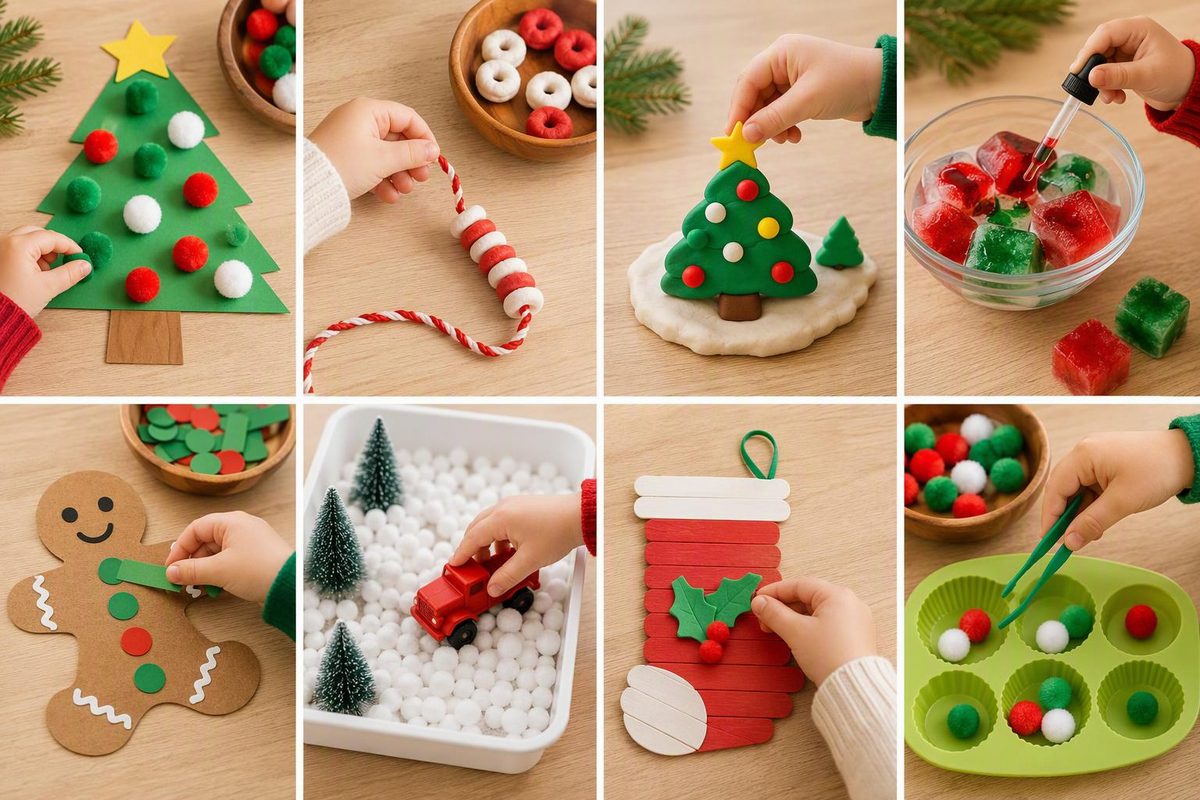
Choose one activity to begin with: tree counting for number practice, a delivery game for name matching, or Christmas freeze-and-move when you need no supplies. Each idea below includes a simpler entry point and an optional challenge. Choose by what the child is ready to try, not age alone.
Before you set out supplies
These activities use paper rather than food or decorative small parts. Leave beads, loose bells and other small embellishments out of the setup, especially when younger siblings are nearby. Follow product age labels and keep small objects away from young children, as advised in CPSC’s choking-hazard guidance.
Choose clearly labeled, non-toxic art materials intended for children, without cautionary or warning labels, and follow their directions. Supervise directly, keep food and drinks away from the art area, and wash hands afterward. “Non-toxic” does not mean edible; the CPSC Art and Craft Safety Guide cautions that even non-toxic products can be harmful when misused. Have an adult cut the paper shapes before play.
At home, use the Christmas traditions meaningful to your family. In a classroom, check family preferences and program policy before planning a shared celebration. Avoid assuming every child celebrates Christmas or receives presents.
NAEYC’s guidance on holidays distinguishes learning about families’ celebrations from asking everyone to celebrate; Christmas trees and Santa themes are not culturally neutral simply because they are presented as play. Where a shared Christmas theme does not fit, use the non-holiday versions at the end of this article.
1. Count decorations onto a paper tree
Learning opportunity: Pairing one number word with each object.
Materials and setup: Cut a large tree from paper and several palm-sized paper circles. Put three circles beside the tree to start. Leave out glue so children can move and reuse them.
Play: Invite the child to decorate the tree. Touch or move each circle once while counting together. Ask, “How many decorations did you put on?” Let the child rearrange them and count again.
- Simplify: Offer two circles and place them together, saying one number for each.
- Extend: Add one circle and ask the child to count the new total. Later, offer numeral cards to match to the collection.
Keep the circles large. If a child mouths loose pieces, remove them and count decorations drawn on the tree instead.
2. Make a repeating paper-light pattern
Learning opportunity: Noticing and continuing a repeating sequence.
Materials and setup: Draw a curved line on a sheet of paper. Cut large paper “bulbs” in two clearly different shapes, such as circles and squares.
Play: Lay out circle, square, circle, square along the line. Say the sequence aloud and ask, “What could come next?” Leave the bulbs unglued so children can change their minds. Free decorating is another way to use the same materials.
- Simplify: Sort circles and squares into two groups before trying a pattern.
- Extend: Invite the child to invent a repeating pattern and explain which part repeats.
For more choices involving paint, printing or collage, see our Christmas art activities for preschoolers.
3. Deliver Christmas cards to matching names
Learning opportunity: Matching written names and noticing letters.
Materials and setup: Write each participant’s name on a folded paper card and on a corresponding open box or basket. Use the same capitalization on both. Add matching photos if helpful.
Play: Invite the child to be the card carrier. Pick up one card, find its matching name, and deliver it. Read the name aloud together rather than expecting the child to read independently.
- Simplify: Use two destinations with photos and names.
- Extend: Cover the photos and compare letters. If two names start alike, look at the next letter together.
This is name matching, not a test. Our name activities by skill stage offer other ways to explore familiar print.
4. Open a pretend gift-wrapping station
Learning opportunity: Holding materials with one hand while manipulating them with the other, plus planning pretend play.
Materials and setup: Offer small, clean empty boxes, large sheets of paper, crayons and short pieces of tape placed on the table edge by an adult. Remove staples and sharp packaging first.
Play: Let children choose a box, draw on the wrapping paper, and experiment with folding it around the box. Ask, “Which part still needs covering?” They can give the pretend parcel to a toy or unwrap it and start again.
- Simplify: Wrap only the lid or decorate the box directly.
- Extend: Compare two sheets and predict which will cover the box.
Skip ribbon, cords and real gifts that could break.
5. Play Christmas freeze-and-move
Learning opportunity: Listening for a cue and choosing controlled movements.
Materials and setup: No supplies needed. Clear a space where children can move without bumping furniture or one another.
Play: Call an action: “March like a toy soldier,” “Stretch like a tall tree,” or “Sway like a branch.” After a few movements, say “Freeze.” Pause, then offer the next action. Keep it cooperative; nobody is out for moving after the cue.
- Simplify: Model one action and use a visible raised hand alongside “Freeze.”
- Extend: Invite a child to lead or give two actions in order: “March, then stretch.”
Offer seated arm movements and small gestures as equal ways to participate.
6. Tell a three-picture Christmas story
Learning opportunity: Describing events and putting them in sequence.
Materials and setup: Draw three simple pictures on separate cards: an empty tree, someone decorating it, and the decorated tree.
Play: Describe the pictures together. Ask, “What might happen first?” Let the child arrange them and tell a story while you listen. Write down their words if they want a story to keep. Accept imaginative versions rather than insisting on your expected order.
- Simplify: Use two pictures and offer a choice: “Before decorating or after?”
- Extend: Add a blank card so the child can draw what happens next.
Children can point, gesture or use their home language; an adult can help narrate.
7. Build a block Christmas tree
Learning opportunity: Comparing arrangements and solving building problems.
Materials and setup: Set out large, age-appropriate blocks on a stable floor or table surface. Keep the building area separate from the movement game.
Play: Ask, “How could you make a tree that is wide at the bottom and narrow at the top?” Children might build a tower, lay out a flat triangle, or create something quite different. If it falls, ask what they want to change.
- Simplify: Make a flat tree outline together instead of stacking.
- Extend: Count blocks in each row or compare two trees’ heights.
Keep towers low enough to manage safely and leave clear space around them.
8. Make a card with a child’s own message
Learning opportunity: Using drawing, marks or dictated words to communicate.
Materials and setup: Fold a sheet of paper and offer crayons. Let the child choose a recipient—a family member, friend or someone who helps them.
Play: Ask, “What would you like this person to know?” The child can draw, make marks, or dictate while you write exactly what they say. Read the message back and ask whether they want to add anything. A Christmas greeting is optional; “I like playing with you” is a complete message.
- Simplify: Offer to write while the child chooses colors or points to their drawing.
- Extend: Provide a name model if the child wants to copy a signature. Do not require it.
Use the same play without a holiday theme
For a non-holiday version, count paper shapes, make shape patterns, deliver friendly notes, wrap pretend parcels for a toy’s move, and build structures. Tell a three-picture story about building with blocks, or play freeze-and-move using animals as movement prompts. Keep the same materials and learning choices available without requiring holiday participation.