
A Week of Looking, Listening, Smelling, Tasting, and Touching
Uses familiar objects, clear questions and flexible participation instead of elaborate sensory bins, specialty supplies or mandatory tasting.
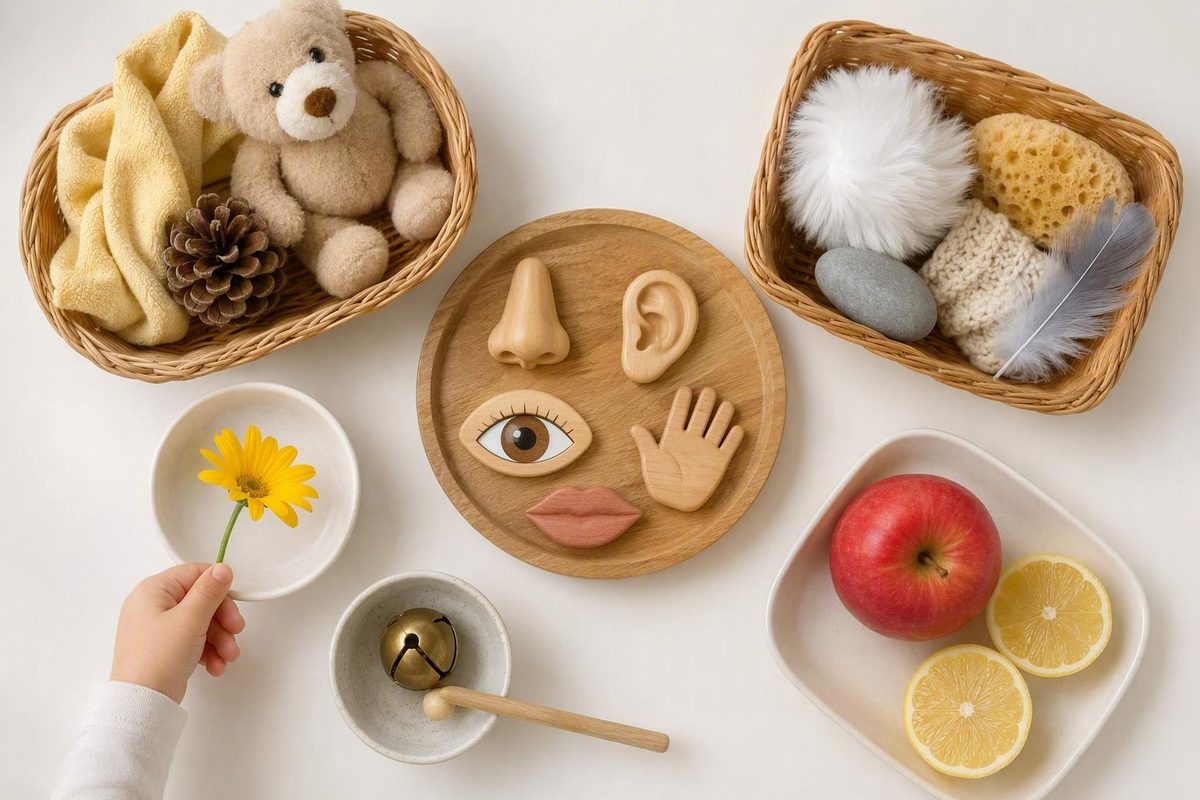
- A week of looking, listening, smelling, tasting, and touching *
A practical five senses preschool theme does not require elaborate sensory bins, specialty supplies, paid printables, or mandatory food tasting. Familiar objects, clear questions, flexible participation choices, and thoughtful adult planning are enough.
This five-day plan introduces sight, hearing, smell, taste, and touch through short investigations. Each lesson invites children to notice, compare, classify, describe, and communicate. Children may respond by speaking, dictating, drawing, pointing, signing, choosing a picture, or using AAC.
Participation is always optional and adaptable. A child may observe, decline, use a tool, choose an alternative material, or investigate through another relevant sense. Sensory exploration should never become a test of compliance.
Editorial scope: This is a classroom-planning guide informed by eleven years of pre-K teaching experience. It is not medical, feeding, allergy, occupational-therapy, or individualized accessibility advice. Adults should follow their program’s policies, product instructions, individual care plans, and guidance from caregivers or qualified professionals.
What preschoolers will explore during the week
Preschool activity resources commonly organize this theme around five familiar senses:
- Sight
- Hearing
- Smell
- Taste
- Touch
For classroom shorthand, adults often connect sight with the eyes, hearing with the ears, smell with the nose, taste with the mouth or tongue, and touch with the hands or skin. These pairings are useful introductions, but they should not imply that every person receives, processes, or communicates sensory information in the same way.
Use precise language when discussing hearing: hearing is the sense; sound is the input being heard. A child might say, “I used hearing to notice the sound of a truck.”
The unit focuses on four observable actions:
- Name or recognize a sense.
- Connect that sense with a commonly taught body part.
- Choose a useful sense for an investigation.
- Describe or compare what was noticed.
This moves the theme beyond memorizing a list. A child deciding to look at an outline, listen for a source, or touch an object through a cloth is making a purposeful observation.
Useful sentence frames
Model the same small set of phrases throughout the week:
- “I notice…”
- “It feels…”
- “I hear…”
- “These are different because…”
- “My preference is…”
These frames may be spoken, dictated to an adult, signed, selected from pictures, or produced with AAC. Accept partial responses, gestures, and descriptive word choices. A child who points to “rough” or indicates that two sounds are different is communicating an observation without needing to produce a complete spoken sentence.
The instructional intention is to provide practice with observation, comparison, classification, and descriptive language. Sorting, counting, drawing, movement, and storytelling can be added, but this plan does not claim that a short sensory unit produces particular developmental or academic gains.
A repeatable daily rhythm
The following is a publisher-created planning template, not a research-based lesson duration:
- 5 minutes: Introduce the sense, body-part shorthand, and participation choices.
- 10–15 minutes: Complete the investigation in a small group.
- 5 minutes: Share or document observations.
Shorten, divide, repeat, or extend a lesson according to the group’s interest, communication methods, transitions, and comfort in the setting.
A simple opening script can remain the same each day:
“Today we are investigating with our sense of ____. You may try the material, watch, use a tool, or choose the alternative. Different people may notice different things.”
Plan the materials, participation choices, and safety review first
Establish one rule before the unit begins:
You may observe, decline, use a tool, choose another material, or participate through a different relevant sense.
Tasting, direct smelling, touching unfamiliar materials, and covering the eyes are not required in this plan. “No thank you,” “I will watch,” and “Can I use a tool?” are appropriate classroom responses.
Complete a pre-unit planning review
Before preparing an activity, ask the staff member responsible for classroom safety to review:
- Known allergies and dietary restrictions
- Existing feeding or swallowing plans
- Documented scent sensitivities
- Individual health or care plans
- Potential ingestion or choking concerns
- Cleaning, serving, and cross-contact procedures
- Noise preferences or accommodations
- Product and material labels
- School or program rules
- Caregiver permissions or instructions
- The number of adults available
- Whether the activity can be closed when direct oversight is unavailable
This checklist identifies questions; it does not answer them or certify an activity as suitable. Obtain any permission required by the program. Follow applicable school, caregiver, professional, and product guidance rather than treating a general activity article as a safety protocol.
Skip blindfolds in the core lessons
Blindfold games appear in some preschool five-senses collections, but eye covering is not necessary for any lesson in this plan. When a visual clue needs to be concealed, use one of these options:
- Put the object in an opaque bag with a hand opening.
- Use a covered or concealed container.
- Place a screen between the child and the object.
- Invite a comfortable child to look in another direction.
- Let a partner hold or describe the object.
Review suggested sensory materials rather than copying a list
Published activity collections include materials such as water beads, coins, buttons, dry beans, cereal jewelry, plastic eggs, foods, fragrances, drink powders, shaving cream, and loose fillers. Their appearance in an activity guide does not establish that they are suitable for a particular group or setting. For example, one documented homeschool unit combines small shaker fillings, water beads, foods, blindfolds, and homemade mixtures without providing a comprehensive classroom safety protocol (Discovering Mommyhood’s five-senses unit).
None of those materials is necessary here. Simpler substitutions include:
- Large familiar objects instead of small fillers
- Pictures instead of food
- Unscented art supplies instead of fragranced products
- Quiet sounds or visual rhythm cards instead of loud instruments
- Shoe-on observation walks instead of barefoot paths
- Stable surfaces for rubbings instead of glitter or loose texture mixtures
A substitution does not automatically make an activity appropriate. It gives the responsible adult a simpler option to evaluate under the program’s existing procedures.
Use a supervision-friendly format
For a classroom group:
- Demonstrate the investigation to everyone.
- Rotate small groups through one adult-managed activity.
- Give each child a separate tray or portion when the activity calls for it.
- Keep unused materials closed and out of reach.
- Remove or close the station when the assigned adult is unavailable.
This is an editorial classroom-management recommendation, not a universal supervision standard. The responsible adult must determine the level of oversight required for the actual children, materials, and setting.
Quick planning matrix
Complete this matrix before each lesson. Use review required whenever suitability depends on the selected object, food, product, child, or setting. The matrix helps adults identify questions; it does not certify an activity as safe.
| Activity | Food | Fragrance | Small parts | Noise | Mess | Direct supervision | Proposed alternative |
|---|---|---|---|---|---|---|---|
| Outline match | No | No | Review required | Low | Low | Yes | Large-object visual tray |
| Listening walk | No | No | No | Variable | Low | Yes | Visual sound cards |
| Smell comparison | No | Yes | Review required | Low | Low | Yes | Fragrance-free picture sort |
| Mystery bag | No | No | Review required | Low | Low | Yes | Visual inspection or tool |
| Taste investigation | Yes | Variable | Review required | Low | Variable | Yes | Food photographs or pretend café |
| Orange review | Yes | Yes | Review required | Low | Variable | Yes | Large classroom object |
Adjustable challenge choices
Difficulty can change without being tied to age:
- Simpler version: Offer two highly contrasting choices and invite pointing.
- Middle version: Offer several choices and ask for one descriptor.
- More complex version: Invite a prediction, comparison, classification rule, or dictated explanation.
These are optional challenge levels, not developmental benchmarks. A child may use different levels on different days or with different communication methods.
Day 1: Sight with a hidden-object outline match
Objective: Use sight to notice and compare color, shape, size, outline, and pattern.
A traced-object matching game is a documented, low-preparation format for introducing sight: children find familiar objects and compare them with their outlines (Toddler Approved’s five-senses activity guide).
Materials
- Four to six large, familiar classroom objects
- Plain paper
- Marker or pencil
Choose sturdy objects already permitted in the classroom. The responsible adult should review their size and condition before use. Possible classroom objects include a large block, cup, toy vehicle, brush, or roll of tape.
Setup
- Place each object on a sheet of paper.
- Trace around it.
- Put the outline sheets where children can see and reach them.
- Hide or partially conceal the objects within a clearly defined search area.
For an easier comparison, select objects with very different shapes. For a greater challenge, choose related outlines or rotate some of the traced shapes.
Activity sequence
- Inspect the outlines. Ask children what they notice without revealing the objects.
- Predict. Invite them to suggest what might fit each shape.
- Search. Let each child find one object.
- Compare. Place the object on or near different outlines.
- Communicate the match. The child may explain, point, gesture, or select a descriptive word or picture.
- Look again. Notice whether the outline captures every visible feature.
An outline may show overall shape and size without showing color, pattern, material, or internal details. That difference creates a useful discussion about what visual information is available.
Prompts
- “What detail did you notice first?”
- “Which shape looks similar?”
- “Is this object larger or smaller than the outline?”
- “What changed when you looked more closely?”
- “What part fits?”
- “What part does not fit?”
- “Could another object have a similar outline?”
Avoid turning every exchange into a hunt for one adult-approved sentence. If a child notices color before shape, that is still relevant visual information.
Math extension
Sort the objects by one visible attribute:
- Color
- Shape
- Relative size
- Pattern
- Curved or straight edges
Count how many share that attribute, then ask whether the same objects could be sorted another way. An object may belong in more than one category depending on the rule.
Literacy and art extension
Invite each child to draw one object and dictate an “I notice…” sentence.
Examples:
- “I notice two circles.”
- “I notice blue stripes.”
- “I notice that the handle sticks out.”
The adult may write the child’s exact words beneath the drawing. A child can also choose from picture-supported descriptors.
No-print center alternative
Arrange several large objects on a tray. Give children time to look, then have them turn away while an adult removes one item. Ask:
- “What changed?”
- “What clue helped you?”
- “What is still in the same place?”
No printed card is required. Adjust the number of objects to change the challenge.
Differentiation
Change:
- The number of objects
- The contrast between their shapes
- How much of each object is concealed
- Whether the object can be placed directly on the outline
- Whether verbal or picture clues are available
Choose the version that supports attentive participation without making the activity either obvious or frustrating.
Informal learning indicator: The child uses visual information to find, match, compare, or describe an object.
Day 2: Hearing with a listening walk
Objective: Listen for sounds, identify possible sources, and compare sounds using words such as loud, quiet, near, far, long, and short.
A listening walk appears across preschool activity resources as a hearing investigation that does not depend on complicated equipment (Pocket of Preschool’s collection of five-senses activities).
Materials
- Paper or a clipboard for adult notes
- Writing tool
- Optional homemade picture cards showing familiar sound sources
A printable is not required. Draw quick symbols, use available photographs, or simply record children’s comments.
Prepare the walk
Choose a short, familiar route and establish a clear walking boundary. Identify places where the group can pause without obstructing a walkway. Consider whether the likely volume and activity level fit the group’s existing plans and program procedures.
Tell children:
“We are using hearing to notice sounds. You may listen, watch the group, use a visual card, or move with an adult to the alternative location.”
Activity sequence
- Pause at the first indoor or outdoor location.
- Listen briefly.
- Invite children to name, point to, draw, sign, or select a picture for what they heard.
- Ask where the sound might have come from.
- Move to another location and compare.
Keep listening periods brief and flexible. Prolonged silence or stillness is not required. A few attentive moments may be enough to generate an observation.
Use tentative language when the source cannot be seen: “It might be a cart,” rather than “That is definitely a cart.” The goal is to use auditory clues, not to reward confident guessing.
Prompts
- “What did you hear?”
- “Where might it have come from?”
- “Was it near or far?”
- “Was it loud or quiet for you?”
- “Did it stay the same?”
- “Was it long or short?”
- “How were these two sounds different?”
Different listeners may attend to different sounds. One child may notice an air vent while another notices footsteps.
Math extension
Create broad categories:
- People
- Nature
- Vehicles
- Classroom or building objects
Tally each observation with a mark. If the source is uncertain, place it under “not sure” or in two possible categories. This keeps the tally focused on organizing observations rather than grading guesses.
Movement extension
Produce or play two contrasting tempos at a volume permitted by the setting. Children may move quickly for one and slowly for the other. They can also follow visual rhythm cards instead of listening.
Watching is a complete participation option. A child can observe peers, follow the adult’s movement cue, or hold up a matching “fast” or “slow” card.
Low-noise alternative
If a walk or music activity is unsuitable:
- Present a few quiet sounds at the program’s usual classroom volume.
- Use visual cards showing a long or short rhythm.
- Tap a visible pattern on a table.
- Use an approved device or instrument to demonstrate a gentle vibration.
- Have one person make a quiet sound while others indicate when it starts and stops.
Avoid surprise noises and competitive “Who can be quietest?” framing.
Some activity guides suggest sealed sound containers filled with loose objects. If a program chooses that extension, the responsible adult should review the container, contents, construction, storage, and supervision under the program’s normal material-selection procedures. The listening walk remains the core lesson and needs no loose filler.
Informal learning indicator: The child attends to a sound and communicates something about its possible source or quality through speech, pictures, gestures, signs, or another available mode.
Day 3: Smell with covered scent containers—or a fragrance-free alternative
Objective: Recognize smell as information received through the nose and compare approved odors as the same, different, strong, mild, familiar, or unfamiliar.
Before preparing scent materials, consult the program’s fragrance policy, individual care plans, caregiver instructions, and designated staff. Do not introduce essential oils, concentrated fragrance products, sprays, or an unreviewed food simply because it appears in an activity guide.
Covered scent containers and picture matching are documented preschool activity formats, but published examples vary widely and do not establish universal suitability (Pocket of Preschool’s five-senses activity presentation).
Scent-permitted version
Use this version only if scent activities are permitted for the group. Select a small number of source materials that:
- Are already allowed in the setting
- Have been reviewed by the responsible adult
- Can remain covered
- Do not need to be sprayed, heated, mixed, or concentrated
- Are familiar to the adult preparing the activity
- Can be removed and sealed promptly
Use covered containers that prevent direct handling while allowing a willing child to notice an odor from a comfortable distance. The adult, rather than the child, should manage the containers and present them one at a time.
If children are matching a scent to a possible source, offer two or three simple picture choices.
Activity sequence
- Review the choices: smell, watch, or skip.
- Show the covered container without naming its contents.
- Present it at a distance selected by the willing child and supervising adult.
- Ask for a comparison rather than demanding identification.
- Present a second approved sample.
- Match samples, pictures, or descriptive words if appropriate.
- Close and remove the materials.
The aim is to compare information, not to test endurance or require a correct guess.
Neutral prompts
- “Do these seem the same or different?”
- “Does this remind you of anything?”
- “Would you like to smell it, watch, or skip it?”
- “Does it seem strong or mild to you?”
- “How can we describe it without calling a preference correct or incorrect?”
Avoid requiring “yummy” or “yucky.” Those words combine description with preference and can make one response sound like the group’s correct answer. Children may describe or prefer the same input differently.
Fragrance-free lesson
Try one of these:
- Match pictures of familiar objects to places where smells may originate.
- Sort picture examples into “may have a smell” and “not sure.”
- Discuss situations in which the nose can provide a clue.
- Match a pictured object, such as a flower or bar of soap, to a pictured setting.
- Read a familiar story and identify moments when a character might use smell.
Say clearly:
“We are learning about smell through pictures today. We are not directly smelling these objects.”
Literacy extension
Create picture vocabulary for:
- Same
- Different
- Strong
- Mild
- Familiar
- Unfamiliar
- Prefer
- Not sure
Record dictated sentences such as:
- “These seem different.”
- “This reminds me of a garden.”
- “My preference is to watch.”
- “I am not sure what it might be.”
Math extension
If a scent activity was approved, graph voluntary responses using neutral choices:
- Prefer sample A
- Prefer sample B
- No preference
- Chose not to smell
Do not announce a “winning” scent or imply that the largest group is correct. The graph records individual responses.
Scented markers, drink powders, extracts, spices, fragranced dough, and lotions appear in published sensory activity collections. They are not default materials in this plan; any proposed product must go through the setting’s normal review process.
Informal learning indicator: The child identifies the nose as associated with smell or communicates a comparison between approved samples. A fragrance-free participant may demonstrate the concept through picture matching or discussion.
Day 4: Touch with a no-blindfold mystery bag
Objective: Use touch to compare texture, shape, hardness, and mild temperature differences approved for the setting.
Concealed-object touch games are a documented preschool format: children feel an object, describe its texture, and may guess what it is. This version removes the blindfold and keeps the bag with an adult (Toddler Approved’s touch activity).
Materials
- Opaque cloth bag or paper sack
- Several large, familiar objects with contrasting properties
Possible contrasts include:
- Smooth and rough
- Hard and soft
- Bumpy and even
- Fluffy and firm
- Rounded and edged
Use familiar classroom materials that have been reviewed under the setting’s normal procedures. This plan does not use hot, frozen, sharp, damaged, breakable, toxic, or intentionally mouthable objects.
Setup and supervision
Inspect each object immediately before the activity and keep the bag with the supervising adult. Put one object in the bag at a time when possible. This makes the sequence predictable and allows the adult to verify what the child will encounter.
Activity sequence
- Show the bag and explain that it hides the visual clue.
- Offer choices: reach in, touch with one finger, use a tool or barrier, watch, or pass.
- Let the child feel one object without covering the eyes.
- Invite one or more descriptive words.
- Offer an optional guess.
- Reveal the object.
- Compare the tactile prediction with what is visible.
Guessing correctly is not the goal. A child who says “hard with edges” has made a relevant observation even if the object’s identity remains unknown.
Prompts
- “What do you notice with your hand?”
- “Is it hard or soft?”
- “Does it have edges?”
- “Does it feel smooth, rough, bumpy, or something else?”
- “What clue helped you?”
- “How is it different from the last object?”
- “Would another word also fit?”
Do not reject a personal description simply because an adult would choose another term. Ask the child to indicate the feature that led to the word.
Participation alternatives
A child may:
- Touch with one finger
- Use tongs
- Touch through a clean cloth barrier
- Inspect the object visually while another person describes it
- Point to a texture card
- Ask an adult to demonstrate
- Decline direct contact
These are editorial participation options, not specialized interventions. Follow any individualized plan already in place.
Math extension
Sort the objects by one tactile property, then discuss objects that could belong to more than one group.
For example, an item might be both hard and smooth. Ask:
- “Where could we put it?”
- “Could it fit in both groups?”
- “What rule are we using now?”
Change the rule and sort again.
Art extension
Make texture rubbings from stable, clean surfaces approved for classroom use. Place paper over a textured surface and rub with an unwrapped crayon held sideways. Use fixed or adult-held surfaces rather than loose fillers, glitter, or fragranced mixtures.
Compare the visible pattern with the texture:
- “This surface felt bumpy. What does the rubbing show?”
- “Which lines look close together?”
- “How are these two rubbings different?”
Informal learning indicator: The child uses touch, a tool, visual information, or another accepted method to communicate at least one property or comparison.
Day 5: Taste as an optional, policy-dependent investigation
Objective: Understand taste as information associated with the mouth or tongue and learn descriptive categories commonly used in preschool activities: sweet, sour, salty, and bitter. Savory may be introduced as an optional additional term because preschool activity resources do not classify taste categories consistently.
Taste comparisons are a documented preschool activity format, but published food examples should be treated as illustrations—not as recommendations for every child or classroom. One activity guide, for example, organizes foods into several taste categories and records preferences without providing a universal safety standard.
Make the program decision first
Direct tasting belongs in this plan only when the program permits it. Before choosing that version, the responsible adult should consult:
- Program food-service and classroom policies
- Known allergies and dietary restrictions
- Existing feeding or swallowing plans
- Individual care plans
- Caregiver permissions or instructions
- The setting’s cleaning, serving, and cross-contact procedures
- Its process for selecting portions, utensils, and preparation methods
- Its supervision requirements
This article cannot determine whether a food, portion, preparation method, or tasting activity is appropriate for a particular child. Refer those decisions to the people and policies responsible for the child’s care.
No child should be pressured to taste, chew, swallow, close the eyes, or explain a refusal. Looking, passing, or completing the no-food activity are valid forms of participation.
Approved tasting version
Use separate child portions of familiar foods selected through the program’s established process. This plan intentionally provides no universal food list because a classroom article cannot identify one food as suitable for every child or setting.
Prepare and serve only what has been approved. Follow the setting’s procedures for hands, surfaces, utensils, portions, serving, cleanup, storage, and cross-contact.
Activity sequence
- Look first. Notice color, shape, surface, or packaging information.
- Predict. Choose a possible taste word or “I don’t know yet.”
- Offer choices. Taste, look, or pass; include smell only if that has also been approved.
- Optionally taste. A willing child samples the portion according to the setting’s procedures.
- Communicate. Select a descriptive word, make a gesture, dictate a comment, or state a preference.
- Compare carefully. Discuss how two people can have different preferences.
Observation and preference are not the same. “Salty” attempts to describe a property; “I like it” expresses a preference. Both may be recorded, but neither should be forced.
Prompts
- “What do you notice before tasting?”
- “Would you like to taste, look, or pass?”
- “Which word might describe it?”
- “Would ‘I don’t know yet’ fit?”
- “Can two people have different preferences?”
- “What could you say instead of ‘everyone likes this’?”
Avoid praise that rewards eating over other forms of participation.
Fully no-food version
Use:
- Food photographs
- Empty, clean packaging permitted by the setting
- A pretend café
- Picture menus
- Teacher-labeled taste-category cards
- A grocery-store dramatic-play area
Children can match familiar foods to taste words based on previous experience, sort pictures, take pretend orders, or explain that they do not know how an unfamiliar item tastes.
Be honest about the limitation: this teaches taste vocabulary and the concept of taste, but it does not create a direct tasting observation.
Math extension
Graph voluntary responses:
- Prefer this
- Prefer another
- No preference
- Did not taste
- I don’t know yet
Alternatively, sort pictures into teacher-labeled taste categories. Keep an “I don’t know yet” category so children are not required to guess.
Literacy extension
Create a class page of dictated taste words and preference statements:
- “I think it may be sour.”
- “My preference is not to taste.”
- “I have tried this before.”
- “I don’t know yet.”
- “We chose different words.”
Do not edit the page to make children’s responses agree.
Informal learning indicator: The child associates taste with the mouth or tongue and chooses, communicates, or recognizes a relevant descriptive word or example. Actual eating is not an assessment requirement.
Finish with an all-senses investigation and an informal checklist
An orange is a documented culminating object in a published preschool five-senses plan (Preschool Packets’ five-day senses plan).
Using an orange does not make the activity automatically appropriate. Apply the same program review used for the taste and smell lessons, including applicable food policies, individual plans, caregiver instructions, preparation procedures, and supervision requirements.
Orange investigation
Prepare one whole orange for adult demonstration. Provide individual handling or tasting portions only if those options have been approved through the setting’s normal process.
Sequence the investigation:
- Look: Observe the whole orange’s color, shape, size, and surface.
- Listen: Listen as the responsible adult gently handles or peels it. Quiet observations count.
- Smell: Offer this only when scent participation is permitted and the child chooses it.
- Touch: Allow direct contact, a tool, a barrier, or visual observation.
- Taste: Make tasting completely optional and follow the program’s approved food procedures.
Chart observations by sense. If an observation could fit more than one category, discuss the reasoning instead of insisting on one placement.
Capstone prompts
- “What do you notice?”
- “What changed after the peel came off?”
- “Which sense gave you that clue?”
- “Did your prediction change?”
- “What could you draw or dictate to remember?”
- “Which observation could another person describe differently?”
- “Which participation choice did you use?”
Children might notice that appearance, texture, or smell changes when the peel is removed. They may also decide that a previous prediction no longer fits.
Food-free capstone
Use one large, familiar flower, pinecone, classroom tool, toy, or other object already permitted in the setting.
Not every object meaningfully involves all five senses. Record only relevant observations. Do not pretend to taste a pinecone, smell an odorless block, or force a sound from an object simply to fill five boxes.
Instead, ask:
- “Which senses are useful for this object?”
- “Which sense would not be appropriate?”
- “Could we use a tool?”
- “What information can sight give us that touch cannot?”
- “What information is still unknown?”
Recognizing that a sense is irrelevant or unsuitable is part of choosing an appropriate observation method.
Document learning without worksheets
Use any combination of:
- Photographs permitted by program policy
- Child drawings
- Dictated comments
- Sorting records
- Brief teacher notes
- A group chart
- Picture or word choices saved from the activity
- A child’s recorded prediction and later revision
A brief note can capture the sense used, the observation communicated, and the support or alternative selected:
“Used sight to match the brush to its outline. Pointed to ‘long’ and dictated, ‘The handle fits.’”
That is more informative for this unit than recording only whether the child guessed an object’s name.
Informal observation checklist
This checklist is an editorial classroom documentation tool. It is not a validated assessment, screening instrument, diagnostic tool, professional evaluation, or developmental benchmark.
| Observation | Not yet observed | Observed with support | Observed |
|---|---|---|---|
| Names or recognizes one or more senses | |||
| Associates a sense with a commonly taught body part | |||
| Chooses a relevant sense for a task | |||
| Uses or selects a descriptive comparison |
“Observed with support” might include pointing to a picture after an adult offers two choices, using an AAC selection, copying a modeled sign, or completing a comparison with a sentence frame. Note the communication mode rather than treating spoken language as the only evidence of understanding.
Adult reflection box
After the unit, record:
- Which materials invited participation?
- Which materials created discomfort or barriers?
- Which alternatives did children select?
- Were some children more comfortable in individual or small-group investigations?
- Which prompts produced specific observations?
- Did any activity rely too heavily on guessing?
- Which materials should be removed or replaced?
- What should change before the unit is repeated?
Different observations and preferences can coexist. The purpose is to notice and communicate—not to make every child touch the same object, use the same word, or arrive at an identical answer.
Frequently asked questions
Should a five senses preschool theme last one week or longer?
Either structure can work. Some preschool plans assign one sense to each day, while other activity guides suggest spending several days or a week on each sense (Preschool Plan It’s extended five-senses theme).
Use one week when children need a concise introduction or when the theme must fit between other units. Extend it when children remain interested, need more time with the vocabulary, or would benefit from repeating activities in smaller groups.
There is no need to complete every extension. A well-paced short unit is more useful than a longer one padded with unnecessary materials.
Can I teach taste without serving food?
Yes. Use food photographs, approved empty packaging, picture menus, a pretend café, or teacher-labeled taste categories. Children can connect taste with the mouth or tongue, discuss familiar examples, sort pictures, and use words such as sweet, sour, salty, and bitter.
Eating is not required as proof of learning.
Do children need to wear blindfolds for five-senses activities?
No. Use an opaque bag, covered container, screen, or concealed object. A child may also look away voluntarily if comfortable, but eye covering is unnecessary.
These alternatives remove a visual clue while allowing the child to stay oriented and end participation immediately.
What should I do if a child does not want to touch, smell, hear, or taste something?
Accept the refusal without requiring an explanation. Depending on the activity, offer choices such as:
- Watch from a comfortable location
- Use a tool or barrier
- Choose a picture
- Investigate through another relevant sense
- Move with an adult to the planned alternative
- Select another material
- Pass entirely
Do not repeatedly re-offer the same input after the child has declined. Record what the child communicated through the alternative rather than describing the refusal as noncompliance.
These participation choices are practical editorial suggestions, not substitutes for an individualized plan. Follow the child’s existing plan and consult the appropriate caregivers, staff members, or qualified professionals when required.
How can I assess a five-senses theme without worksheets?
Use drawings, dictated comments, photographs allowed by policy, sorting records, group charts, and short teacher notes. Look for whether the child:
- Recognizes a sense
- Connects it with a commonly taught body part
- Selects a relevant sense for a task
- Communicates a property or comparison
Document speech, gestures, signs, picture selections, and AAC as communication. Treat the checklist as an informal record of what occurred during these activities—not as a test, diagnosis, or age-based benchmark.
Children do not need elaborate sensory supplies or mandatory tasting to explore how they gather information. A familiar object, a few precise questions, flexible ways to participate, and careful adult planning can support a complete week of looking, listening, smelling, tasting when appropriate, touching, comparing, and communicating observations.