
A Realistic Guide to Coloring Fabric with Beets
Editorial note: This guide distinguishes peer-reviewed textile research from informal craft experiments. It offers a conservative activity framework, not a toxicology assessment or a guarantee of colorfastness.
The short answer: beetroot colors fabric, but usually does not dye it permanently
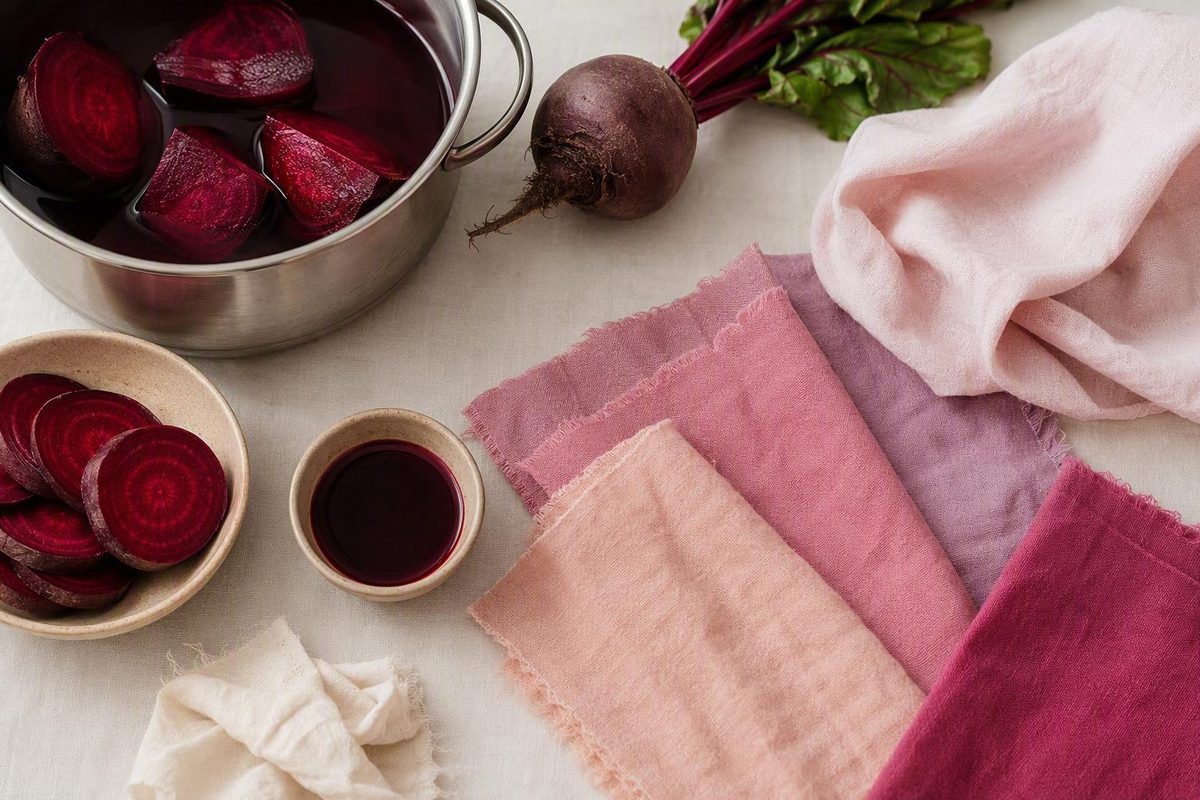
Beetroot can give fabric an immediate pink, magenta, or red color. An ordinary home beet bath, however, should be treated as a temporary or experimental coloring process—not as a reliable way to make permanently dyed cloth.
The first result may be pink, magenta, red, orange, beige-brown, or somewhere between those shades. Fiber type, beet concentration, water quantity, pH, temperature, extraction method, soaking time, rinsing, and drying can all affect the outcome.
It is important to distinguish color uptake from colorfastness. A wet, unrinsed swatch may look dramatically saturated because beet liquid is present in and around the fibers. That does not show that the pigment will remain after loose color is rinsed away.
Two forms of durability matter:
Craft instructions and practitioner reports commonly warn that beet color fades during rinsing or later use. Vermont Harvest of the Month describes beet color on fabric as temporary and likely to fade over time, but that observation does not establish one universal lifespan or a fixed number of washes (Vermont Harvest of the Month’s beet-dye overview).
Use this quick guide before choosing beetroot:
| Your goal | Is beetroot a sensible choice? |
|---|---|
| Temporary cotton craft | Yes |
| Color-change demonstration | Yes |
| Experimental test swatch | Yes |
| Display item that will rarely be washed | Possibly |
| Everyday clothing | Usually no |
| Yarn for a long-term project | Usually no |
| Keepsake expected to retain its original shade | No |
| Predictable, repeatable textile color | Choose a more established dye |
For a preschool activity, use a conservative division of roles: an adult prepares the beet liquid and controls the cutting, heating, blending, straining, and appliances. Children participate only at a protected activity table after the strained liquid has cooled completely. This is an activity rule, not a finding that beet dye is harmless in every classroom or exposure context.
Why beetroot gives strong color at first—and why that color changes
Beetroot contains pigments called betalains. They include red-violet betacyanins and yellow-orange betaxanthins.
The central problem is that visible uptake and pigment stability are different. Fabric may absorb enough beet liquid to look intensely colored while wet, yet the pigments can remain vulnerable to rinsing, laundering, light, heat, changes in acidity, and storage.
Peer-reviewed research on wool reports that untreated betalains have little inherent affinity for textiles. Researchers achieved more intense reds by modifying the beet pigments or the wool under controlled conditions, particularly acidic ones. The same research identifies pH, light, temperature, time, and enzymatic changes as relevant to betalain color and stability (research on beetroot betalains and wool).
That creates at least two possible routes to fading:
- Poor attachment: loosely held pigment leaves the fabric during rinsing or washing.
- Pigment degradation: pigment associated with the fabric changes chemically because of light, heat, pH, time, or other conditions.
A mordant or another process adjustment might improve initial uptake without fully solving pigment degradation. A stronger first shade is therefore not automatically a more durable one.
Informal trials illustrate the possible color range but cannot isolate its causes. In one personal wool experiment, a heated method produced orange while a cold-soak method produced baby pink. The trials also differed in beet preparation, beet quantity, fiber weight, and processing time, so they do not prove that heat alone causes orange or that cold extraction guarantees pink (hot and cold beetroot wool experiment).
Stored dye may change too. In an informal cellulose-fabric experiment, beet liquid kept for a day or two changed tone, and one batch became brown. The creator could not determine the cause, making this a reason to document storage conditions rather than evidence for a particular browning mechanism (cellulose color-retention experiment).
Why some beetroot dye studies sound more optimistic
“Beetroot dye works” can refer to very different systems:
- household cotton soaked in cooked beet liquid;
- alum-treated wool in an acidic bath;
- chemically functionalized wool;
- laboratory-dyed nylon 6 with controlled pH, temperature, concentration, time, and mordants.
Those systems are not interchangeable.
A 2024 nylon 6 study varied temperature, time, concentration, acidity, and mordants. It reported favorable fastness under optimized acidic conditions using selected natural mordants, including pomegranate peel, walnut husk, pistachio hull, and Terminalia chebula. The available summary does not provide all underlying grades, standards, sample details, or statistical results, so the findings should be interpreted narrowly (2024 nylon 6 beetroot-dye study).
That research is promising for the tested nylon 6 system. It does not show that a bowl of beet juice will produce a washfast cotton shirt, linen napkin, or wool skein at home.
Choose the fabric and define the goal before starting
Decide first whether your priority is the experiment or the finished shade. If an item must remain pink, beetroot is risky. If observing uptake, rinsing, and fading is part of the activity, its instability can become useful rather than disappointing.
Always begin with a small swatch from the same fabric as the intended project. A label saying “natural fabric” is not specific enough; check the actual fiber composition.
| Fiber | Documented process | Likely initial appearance | Durability evidence | Confidence level |
|---|---|---|---|---|
| Cotton | Prewashed cotton saturated with cooled beet liquid and rested before rinsing | Pink to magenta before rinsing; usually paler afterward | Instructional evidence anticipates fading during rinsing; no standardized fastness data | Moderate for temporary color; low for durability |
| Linen | Prewashed white linen treated and soaked in beet dye | Pink or muted red may be possible | One tutorial covers cotton or linen but does not establish equivalent performance | Low |
| Cellulose fabrics generally | Aluminum acetate and tannin pretreatment followed by beet dye | Initial pink, with much less color after rinsing in one experiment | Most color rinsed out in an informal test that cannot represent every cellulose process | Low to moderate as a caution |
| Wool | Alum-treated, acidic, heated, cold-soaked, or functionally modified systems | Pink, red, or orange; controlled systems can be intense | Research supports stronger uptake under specific treatments, while practitioner reports raise lightfastness concerns | Moderate for uptake; low to moderate for home-use durability |
| Nylon 6 | Controlled acidic laboratory process with selected mordants | Strong color under optimized conditions | Favorable fastness was reported for the tested system | Moderate for that system; very low for generalization |
Cotton
Prewashed white cotton is the clearest material for the simple temporary method in this guide. It offers a plain surface, is easy to divide into test swatches, and is the fabric specified by the documented tie-dye workflow. Expect it to lighten as loose color is rinsed away.
Do not compare the finished result with a commercial fiber-reactive dye. The documented beet process warns that its color fades during rinsing and will not be as bold as commercial dye.
Linen and other cellulose fibers
An instructional method may name both white cotton and linen, but that does not prove that the fibers retain equal amounts of pigment or fade at the same rate. Treat linen as a separate experiment before committing napkins, clothing, or household textiles.
One informal test pretreated cellulose fabric with aluminum acetate and avocado-derived tannin before applying beet dye. Most of the color left during rinsing, although one sample retained some pink. The fabric composition, quantities, pH, temperatures, and treatment times were not fully documented, so the result cannot stand for every cellulose method. It does show why an attractive unrinsed swatch should not be mistaken for a washfast one.
Wool
Controlled acidic treatment or functionalization can produce visible and sometimes intense red. Informal home experiments have also produced orange and pale pink.
Good uptake does not settle the lightfastness question. One practitioner used alum, a large quantity of beetroot, controlled heating, acidification, and overnight cooling to produce saturated wool. An anecdotal follow-up associated with that method reported poor lightfastness after exposure, but no standardized test was supplied (experimental beetroot method for wool).
Treat beet-dyed wool as experimental unless matched wash and light comparisons show that it meets the needs of your project.
Nylon 6
The tested process used controlled variables and specific mordants. Its findings should not be transferred to another synthetic fiber—or to cotton, linen, silk, or wool.
How to make beetroot dye for a temporary cotton craft
This is an adult-prepared method for a temporary cotton craft, not a recipe for permanent clothing.
The documented workflow specifies 1 pound of beets, described as about three large beets; prewashed white 100% cotton; beet pieces roughly 1 inch across; water reaching about 2 inches above the beets; and a sealed resting period overnight or for up to 24 hours (Newfields’ beet tie-dye method).
Materials
- The specified quantity of beets
- Water
- A medium pot
- A cutting board and knife
- A blender
- A fine-mesh strainer
- A large bowl
- Gloves
- Prewashed white cotton swatches, socks, or another low-stakes item
- Rubber bands, if making tied patterns
- Squeeze bottles or a ladle
- One sealable bag per item
- Protective coverings for the work area
Use equipment suitable for a staining craft process. Keep food preparation and craft use appropriately separated according to the practices of your home or setting.
1. Prewash the cotton
Wash and dry the cotton before dyeing. The documented method does this to remove impurities or fabric enhancers that could interfere with wetting or color uptake.
Begin with an expendable swatch rather than a valuable garment. If comparing several methods, cut the swatches from the same piece of cloth and prewash them together.
2. Cut and cover the beets
An adult should cut the beets to the documented approximate size, place them in the pot, and add water to the specified level above them.
Rather than correcting this with an untested formula, record approximately how much water you used.
3. Heat until the pieces soften and lighten
Bring the pot to a boil, then reduce the heat to a simmer. Continue until the beet pieces become lighter red and can be pierced easily with a fork.
Do not invent a fixed cooking time. The source supplies visual and texture cues instead, and timing can vary with the pot, piece size, beet condition, and heat level.
4. Cool, blend, and strain
Allow the mixture to cool to room temperature. Following the appliance manufacturer’s directions, blend the cooked beets with their liquid into a slurry.
Place the fine-mesh strainer over a large bowl. Pour in the slurry and press it to collect as much liquid as practical. Because blending and transferring beet slurry can create splashes, keep this stage adult-controlled and protect nearby surfaces.
5. Fold or tie the fabric
Fold, twist, or bunch the prewashed cotton. Add rubber bands if you want resisted areas.
Leave at least one swatch unfolded if you want to evaluate the color without a pattern obscuring it. Label the pieces before dyeing when comparing different soaking or finishing conditions.
6. Saturate with cooled dye
Apply the fully cooled, strained liquid with a squeeze bottle or ladle, or immerse the item in a bowl. Work the liquid through the cotton so that dry folds remain only where they are part of the intended design.
Freshly saturated fabric will probably look much darker than the finished piece. Use the color after rinsing and drying—not the wet color—as your practical baseline.
7. Seal and rest
Place each saturated item in a separate sealable bag and leave it at room temperature for the documented resting period.
Extended contact may deepen the immediate appearance. It should not be interpreted as proof of improved washfastness or lightfastness.
8. Rinse separately
Remove the fabric and rinse it separately until the water runs clear. Expect noticeable lightening as loose beet liquid leaves the fibers.
Protect the sink, tub, clothing, and surrounding surfaces. Do not combine the first rinse with ordinary laundry.
9. Air-dry
Air-dry the item, then compare it with photographs taken while wet. The dry shade may appear softer or less saturated.
The source follows air-drying with a full high-heat dryer cycle, but it provides no controlled comparison showing that dryer heat makes beet pigment durable. If you copy that step, treat it only as part of the tutorial. Newfields also warns that beet and turmeric can stain hands, clothing, tubs, dryers, and other surfaces, so consider the possibility of transferable color before using an appliance (Newfields’ staining and finishing cautions).
Do not add an improvised mordant recipe to this beginner activity. A temporary result is the expected outcome, not a failed version of the project.
Adapt the activity for preschool without putting children near the hot process
A preschool version should be framed as a conservatively managed, adult-prepared color investigation. The available evidence does not establish preschool-specific toxicology for beet craft dye or metal mordants, so this section does not declare the activity universally safe. Educators must apply their own setting’s supervision, allergy, hygiene, and activity policies.
Adult-only preparation
For this version, make the following non-negotiable activity rules:
- Adults control the knife and cutting board.
- Adults control the stovetop, pot, and heated liquid.
- Adults operate the blender and strain the slurry.
- Adults transfer concentrated dye into activity containers.
- Adults control any dryer, iron, or other appliance.
- Adults manage additives, cleanup, and disposal.
Prepare the liquid before the session, strain it, portion it into suitable containers, and allow it to cool completely before it reaches the activity table. Keep the preparation area separate from children.
Do not include alum, aluminum acetate, iron, or other metal mordants in the child-led portion. The supplied evidence does not provide preschool-specific exposure, handling, or disposal guidance for those materials. “Natural” is not enough to establish suitability for unrestricted classroom use.
Set up a low-stakes activity
Use small pieces of prewashed white cotton instead of children’s clothing or an important keepsake. The color may change during rinsing, drying, display, or later washing, so choose a project that remains worthwhile if the pink fades.
Protect tables and nearby floors. Use smocks or stain-tolerant clothing and make gloves available. Beet liquid is known to mark hands, cutting boards, clothing, tubs, and other surfaces even though its color may later fade from fabric.
Possible tools for cooled, adult-portioned dye include:
- small squeeze bottles;
- droppers;
- shallow bowls;
- spoons or ladles.
These are planning options, not evidence-tested developmental tools. Choose them according to the children, the setting, and the supervision available.
Turn fading into the investigation
Instead of promising permanent pink cloth, invite children to observe change:
- What color do you predict the white cotton will become?
- Does the wet fabric look pink, red, purple, or another color?
- Which areas received the most liquid?
- What changed after the fabric dried?
- What changed after an adult rinsed one sample?
- Does a displayed sample look different later from one kept in a dark folder?
Younger preschoolers can choose a fold or apply cooled color with close supervision. Older preschoolers can help label swatches, compare light and dark areas, and dictate observations for an adult to record.
Do not present them as guarantees of a specific developmental outcome.
Treat all dye and equipment as craft materials. As a conservative classroom rule, prevent drinking, tasting, and mouthing; keep containers clearly distinct from drinking vessels; and follow the individual allergy and supervision procedures of your setting. These restrictions do not amount to a general toxicological assessment.
Mordants, vinegar, salt, and heat: what the evidence actually shows
A mordant is a treatment intended to help create a connection among the fiber, dye, or both. Better attachment may improve uptake or retention in some dye systems. It does not necessarily prevent an unstable pigment from changing when exposed to light, heat, oxygen, or time.
Craft tutorials recommend vinegar, salt, alum, tannins, long soaking, ironing, or dryer heat. The available home-craft evidence does not prove that any one of these treatments universally makes beetroot colorfast.
| Claim | What the evidence supports | Practical conclusion |
|---|---|---|
| Vinegar makes beet dye permanent | Acidity can affect shade and fiber-pigment interactions, but home tutorials do not provide controlled proof of permanence | Treat vinegar as a process variable, not a guarantee |
| Salt fixes beet dye | Some tutorials recommend salt, but they do not supply controlled beet-fabric comparisons | Do not promise improved durability |
| Alum solves fading | Alum appears in wool and natural-fiber methods, yet anecdotal lightfastness remains poor or uncertain | It may alter uptake or shade without resolving instability |
| Tannin fixes beet on cellulose | One aluminum-acetate-and-tannin experiment lost most of its apparent color during rinsing | The test is not universal, but it supports caution |
| Long soaking locks in color | Longer soaking may deepen the immediate appearance | A darker wet result does not prove better fastness |
| Ironing sets beet dye | Some instructions include ironing without a controlled durability comparison | Treat it as an unproven finishing step |
| Dryer heat sets beet dye | One cotton tutorial includes high dryer heat but no comparative fastness test | Do not rely on it to create permanence |
| Sunlight sets the color | Some craft instructions use hot sun for drying, while betalain research identifies light as a stability concern | Do not treat sunlight as a presumed fixative |
Vinegar and salt
One cotton-and-linen tutorial recommends a vinegar pretreatment and offers salt water as an alternative while also acknowledging that natural beet color is less colorfast than store-bought dye (beet-dye tutorial for cotton and linen).
There is a reason acidity may change the result: pH affects betalain color and interactions with some fibers. Controlled wool research produced more intense red under acidic functionalization. But greater intensity is not the same as long-term washfastness or lightfastness.
Without matched samples, you cannot know whether vinegar changed attachment, altered the shade, or merely coincided with a stronger first result. Salt should be treated just as cautiously: a tutorial recommendation is not a measured comparison.
Alum and tannin
Practitioners use alum in experimental beet dyeing on wool, sometimes with acidification and extended heating. Such processes can produce visible color, but practitioner observations still include uncertain or poor resistance to light.
The informal cellulose experiment using aluminum acetate and avocado-derived tannin is instructive because it included a rinse. Most of the apparent beet color left the fabric. That result does not prove that all tannin and aluminum acetate processes fail, but it shows why familiar mordanting steps do not justify assuming success.
Specialized bio-mordants on nylon 6
The nylon 6 research should be taken seriously but narrowly. It reported favorable fastness with specific natural mordants under optimized acidic conditions. The supplied summary does not include all detailed test values or methods needed to evaluate every reported result independently.
The study therefore supports the possibility that beet pigments can perform better in a carefully engineered fiber-and-process system. It does not provide a universal kitchen recipe.
Soaking and heat
A longer soak may increase the amount of colored liquid present before rinsing and deepen the immediate appearance. Without later wash and light comparisons, that says little about lifespan.
The same caution applies to ironing, hot dryers, and drying in strong sunlight. Their inclusion in a tutorial is not controlled evidence that they prevent later fading. Because heat and light are themselves relevant to betalain stability, more heat or sunlight should not automatically be considered better.
Test the result instead of guessing how long it will last
There is no defensible universal answer to “How long does beetroot dye last?” Available instructions vary in fiber, beet quantity, water level, extraction, temperature, acidity, mordant, soaking, rinsing, and finishing. Most craft accounts do not use standardized washfastness or lightfastness tests.
You can still conduct a useful household comparison.
Prepare three matching swatches
Cut at least three equal swatches from the same fabric. Prewash them together, dye them in the same bath, and rinse and dry them in the same way.
Label them:
- Control: stored dry and away from light.
- Light: exposed to an ordinary, consistent light condition.
- Wash: reserved for separate washing.
A fourth swatch can serve as an untouched backup.
Create a consistent visual record
Photograph all swatches immediately after they dry. Keep the following as consistent as practical:
- location;
- lighting;
- background;
- camera;
- distance;
- fabric orientation;
- camera settings, where possible.
Repeat the photographs at consistent checkpoints.
Compare light exposure
Keep the control in a closed, labeled envelope or box. Place the light swatch where it receives a consistent amount of ordinary indirect light.
This is not a formal lightfastness test. It is a household comparison intended to reveal whether one sample changes relative to a similar piece stored away from light. If you choose a stronger light condition, document it and remember that heat may become another variable.
Compare washing
Rinse or gently hand-wash the wash swatch separately in cool water. Dry it away from direct sunlight, then compare it with the stored control.
If the water becomes colored or the swatch loses intensity, document that outcome. Do not continue washing in an attempt to produce a preferred conclusion; the color loss is the result.
Keep a process record
Write down:
- exact fiber composition;
- whether the cloth was prewashed;
- beet weight or number of beets;
- approximate water quantity or level;
- extraction method;
- heating cues or measured temperatures;
- soaking time;
- additives;
- rinsing method;
- air-drying, dryer, ironing, or other finishing;
- storage and light conditions.
This is a household observation exercise, not a standardized laboratory fastness test. Its value lies in making your own result easier to interpret and repeat.
Troubleshooting beetroot dye
| Problem | Possible interpretation | What to do next |
|---|---|---|
| The color became pale during rinsing | Much of the first color may have been loose liquid rather than durable uptake | Photograph the post-rinse result, lower durability expectations, or choose another dye |
| The color is uneven | The fabric may have wetted unevenly, folds may have blocked liquid, or slurry may have remained | Record the method; next time prewash, wet evenly, strain carefully, and include a flat test swatch |
| The pink shifted toward orange after heating | Heat, pH, time, or another changed variable may have affected the result | Do not blame heat alone; document all conditions and compare a matched lower-heat batch |
| The dye or fabric browned in storage | Pigment degradation or another uncontrolled process may have occurred | Record storage time and conditions, stop treating the batch as predictable, and compare fresh dye |
| The fabric continues transferring color | Loose pigment remains or the result is not sufficiently washfast for use | Keep it away from other laundry and valued surfaces; use it as a display sample or switch dyes |
Troubleshooting cannot convert every beet bath into a durable textile dye. Sometimes the accurate conclusion is that beetroot is unsuitable for the intended project.
Care, cleanup, and better choices when lasting color matters
Assume a beet-dyed item may continue to lose or transfer color. Wash it only when necessary, separately, and in cool or lukewarm water. They may slow change, but they cannot make an unstable home dye permanent.
Protect hands, clothing, floors, counters, cutting boards, tubs, and other surfaces during preparation and rinsing. Use gloves, stain-tolerant clothing, protected work areas, and equipment appropriate to the process.
If you move beyond plain beet liquid and use a specialized mordant, follow the product’s exact handling requirements and applicable local disposal rules. Do not improvise chemical quantities, protective measures, or disposal methods from a simplified craft overview.
Better dye choices by color family
When lasting color is the priority, consider a more established dyestuff and follow a process designed for the specific fiber:
- Pink to red: madder or cochineal
- Purple: logwood
- Blue: indigo
A natural-dye practitioner recommends these as more established alternatives to fugitive beet pink and explains that indigo uses a vat process rather than the ordinary mordant workflow used for many other dyes (practitioner guide to beetroot and alternative dyestuffs).
These are not universal drop-in replacements. Each dye has its own fiber requirements, process, care needs, safety considerations, and possible color shifts.
Frequently asked questions
How long does beetroot dye last on fabric?
There is no universal lifespan. Practitioner accounts sometimes describe rapid fading, while tutorials more generally warn that color lightens during rinsing or changes over time.
Differences in fiber, pH, concentration, temperature, additives, washing, and light exposure make a fixed answer unreliable. Judge your result against a stored control swatch and treat ordinary home beetroot dye as temporary unless your own comparisons show that it meets the limited needs of the project.
Does vinegar or salt make beetroot dye permanent?
No supplied evidence shows that vinegar or salt makes beetroot dye permanent. Tutorials recommend them, and acidity can affect color intensity and fiber-pigment interactions, but neither point proves long-term washfastness or lightfastness.
Use vinegar or salt only as a documented experimental variable—not as a promise that a beet-dyed item will retain its color.
Does beetroot dye work better on cotton or wool?
It depends on what “work” means. Cotton is convenient for a temporary beginner craft, but substantial lightening during rinsing is expected. Wool can develop more intense color under acidic, mordanted, or functionally modified conditions because its chemistry differs from cotton.
Even on wool, strong uptake does not guarantee good lightfastness. Test either fiber before committing a garment, yarn quantity, or keepsake.
Why did my beetroot dye turn orange, beige, or brown?
Beetroot contains both red-violet and yellow-orange pigments. Its color and stability can be affected by pH, light, heat, time, and other process conditions. Loose red color may also leave during rinsing, revealing a duller remaining shade.
In an uncontrolled home process, an orange, beige, or brown shift usually cannot be assigned to one cause. Record the fiber, additives, heating, storage time, and light exposure, then compare a fresh matched batch.
Can beetroot dye be used for a preschool activity?
It can be presented as a conservative, adult-prepared, temporary color investigation, but this is not a determination that beet craft dye is safe for every preschool setting or exposure.
Adults should control cutting, heating, blending, straining, concentrated liquid, and appliances. Children should work only with fully cooled, strained beet liquid on small, low-stakes cotton swatches at a protected table. Keep metal mordants out of the child-led activity, prevent tasting and mouthing as an activity rule, and follow the supervision and allergy procedures of the setting.
The practical takeaway
An attractive first color is not the same as a dependable dye. Beetroot is worthwhile for low-stakes experimentation, an adult-prepared preschool color activity, a labeled test swatch, or a temporary cotton design whose fading becomes part of the observation.
It is a poor choice when clothing, yarn, or a keepsake must remain pink through washing and light exposure. When retaining the final shade matters, choose a more established dyestuff and a process designed for the specific fiber.