
6 Games for 4-Year-Olds With Simple Supplies and Flexible Rules
Try six games for 4-year-olds with clear steps, everyday supplies, learning opportunities, and easier or more challenging ways to play.
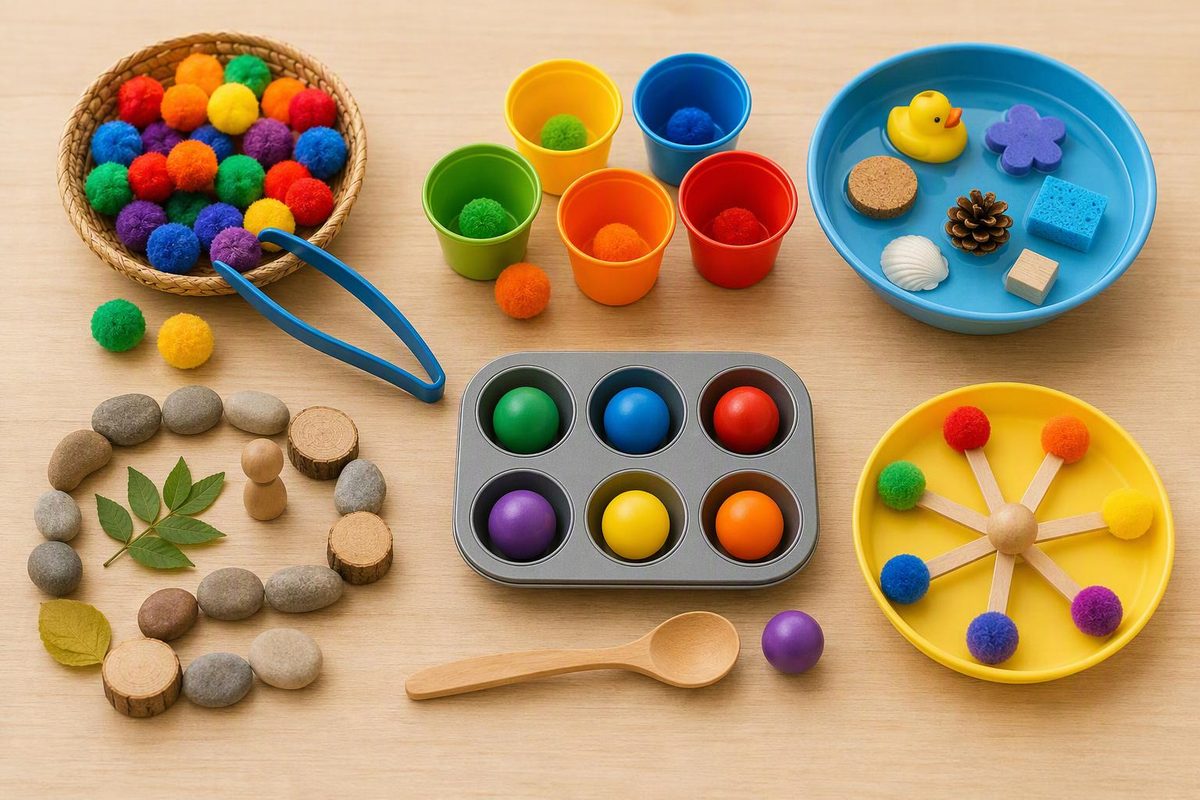
Start with one game, demonstrate a turn, and let the child try before adding another rule. These games for 4-year-olds use everyday supplies and work with an adult and one child or a small preschool group—no reading or worksheets needed.
The CDC’s activities for 4-year-olds include matching games, counting everyday objects, pretend play, and stop-and-go movement. The ideas below offer ways to practice those skills through play, not tests a child needs to pass.
Before you play
Choose materials for the children actually joining, including younger siblings. Follow toy age labels, inspect pieces for damage, and use large objects rather than coins, beads, or buttons. The American Academy of Pediatrics’ toy-safety guidance recommends checking labels and choosing toys and parts larger than a child’s mouth. Clear movement areas of loose toys and slippery rugs; keep an adult nearby.
1. Freeze dance: moving and stopping
Materials: Music you can pause, or your own singing; clear space.
Set up: Give each player room to stretch their arms without touching anyone else.
Play: 1. Explain: “When the music plays, move. When it stops, freeze.” Demonstrate once. 2. Play or sing while everyone dances, marches, or moves their arms. 3. Pause, hold still briefly, then restart. Try several rounds without eliminating anyone who keeps moving.
Learning opportunity: Listening for a cue and pausing an action. PBS KIDS describes freeze dance as a way to practice self-control and suggests slower music at the end to wind down.
Simplify: Say “freeze” and raise an open hand when the music stops. Seated movements work, too.
Extend: Let the child choose the next movement or control the pauses with adult help.
For more group options, see our morning meeting games.
2. Find the pairs: matching and remembering
Materials: Six identical-sized pieces of opaque cardstock and a marker. An adult prepares the cards.
Set up: Draw three pairs of simple pictures, such as two suns, two houses, and two trees. Leave the backs blank.
Play: 1. Spread the cards picture-side up and find the pairs together. 2. Shuffle them and place them face down in two rows. 3. Take turns turning over two cards. Put matching pairs beside the layout; turn nonmatching cards back over in the same spots. 4. Work together until all three pairs are found. Keep one turn per player, even after a match.
Learning opportunity: Comparing pictures, remembering locations, and waiting for a turn.
Simplify: Leave all cards face up or begin with two pairs.
Extend: Add a fourth pair. Keep the layout orderly rather than increasing both the number of cards and the difficulty of the pictures.
3. Block deliveries: counting a small collection
Materials: Five large toy blocks, two baskets, and two dolls or stuffed animals.
Set up: Put the blocks in one basket and leave the other empty for deliveries. Seat the toys a short distance from the block basket. Use a clear walking route.
Play: 1. Give a delivery request: “Bear needs two blocks.” 2. Help the child touch each block once while counting it into the delivery basket. 3. Walk the blocks to Bear and count them together again. 4. Return the blocks, then make a new request for the other toy. Swap roles so the child can place an order.
Learning opportunity: Connecting a spoken number with a collection and counting objects one at a time. The CDC recommends counting familiar objects, including toys.
Simplify: Request one block, then two. Count alongside the child.
Extend: Request up to five, or ask, “Bear has two. Can you bring one more?” Show the objects rather than expecting mental arithmetic.
4. Copy my build: hands and spatial thinking
Materials: Two matching sets of three or four large blocks.
Set up: Sit side by side on the floor or at a stable table, with one set each.
Play: 1. Build a small model, such as two blocks stacked with one beside them. 2. Invite the child to make a matching build while keeping your model visible. 3. Compare together: “This block is on top. Where is yours?” Let the child adjust it. 4. Switch jobs: the child builds, and you copy. Finish after each person has led a round.
Learning opportunity: Grasping and placing blocks, comparing arrangements, and using words such as beside, under, and on top.
Simplify: Copy a flat row of two blocks instead of a stack.
Extend: Add one block or briefly cover the model before copying. Keep towers low and away from faces.
5. Object detective: clues and describing
Materials: A tray, cloth, and four familiar large objects—for example, a shoe, spoon, block, and soft ball.
Set up: Look at and name the objects together, then cover the tray.
Play: 1. Describe one object without naming it: “I’m thinking of something you wear on your foot.” 2. Let the child guess, then uncover the tray so they can point to or pick up the answer. 3. Cover it again and offer another clue. 4. Invite the child to give you a clue. There is no score; take turns until everyone has had a chance to describe something.
Learning opportunity: Listening to descriptions and talking about an object’s features or purpose.
Simplify: Keep the tray uncovered and offer two choices. Accept pointing, gestures, or a response in the child’s home language.
Extend: Give two clues, such as “It is soft, and it can roll.”
6. Toy shop: asking and taking turns
Materials: Four large toys, a table or mat, and a shopping basket. No pretend coins needed.
Set up: Arrange the toys as a small shop. One player is the shopkeeper; the other is the customer.
Play: 1. Model a short exchange: “May I have the truck?” “Here it is.” “Thank you.” 2. Let the customer choose one item and place it in the basket. 3. Return the item to the shop, then swap roles. 4. In a small group, have customers visit one at a time while an adult helps with the exchange.
Learning opportunity: Pretend roles, making requests, and alternating turns. The CDC recommends imaginative play and modeling phrases such as “Can I have a turn?”.
Simplify: Offer two toys and let the customer point. Model the words without requiring repetition.
Extend: Add a pretend problem: “The truck is being used. Would you like the bear, or would you like to wait?” Let players suggest a solution.