
Make Regrouping Visible With Dots, Tens, and Carries
The worked example requires exchanges in adjacent categories: units and tens. Readiness checks show when to start. Error checks trace skipped dots and lost carries.
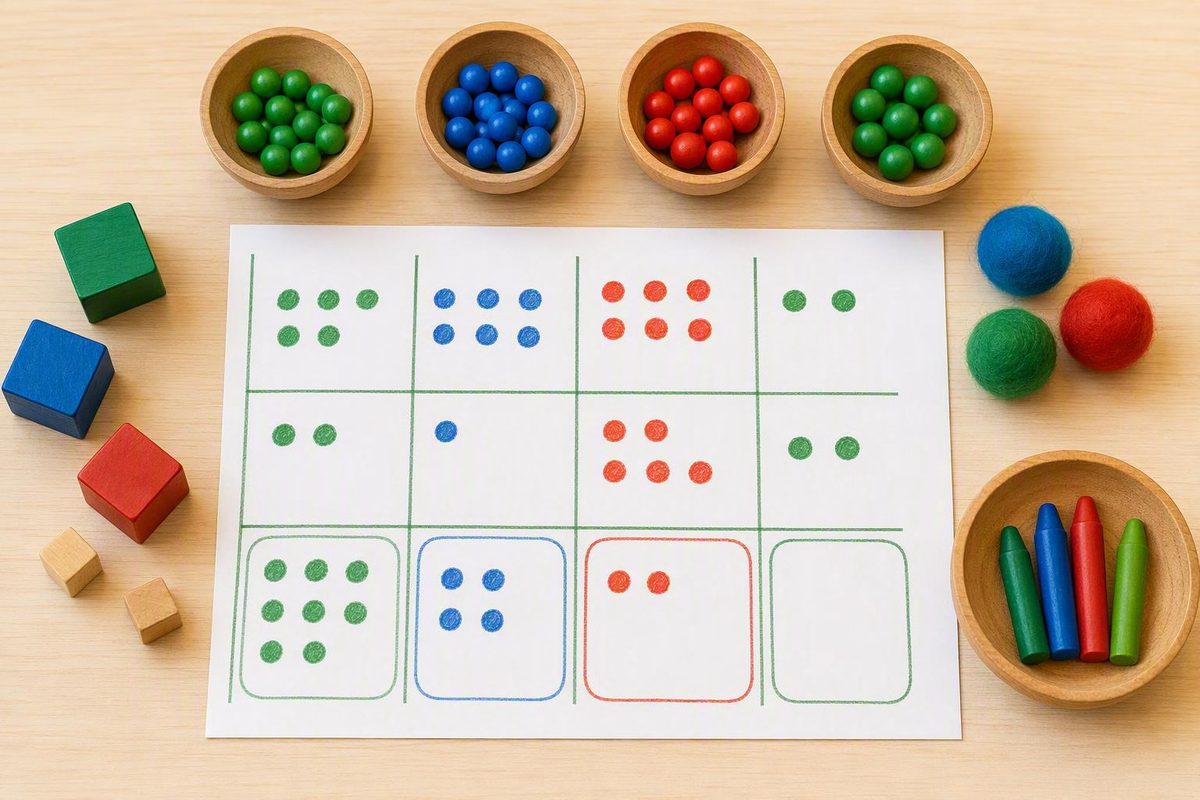
The Montessori Dot Game turns multi-digit addition into a visible record of place-value exchanges. Instead of moving beads or stamps, the child draws dots in columns, finds complete groups of 10, and replaces each group with one carried mark in the next category.
The central idea is simple:
Every 10 in one place becomes 1 in the next place.
The recording process is not necessarily simple for a beginner. A child must already understand decimal place value, recognize or systematically make groups of 10, and know why an exchange moves into the next column.
This guide focuses on dynamic addition—the best-documented use of the Montessori Dot Game—and explains how to set up the grid, present a problem, complete exchanges, and respond to errors without taking over the child’s work.
What the Montessori Dot Game Is—and What It Is Not
The Montessori Dot Game is a place-value exercise in which the digits of several addends are represented by dots. The grid divides those dots into units, tens, hundreds, thousands, and, in many versions, ten-thousands.
Suppose an addend is 2,136. The child records it as:
- 2 dots in the thousands column
- 1 dot in the hundreds column
- 3 dots in the tens column
- 6 dots in the units column
The child does the same for every addend. Once all the quantities have been entered, the dots are combined by place value. If a column contains 10 or more dots, each complete group of 10 is marked off and exchanged for one carried mark in the next column.
The decimal relationships remain visible throughout:
- 10 units become 1 ten.
- 10 tens become 1 hundred.
- 10 hundreds become 1 thousand.
- 10 thousands become 1 ten-thousand.
After every complete group of 10 has been exchanged, a processed column can contain no more than nine ungrouped dots. That remainder becomes the answer digit for that place. If 18 unit dots are present, for example, the child exchanges 10 units for 1 ten and records the remaining 8 as the units digit.
This guide concentrates on dynamic multi-addend addition, meaning addition that requires at least one exchange. Practitioner instructions consistently show the child entering addends as dots, marking complete rows of 10, and carrying one mark into the next category. A third-party-hosted Dot Game instructional PDF bearing Montessori Print Shop’s name provides one detailed version of that procedure.
The Dot Game is commonly described as a bridge toward written arithmetic. It preserves the place-value categories and exchanges found in more concrete work, but the child now uses drawn symbols instead of movable quantities. That description should not be expanded into an unsupported claim that the activity has been proved to improve achievement, fluency, intelligence, or long-term mathematical understanding.
Nor should the Dot Game be presented as a universally standardized lesson. The available descriptions come from instructional blogs, videos, third-party documents, educational platforms, and commercial pages. They agree on the central exchange process but differ in grid layout, colors, age recommendations, carry notation, and presentation order.
Some sources also list multiplication and subtraction as possible Dot Game applications. Their addition coverage is considerably more complete, however. Multiplication and subtraction require separately verified presentations and should not be treated as automatic variations of the addition procedure described here.
Use a Readiness Checklist, Not a Birthday
Several practitioner sources place the Montessori Dot Game at approximately age five or within the five-to-six range. These are recommendations from instructional sources, not developmental research findings, and they do not establish one correct starting age.
For example, Montessori Print Shop’s instructional PDF recommends ages five to five and a half, while the IPC activity page labels its version for ages five to six. Montessori Album uses an age-five-and-older label.
Other labels make the picture even less uniform. A low-authority, user-uploaded document recommends the activity from age four and a half onward, while a retailer advertises a Dot Exercise board for ages three to six. A retail category is not evidence that every child within that range is prepared to perform multi-addend regrouping; it is simply the seller’s stated label for the product. The retailer lists the board for ages three to six.
For a general preschool audience, the distinction matters. A child who is still developing numeral-quantity correspondence, reliable counting, or basic place-value understanding does not yet have the prerequisites for a task involving multi-digit numbers, several addends, and repeated exchanges.
Use skills, not age alone, to decide whether to present the activity.
Readiness checklist
A child is more likely to be ready when the child can:
- Identify units, tens, hundreds, and thousands.
- Explain what each digit means in a suitable multi-digit number.
- Read the numbers selected for the activity.
- Count objects or marks accurately without repeatedly losing place.
- Recognize or systematically make complete groups of 10.
- Explain that 10 of one category can be exchanged for 1 of the next category.
- Follow exchanges such as 10 units for 1 ten and 10 tens for 1 hundred.
- Complete dynamic addition with concrete place-value materials.
- Maintain vertical place-value alignment when reading an addition problem.
- Record quantities methodically enough that dots are not routinely skipped or duplicated.
Prior experience with the Stamp Game is a useful readiness indicator in a Montessori setting. Several practitioner presentations place Dot Game work after dynamic addition with stamps or other concrete decimal materials. That sequence allows the child to encounter the exchange with movable quantities before representing it with written marks. Montessori Album, for example, lists Stamp Game work as a prerequisite in its Dot Game overview.
The key question is not, “Has the child reached the suggested age?” It is:
Can the child focus on the new representational challenge of replacing physical quantities with dots?
Postpone the activity if the child frequently:
- Guesses which column a digit belongs in.
- Reads a digit without understanding its place value.
- Loses track before making a group of 10.
- Treats a carried mark as another unit in the original column.
- Cannot explain why a group disappears from one category and reappears in the next.
- Needs continual adult correction merely to enter the addends.
Useful preparatory work includes sorting quantities by place, building and identifying groups of 10, exchanging concrete units for tens, and composing numbers with physical place-value materials. These are practical preparations, not parts of a mandatory universal sequence.
Materials and the Anatomy of a Dot Game Grid
The basic setup is modest. You need:
- Prepared Dot Game paper, graph paper, or a reusable grid
- An ordinary pencil or fine-tipped marker for original dots
- A clearly contrasting pencil or marker for carried marks
- Appropriately selected addition problems
- Optional answer cards for checking completed work
A common Dot Game grid contains:
- Labeled place-value columns. These usually include units, tens, hundreds, and thousands. Many templates also include ten-thousands.
- Horizontal rows of 10 squares. One dot is entered in each square, ordinarily from left to right.
- A carry area. This provides a consistent location for recording exchanges into the next category.
- A result area. The remainder for each processed column is recorded here.
- An equation area. The vertically aligned addition problem and final sum can be written beside the grid.
The exact arrangement varies. Some grids put the carry and result spaces beneath each place-value column. Others place carried dots directly in the next column or use an additional notation area. Either approach can work if the adult demonstrates one internally consistent system.
Why the rows contain 10 squares
The row does not change the mathematics. Ten dots are still 10 dots wherever they appear. Its purpose is organizational: it helps the child recognize, mark, and trace each exchange.
Do you need a ten-thousands column?
Not for every problem. A grid ending at thousands is adequate when the selected addends cannot produce a five-digit sum.
A ten-thousands column is necessary when the thousands column may total 10 or more. This can happen even if every original addend contains only four digits: several four-digit addends can combine to produce a carry from thousands into ten-thousands.
Many detailed templates contain five columns, from units through ten-thousands, while other versions stop at thousands. One five-column structure, including bottom recording spaces and a right-side equation area, is shown in this step-by-step Dot Game presentation.
Low-cost and reusable options
A commercial board is not required. Practical alternatives include:
- Drawing five labeled columns on graph paper
- Printing a prepared worksheet
- Placing a paper grid inside a reusable transparent sleeve
- Laminating a grid and using fine-tipped erasable markers
- Making separate thousands-only and ten-thousands grids for different problem sizes
If using an erasable surface, test the markers first. Lines and dots must remain fine enough to keep individual squares legible.
Color conventions also vary. One presentation may use a standard pencil for original dots and orange or red for carries; another may use different colors for each place value. Rather than treating one convention as mandatory, follow a simple rule:
- Use one consistent color for original dots.
- Use one clearly contrasting color for all carried marks.
The grid must also be large enough for the problem. A page that technically contains all the necessary columns may still be unsuitable if the chosen addends create more dots and exchanges than can be recorded cleanly.
Finally, write the equation vertically and align every digit with its place:
  1,354
  2,136
+ 1,468
-------
This makes it easier to compare each written digit with the corresponding dot column.
How to Present a Dynamic Addition Problem
For a first demonstration, choose a manageable problem. Avoid combining a large number of addends with exchanges in every column. The new difficulty should be the written dot representation, not an overwhelming page of marks.
1. Orient the child to the grid
Point to each heading and invite the child to name the categories:
- Units
- Tens
- Hundreds
- Thousands
- Ten-thousands, if present
Ask what belongs in each column. If the child cannot reliably identify the categories, return to preparatory place-value work.
Also examine the square rows. Count one row together and establish that each horizontal row contains 10 places.
2. Write the addition problem
Write the addends vertically, with digits aligned by place value. Include the plus sign and a line for the sum.
At first, use only as many addends as the child can follow. A child who understands regrouping may still need time to learn the recording routine.
3. Enter the first addend
Read the first number by place value. If it is 1,354, say:
- “One thousand.”
- “Three hundreds.”
- “Five tens.”
- “Four units.”
Draw the corresponding number of dots in each matching column. Fill the squares in an orderly left-to-right pattern. Do not scatter the dots around the grid, because the rows of 10 are meant to reveal exchange groups.
4. Mark the completed addend
After all digits in the first number have been represented, place a small check beside that addend. This simple control helps prevent repeating or skipping a number.
Repeat the entry process for every remaining addend. During an initial presentation, the adult might enter the first one or two numbers and then invite the child to continue.
5. Begin with the units
Once all addends are represented, start processing the units column.
Find every complete row or group of 10 unit dots. Mark through each complete group. For every group marked off, place one contrasting carried mark in the designated carry area for tens or directly in the tens column, depending on the system chosen.
Use concise language:
“Ten units exchange for one ten.”
Avoid introducing unrelated mnemonic tricks. The purpose is to connect the quantity, category, group of 10, exchange, and remainder.
6. Record the units remainder
Count the uncrossed unit dots. Confirm that the remainder is between zero and nine, then write that number in the units result space.
If more than nine dots remain, the column has not been fully processed.
7. Process the tens
Add the carried tens to the original tens dots. Complete and mark every group of 10.
For each group of 10 tens, enter one contrasting carried mark in the hundreds category:
“Ten tens exchange for one hundred.”
Count the ungrouped tens and record that remainder as the tens digit.
8. Continue through the remaining categories
Repeat the same process through hundreds, thousands, and ten-thousands as required:
- Find complete groups of 10.
- Mark off each exchanged group.
- Carry one mark to the next category.
- Count the ungrouped remainder.
- Record the result digit.
Process one column fully before moving to the next.
9. Transfer the answer
Transfer each recorded remainder to its matching place in the written sum. A useful checking order is from units toward the highest place because it follows the exchange process just completed.
Then read the complete sum aloud by place value.
Practitioner instructions differ in exactly where carries are recorded. Some place them in spaces below the originating columns before adding them to the next grid; others enter carried dots more directly in the receiving category. Select one method, define it before starting, and use it consistently throughout the demonstration.
Worked Example: 1,354 + 2,136 + 1,468
Consider:
  1,354
  2,136
+ 1,468
-------
  4,958
This is a useful dynamic example after a child has completed a simpler problem with only one exchange. It requires exchanges in two adjacent categories—units and tens—but does not carry into ten-thousands.
Enter the addends
Break down each number by place value:
| Addend | Thousands | Hundreds | Tens | Units |
|---|---|---|---|---|
| 1,354 | 1 | 3 | 5 | 4 |
| 2,136 | 2 | 1 | 3 | 6 |
| 1,468 | 1 | 4 | 6 | 8 |
Represent those values with dots in the grid:
- 1,354: 1 thousand dot, 3 hundred dots, 5 ten dots, 4 unit dots
- 2,136: 2 thousand dots, 1 hundred dot, 3 ten dots, 6 unit dots
- 1,468: 1 thousand dot, 4 hundred dots, 6 ten dots, 8 unit dots
The following table separates original dots, carried marks, exchanges, remainders, and answer digits.
| Place processed | Original dots | Carry entering | Total represented | Group marked off | Carry to next place | Ungrouped remainder | Final digit |
|---|---|---|---|---|---|---|---|
| Units | 4 + 6 + 8 = 18 | 0 | 18 units | 10 units | 1 ten | 8 units | 8 |
| Tens | 5 + 3 + 6 = 14 | 1 ten | 15 tens | 10 tens | 1 hundred | 5 tens | 5 |
| Hundreds | 3 + 1 + 4 = 8 | 1 hundred | 9 hundreds | None | 0 | 9 hundreds | 9 |
| Thousands | 1 + 2 + 1 = 4 | 0 | 4 thousands | None | 0 | 4 thousands | 4 |
Units: exchange 10 of 18
The three addends contribute:
4 + 6 + 8 = 18 units
On the grid, 18 original unit dots can be represented schematically as:
Original units:
● ● ● ● ● ● ● ● ● ●   ● ● ● ● ● ● ● ●
└──── group of 10 ────┘  └── 8 remain ──┘

Exchange:
◆ 1 carried ten

Units digit:
8
Here:
●represents an original dot.- The first 10 original dots form the exchange group and are marked off.
◆represents the contrasting carried mark.- The 8 uncrossed unit dots become the units digit.
Say:
“We have 18 units. Ten units exchange for one ten. Eight units remain.”
Record 8 in the units result space and one carried mark in the tens category.
Tens: include the carried ten
The original tens are:
5 + 3 + 6 = 14 tens
Add the carried ten from the units exchange:
14 original tens + 1 carried ten = 15 tens
Before the exchange, the two sources can be shown separately:
Original tens:
● ● ● ● ● ● ● ● ● ●   ● ● ● ●
└──── group of 10 ────┘  └ 4 original tens remain

Entering carry:
◆ 1 carried ten
After marking off 10 tens, the four remaining original tens and the one entering carried ten are counted together:
Remainder in tens:
● ● ● ● + ◆ = 5 tens

Exchange from the marked group:
◆ 1 carried hundred

Tens digit:
5
The source of a mark does not change its value once it enters the category. The four uncrossed original dots and the carried mark all represent tens.
Say:
“We have 15 tens. Ten tens exchange for one hundred. Five tens remain.”
Record 5 as the tens digit and carry one mark into the hundreds category.
Hundreds: no exchange
The original hundreds are:
3 + 1 + 4 = 8 hundreds
Include the carried hundred:
8 hundreds + 1 carried hundred = 9 hundreds
Because 9 is fewer than 10, no exchange is needed:
Original hundreds: ● ● ● ● ● ● ● ●
Entering carry:     ◆
Total remainder:    9 hundreds
Final digit:        9
Say:
“There are nine hundreds. There is no complete group of 10, so nine remain.”
Thousands: no exchange
The thousands total is:
1 + 2 + 1 = 4 thousands
There is no carry entering the thousands column and no group of 10 to exchange.
Thousands: ● ● ● ●
Remainder: 4 thousands
Final digit: 4
Read the result
Read the remainders from the highest occupied place to the lowest:
- 4 thousands
- 9 hundreds
- 5 tens
- 8 units
The sum is:
4,958
Conventional column-addition check
The ordinary algorithm confirms the same answer:
    11
  1,354
  2,136
+ 1,468
-------
  4,958
In the diagram, the two carry marks sit above the hundreds and tens columns:
- Units: 4 + 6 + 8 = 18; write 8 and carry 1 ten.
- Tens: 5 + 3 + 6 + 1 = 15; write 5 and carry 1 hundred.
- Hundreds: 3 + 1 + 4 + 1 = 9.
- Thousands: 1 + 2 + 1 = 4.
The conventional check is secondary here. The main purpose of the worked Dot Game example is to show what those small written carries mean: each one records a completed group of 10 in the previous category.
From Static Addition to Independent Dynamic Work
Static addition means that no place-value column reaches 10, so no exchange is needed. It allows a child to practice translating written numbers into organized dots without managing carries at the same time.
For example:
  1,213
+ 2,324
-------
  3,537
Each category remains below 10:
| Place | Calculation | Result |
|---|---|---|
| Units | 3 + 4 | 7 |
| Tens | 1 + 2 | 3 |
| Hundreds | 2 + 3 | 5 |
| Thousands | 1 + 2 | 3 |
Dynamic addition requires at least one exchange between categories. The worked problem above is dynamic because the units and tens columns each produce a group of 10.
A practical progression might be:
- Static placement practice: No column reaches 10.
- One exchange: Only one column requires regrouping.
- Several independent exchanges: More than one column reaches 10.
- An exchange caused by a prior carry: A column reaches 10 only after a carried mark is added.
- A result entering ten-thousands: The thousands total produces a new place.
This is a planning suggestion, not an authoritative universal sequence. Control the number of addends, total dots, and exchanges according to the child’s organization and accuracy.
Two ways to organize the recording
Practitioner instructions document two broad presentation sequences.
Sequence A: Enter complete addends
- Represent every digit of the first addend.
- Check off that addend.
- Represent every digit of the next addend.
- Continue until all addends are entered.
- Process totals from units upward.
Sequence B: Work one category at a time
- Enter all units from every addend.
- Process the units.
- Enter or process all tens.
- Continue through hundreds and thousands.
A practitioner Dot Game presentation describes both approaches. The source does not establish that either sequence is superior for all beginners.
For an initial lesson, maintain the first demonstrated sequence until the child understands where to put dots, how to mark completed addends, and how to process exchanges. Introduce the alternative later as another organizational method rather than unexpectedly changing the rules.
Independence can also develop gradually:
- The adult demonstrates while the child observes.
- The adult enters one addend and the child enters the next.
- The child processes a column with brief prompts.
- The child completes prepared equation cards independently.
- The child checks a result and revises an error.
- The child creates suitable problems once page organization is stable.
Child-created problems can be engaging, but unrestricted choices may produce an unmanageably crowded grid. Initially, set boundaries such as the number of addends, the maximum digit in each place, or the permitted number of exchanges.
Dot Game vs. Stamp Game: The Shift Toward Written Arithmetic
The Stamp Game and Dot Game show the same decimal relationships through different representations.
In the Stamp Game, the child moves physical pieces or “stamps” representing units, tens, hundreds, and thousands. In the Dot Game, those movable quantities are replaced by marks on a grid.
| Feature | Stamp Game | Dot Game |
|---|---|---|
| Representation | Physical pieces or stamps | Written dots or marks |
| Place-value organization | Pieces sorted by category | Dots entered in labeled columns |
| Exchange method | Replace 10 pieces with 1 piece of the next value | Mark off 10 dots and enter 1 carried mark in the next category |
| Typical prior knowledge | Basic decimal categories and quantity-symbol relationships | Confident place value and prior exchange experience |
| Degree of abstraction | More concrete because quantities can be moved | More representational because quantities are recorded |
| Highest category | Depends on the material set | Often includes or introduces ten-thousands |
The mathematical relationship remains constant. Ten units still become one ten, whether the child physically trades pieces or crosses out a row of dots. What changes is the representation and the amount of information the child must track on paper.
That is why prior exchange experience matters. With physical pieces, a child can move, regroup, and recount separate objects.
Practitioner sources commonly position the Dot Game after comfortable dynamic addition with the Stamp Game or related concrete materials. This is a common instructional sequence, not proof that every Montessori classroom follows an identical progression. It also does not establish that dots produce better learning outcomes than other representations.
The defensible point is narrower: the Dot Game retains place value and exchanges while asking the child to record quantities in a less concrete form.
Checking the Work and Fixing Common Errors
The Montessori Dot Game is not consistently described as fully self-correcting. The instructional PDF identifies the adult guide as the control of error, while another detailed presentation recommends equation slips with answers on the back as well as adult checking. An answer card can reveal that a final result is incorrect, but it cannot by itself identify whether the problem came from a skipped dot, misplaced digit, overlooked exchange, or incorrect transfer.
Use an answer card, a separate conventional calculation, or adult review to identify that a mismatch exists. Then return to the grid and locate the first step that no longer matches the equation.
Misplaced digit
If a child puts a digit’s dots in the wrong column, ask:
“Which place-value column matches this digit?”
Reread the addend by category. Compare each digit with the dots entered in the matching column rather than immediately moving the marks for the child.
Skipped or duplicated dots
Ask the child to point to one digit at a time and count its corresponding dots. Then check whether the addend was marked as completed.
Useful prompts include:
- “How many hundreds does this number contain?”
- “Show me the dots that record those hundreds.”
- “Did we already enter this addend?”
A systematic left-to-right pattern makes this check easier.
Overlooked exchange
If 10 or more ungrouped dots remain, ask:
“Can you find a complete group of 10 in this column?”
Let the child locate and mark the group. Then ask what one group of 10 becomes in the next category.
Too many remaining dots
After a column has been processed, no more than nine ungrouped dots should remain. If the child records a two-digit remainder, say:
“A finished column can have zero through nine dots left. Is there another complete group of 10?”
This directs attention to the structural rule without supplying the answer.
Lost carry
Trace the exchange in both directions:
- Point to a crossed-out group of 10.
- Find its contrasting carried mark.
- Confirm that the mark was placed in the immediately higher category.
- Include it when counting that receiving column.
Ask:
“Which carried mark records this crossed-out group?”
Every crossed-out group should have a corresponding carry, and every carried mark should trace back to a completed group.
Incorrect final transfer
Compare the recorded remainder beneath each column with the written sum:
- Units remainder goes in the units position.
- Tens remainder goes in the tens position.
- Hundreds remainder goes in the hundreds position.
- Thousands remainder goes in the thousands position.
- Ten-thousands remainder goes in the ten-thousands position, if needed.
Ask:
“Which place-value column matches this answer digit?”
When the final answer is wrong
Avoid erasing the entire page automatically.
Instead:
- Confirm that the addends were copied correctly.
- Match every digit to its original dots.
- Check that every completed group of 10 was marked once.
- Match each marked group with one carry.
- Recount each remainder.
- Compare the recorded remainders with the final sum.
Revise one step at a time. Start again only when overlapping marks or repeated corrections have made the grid impossible to interpret.
Some Dot Game overviews mention multiplication and subtraction and distinguish static from dynamic versions of those operations. The available descriptions are brief, however, and do not establish that multiplication or subtraction uses the same steps as addition. Treat each operation as a separate lesson requiring its own verified instructions.
Frequently Asked Questions
What age is the Montessori Dot Game for?
Practitioner recommendations commonly cluster around ages five to six, but they vary. One instructional PDF recommends ages five to five and a half, Montessori Album labels the activity for ages five and older, and IPC assigns its version to ages five to six. A user-uploaded document recommends beginning at four and a half, while a retailer uses a broader three-to-six product label.
These are practitioner, platform, document, or retailer recommendations—not developmental research findings. Use readiness instead. A child should understand units through thousands, read the selected numbers, make groups of 10, explain exchanges, and complete dynamic addition with concrete materials.
Can I make a Montessori Dot Game instead of buying a board?
Yes. Draw labeled place-value columns on graph paper, print a worksheet, or laminate a homemade grid for use with fine-tipped erasable markers.
Include rows of 10 squares, a place for carried marks and result digits, and an area for a vertically aligned equation. Use one color for original dots and a contrasting color for carries. A commercial board is optional.
What is the difference between static and dynamic Dot Game addition?
Static addition requires no exchanges because every place-value total remains below 10. For example, 1,213 + 2,324 = 3,537 is static because no column reaches 10.
Dynamic addition requires at least one exchange. When a column contains a complete group of 10, the child marks off that group and records one carried mark in the next place-value category.
Is the Montessori Dot Game self-correcting?
Not consistently. Some presentations identify the adult as the control of error, while others use equation cards with answers and adult checking. An answer card can reveal that the final result is incorrect, but the child may still need to inspect the grid or receive a neutral prompt to find the exact error.
Useful checks include matching each digit to its dots, tracing every marked group to a carry, and confirming that no processed column has more than nine ungrouped dots.
Can the Dot Game be used for multiplication and subtraction?
Some instructional sources say it can be used for multiplication and subtraction, but addition is documented much more fully. Do not assume the dynamic-addition procedure transfers unchanged to another operation. Use a separately verified presentation for Dot Game multiplication or subtraction.
Every stage of the addition activity returns to one organizing idea: every 10 in one place becomes 1 in the next. Begin only when the child is already confident with place value and concrete exchanges. Demonstrate one manageable problem slowly, keep prompts neutral, and look for the child’s ability to explain and record each exchange—not for proof of a broad educational benefit or readiness shared by every preschooler.