
5 Number Games for Preschool, Chosen by Skill
Play five low-prep preschool number games for counting, numeral matching, small quantities and comparison, with simple steps and easy adaptations.
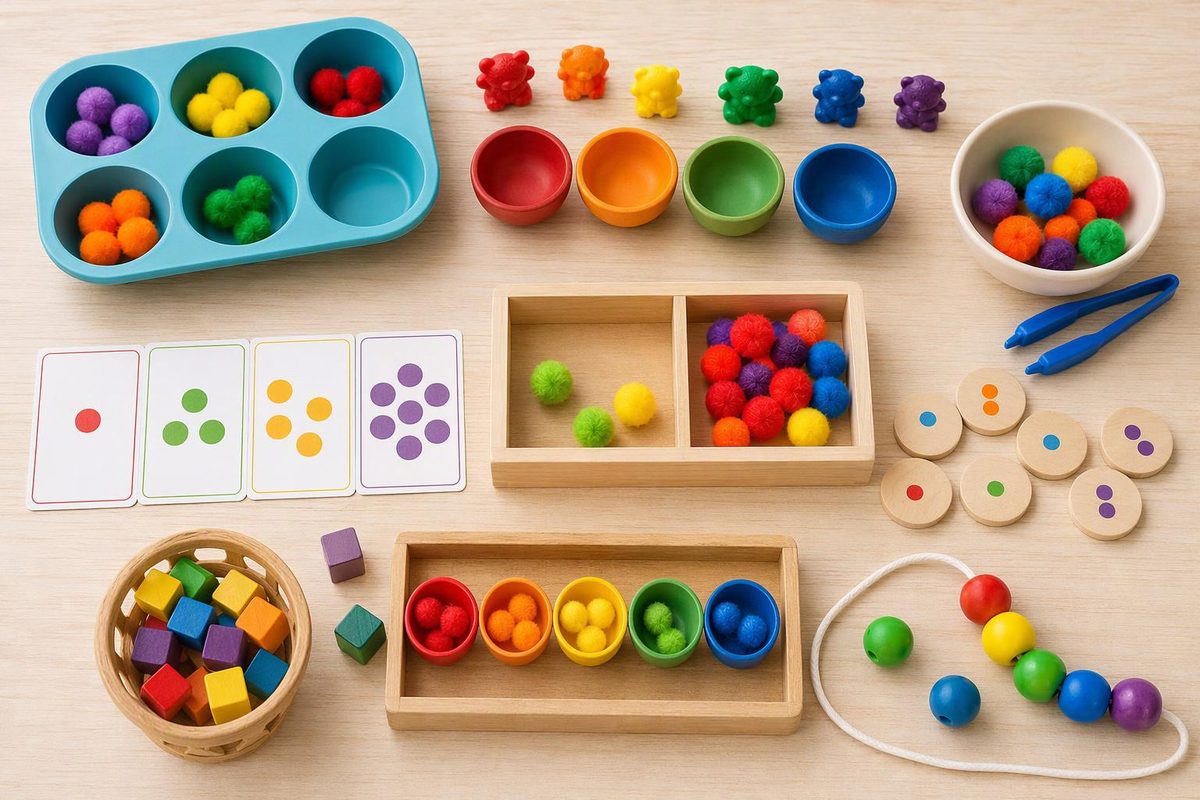
A preschooler may say “one, two, three, four, five” but still need help counting five objects. Counting involves using number words in order, giving each object one count, and understanding that the last number said tells how many there are. DREME’s counting guidance explains these as separate parts of counting.
Choose one game below for the skill you want to explore. Start with quantities from one to three; use one to five when that feels comfortable. These are suggested starting points, not age-based targets.
| If you want to practice… | Try… |
|---|---|
| Counting objects and stopping at a requested amount | Block Delivery |
| Giving each action one count | Copy My Moves |
| Connecting a written numeral with a quantity | Number Garages |
| Recognizing a small quantity without counting | Dot Peek |
| Comparing more, fewer and the same number | Compare the Trains |
Materials check: Use intact, age-appropriate toys and supervise play. Skip coins, beads, marbles and other small counters, especially when children mouth objects or younger siblings can reach the game. Follow toy age labels; CPSC’s choking-hazard guidance explains that these recommendations are based on safety concerns.
1. Block Delivery
Skill opportunity: Counting each object once and making a requested quantity.
Materials and setup: Put five large blocks in a basket. Place a large stuffed animal beside an empty tray: it is waiting for a delivery.
Play: 1. Speak for the toy: “Please bring me three blocks.” 2. Invite the child to move blocks from the basket to the tray, saying one number for each block. 3. Ask, “How many did you deliver?” Check together and add or return blocks if needed. Once there are three, say, “Three blocks. That is what Bear ordered!” 4. Return the blocks and let the child choose the next order for you.
Simplify: Request one or two blocks. Move them together, keeping the counted blocks separate from the basket.
Extend: Use requests up to five, or try “no blocks” and introduce zero as the amount in the empty tray.
Watch for: Does the child stop at the requested amount? If not, count the delivery together rather than treating it as a failed turn.
2. Copy My Moves
Skill opportunity: Matching one number word to each action.
Materials and setup: No materials. Sit or stand where everyone has room to move their arms.
Play: 1. Say, “Let’s clap twice.” Clap slowly while saying “one, two.” 2. Invite the child to copy the two claps with you. 3. Take turns choosing a movement and an amount: three knee taps, one wave or two hand raises. 4. Pause after each round and ask, “How many did we do?”
Simplify: Keep the amount at one or two and move together throughout.
Extend: Let the child lead with amounts up to five. The adult copies and counts along.
Watch for: Keep the movements slow enough to give each one its own count. A child can choose seated movements; jumping is not necessary.
3. Number Garages
Skill opportunity: Connecting a written numeral with its quantity. Learning numeral names and learning what each number means are both parts of number learning, as DREME’s number overview describes.
Materials and setup: Draw three large “garages” on paper, labeled 1, 2 and 3. Gather six large toy vehicles, or use blocks as pretend vehicles.
Play: 1. Point to one label and name it: “This is three.” 2. Say, “This garage needs three vehicles.” Help the child count vehicles into it. 3. Choose another garage and fill it to match its label. 4. Empty the garages so the child can choose where to park next.
Simplify: Use only garages 1 and 2. Draw the matching number of parking spaces beneath each numeral.
Extend: Remove the parking-space clues, or add garages 4 and 5 with enough vehicles to fill them.
Watch for: A child may count the vehicles accurately while still needing you to read the numeral. Name it and keep playing.
4. Dot Peek
Skill opportunity: Recognizing “how many” without counting each dot, called subitizing. Begin with small sets; DREME’s subitizing guidance distinguishes recognizing small quantities from recognizing larger quantities through their smaller groups.
Materials and setup: Draw one, two or three large dots on separate cards. Make a few cards with different arrangements.
Play: 1. Show a card briefly, then turn it face down. 2. Ask, “How many dots did you see?” The child can answer with words or fingers. 3. Turn it back over to look together. Count if the child wants to check. 4. Let the child show you a card for your turn.
Simplify: Leave the cards visible and use only one or two dots. Counting is welcome; this is not a speed test.
Extend: Show three dots in several arrangements, then introduce four.
Watch for: Ask, “What did you notice?” Accept an explanation such as “two here and one there,” not just a quick answer.
5. Compare the Trains
Skill opportunity: Comparing quantities through counting and matching objects in pairs.
Materials and setup: Use same-size large blocks in two colors. Make one train with two blocks and another with three. Lay their blocks in rows with matching spacing and aligned starting points.
Play: 1. Ask, “Which train has more blocks?” 2. Pair each block in one row with a block in the other, pointing to both together. 3. Notice the unpaired block: “This train has one left over, so it has more. The other train has fewer blocks.” 4. Rebuild the trains, sometimes giving them the same number. Ask, “Do they have the same number, or does one have more?” Take turns making trains for the other player to compare.
Simplify: Compare one block with two.
Extend: Spread one train’s blocks farther apart without adding any. Ask, “Did its number change?” Pair or count them again to check.
Watch for: If the child chooses the more spread-out train, bring the rows together and compare pairs rather than simply correcting the answer.
Adjust while you play
Model a turn, shorten the directions or reduce the quantity if a child seems frustrated. If the game is comfortably easy, change one feature at a time. These approaches follow DREME’s guidance for adapting math games.
For a small group, give each child their own materials so everyone can try. Keep turns cooperative, without a race or elimination. When you want a different kind of math play, try these preschool pattern games.