
5 Pattern Games for Preschool, From Copying to Creating
Choose a preschool pattern game by readiness, then play with simple cards, blocks or movements. Includes setup, prompts and easier or harder options.
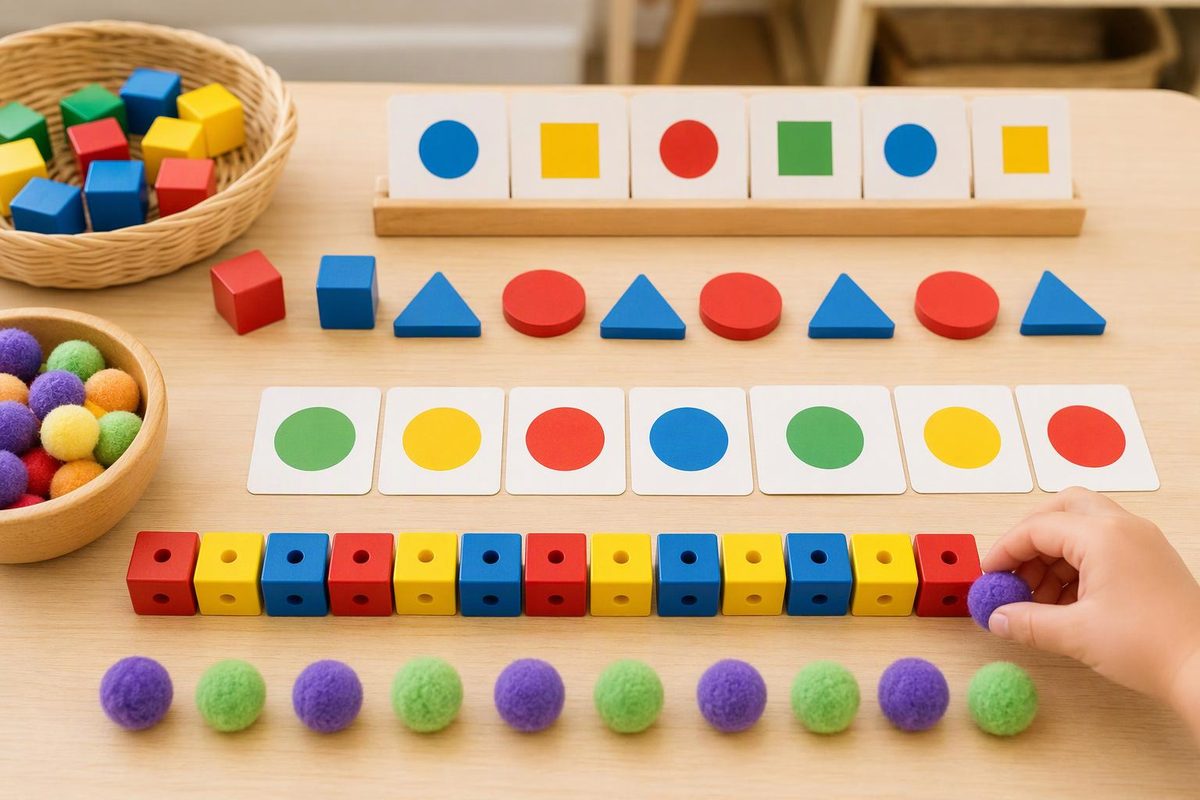
Start with circle, square, circle, square, circle, square. Point to each shape and say its name together. Then ask, “What comes next?” Children can answer by pointing, choosing a piece or placing it—not only by speaking.
These repeating-pattern games for preschool offer different ways to explore the same idea: a sequence has a part that repeats. Choose one game for a short play session rather than working through all five.
Choose the task before the materials
Pattern play includes copying, extending, filling gaps and creating sequences with objects, sounds or movements. These are all part of Head Start’s guidance on understanding simple patterns, under Goal P-MATH 7.
Use what the child does during play—not age alone—to choose a starting point.
| What you notice | Try this game | Main learning opportunity |
|---|---|---|
| The child matches individual pieces but needs a visible model | Copy My Row | Keeping pieces in the same order |
| The child copies a row and is ready to add to it | Keep the Train Going | Predicting and continuing the sequence |
| The child continues a row and enjoys a puzzle | Find the Missing Piece | Using surrounding pieces to fill a gap |
| The child enjoys joining actions or leading others | Movement Leader | Hearing, performing and creating a repeating sequence |
| The child can show which part repeats | Same Rule, New Materials | Keeping the pattern structure when the materials change |
Start with an AB pattern: two different elements alternate. In circle, square, circle, square, the repeating unit is circle, square. AB describes the rule, not particular colors or shapes. EDC’s pattern-game guidance identifies AB as the simplest repeating pattern. The games below adapt its copying, extending, gap-filling, movement and transfer activities.
You can say “circle, square” with beginners; letter labels can come later. Sorting all circles into one pile and all squares into another is useful preparation, but it is not the same task as arranging a repeating sequence.
Make one reusable kit
For the table games, gather:
- Eight large cards with a circle drawn on each and eight with a square drawn on each
- A clear table or floor space for two rows
- One blank card to cover a piece
- Optional age-appropriate blocks in two colors for the transfer game
Make the cards the same size so the shapes are the main difference. A large circle and square on each card also let children distinguish pieces without relying on color.
Skip beads, buttons and other small loose pieces for children who mouth materials or when younger siblings can reach the activity. Follow toy age labels, check for damaged parts and supervise play, as Nemours KidsHealth advises.
1. Copy My Row
Setup: Make a row of six cards: circle, square, circle, square, circle, square. Place spare cards nearby.
Play: Invite the child to build a matching row directly underneath. Point along your row and name each shape slowly. Afterward, compare the rows one position at a time: “Does this piece match the one above it?”
Simplify: Place the first circle-square pair in the child’s row yourself. Let the child continue, with your finger marking the next position.
Extend: Try an ABB model: circle, square, square, circle, square, square. Keep the model visible while the child copies.
Checkpoint: Notice whether the child keeps the order or loses their place. Help them locate the next position rather than rebuilding the whole row for them.
2. Keep the Train Going
Setup: Build the same six-card AB row, leaving clear space at the end. Call it a train with room for more carriages.
Play: Read the row together. Ask the child to add the next carriage, then another, then another. Return to the beginning and check the growing row together.
Simplify: Offer only one circle and one square as choices. Point to the existing row while the child decides.
Extend: Ask, “Can you add the whole part that repeats?” The child adds circle, square together instead of predicting just one card.
Checkpoint: A single correct choice might be a guess. Watch what happens over several additions before changing the pattern rule.
3. Find the Missing Piece
Setup: Make four complete AB units—eight cards. Cover the sixth card with the blank card, leaving its place in the row clear.
Play: Say, “One piece is hiding. What belongs here?” Offer a circle and a square. Let the child choose, then uncover the hidden card and read the repaired row together.
Simplify: Cover the final card instead, making this a familiar “what comes next?” question.
Extend: Make a nine-card ABB row: circle, square, square, circle, square, square, circle, square, square. Cover the eighth card, leaving two complete repeating units visible before the gap.
Checkpoint: If the child is unsure, chant the row while pointing, pausing at the gap.
4. Movement Leader
Setup: No materials are needed. Choose two comfortable actions, such as clapping hands and patting knees. Children can sit or stand.
Play: Perform and say “clap, pat, clap, pat, clap, pat.” Invite children to join. Stop demonstrating while they continue, then offer a child a turn to lead.
For creating a pattern, ask, “Which two moves will you choose? Can we do your repeating part again?” Repeat the child’s unit together.
Simplify: Perform each action alongside the child. Use two visible gestures if sound is distracting.
Extend: Try clap, clap, pat; clap, clap, pat. Ask the leader to show the whole repeating part.
Checkpoint: Keep the pace comfortable. If remembering the actions is difficult, return to a visible card pattern rather than speeding up.
5. Same Rule, New Materials
Setup: Show the circle-square AB row. Offer blocks in two colors, with enough of each to repeat the unit several times.
Play: Say, “Can your blocks follow the same rule as these shapes?” Agree which block represents circle and which represents square. Align the blocks beneath the cards, then read both rows.
Simplify: Begin the block row yourself and let the child finish it while the card model stays visible.
Extend: Transfer an ABB pattern, or turn the shape pattern into two repeating movements.
Checkpoint: Ask, “What stayed the same?” Look for the alternating order, even though the objects changed. This is a more challenging task; return to copying with identical materials if needed.
When the pattern gets muddled
Point and name the pieces together before correcting anything. If the child places a different card, ask, “Shall we read it and check?” Then help them find the repeating part.
Keep one rule steady while changing the task. A child can copy, extend and repair the same AB row without needing a new set of supplies. Finish while the play still feels inviting; next time, use the task that needed a little support.