
5 Preschool Valentine Games With Simple Rules
Play five preschool Valentine games with paper hearts, simple rules, skill opportunities, and easier or harder options—without elimination or candy.
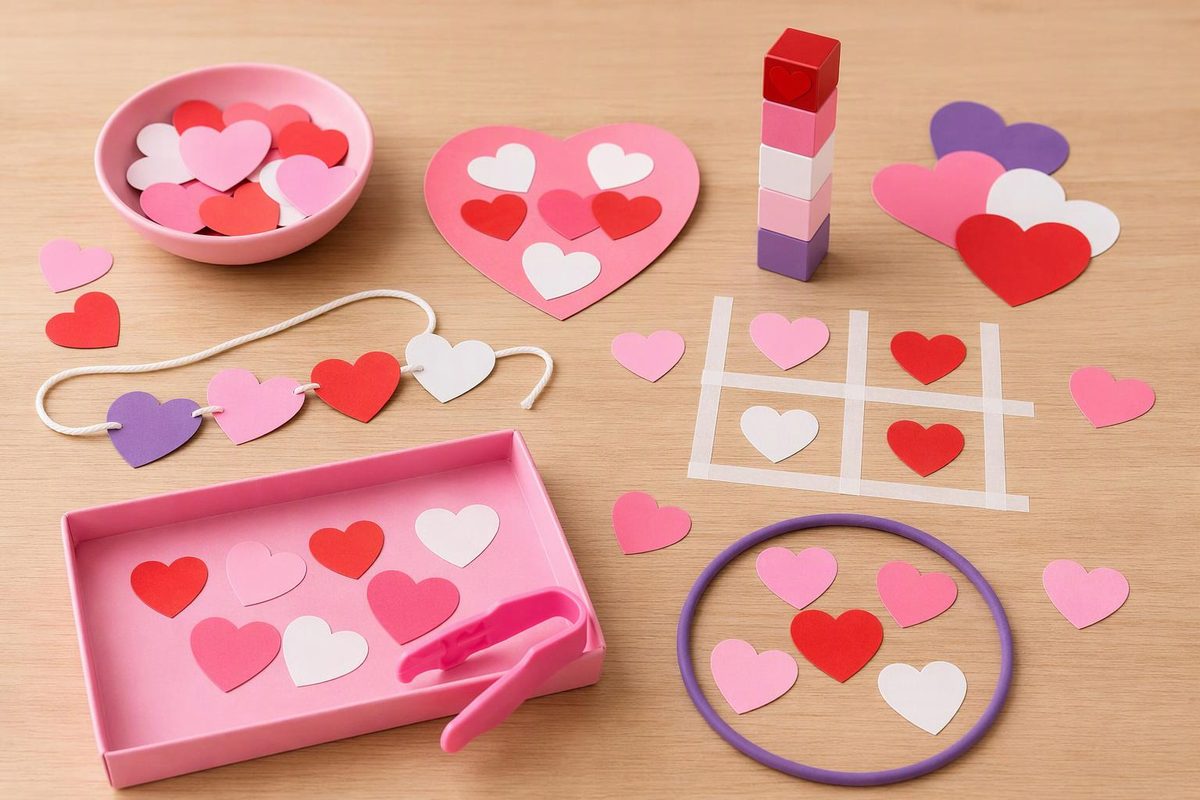
Paper hearts can become matching cards, pretend mail, bingo markers, or a shared target. These preschool Valentine games are for adults playing with children ages three to five, at home or in a classroom. Each has a clear goal, a short set of rules, and a way to adjust the challenge.
Choose by the practice you want to offer:
- Matching and remembering: Heart-Pair Memory
- Counting: Deliver the Valentines
- Listening and comparing: Shared Valentine Bingo
- Aiming and taking turns: Fill the Heart Toss
- Movement and stopping on a cue: Valentine Freeze
Games such as memory matching and Freeze Dance give children opportunities to practice remembering rules and controlling responses. NAEYC’s guidance on executive function through games emphasizes adult support and adapting challenges as children gain experience—not expecting everyone to manage the same rules immediately.
Before you play
Use large paper cards rather than candy, beads, or tiny decorations. Skip balloons: the U.S. Consumer Product Safety Commission warns that uninflated balloons and broken balloon pieces can cause choking. Keep loose supplies away from children who mouth objects and from younger siblings.
Demonstrate one turn before inviting children to join. Offer pointing, partnering, or adult-assisted moves. Use friendship and shared play as the Valentine theme; no child needs to choose a favorite friend, hug someone, or say whom they love.
1. Heart-Pair Memory
Practice: Comparing pictures, remembering locations, and waiting for a turn.
Materials and setup: Make six identical-backed cardstock cards: two with a striped heart, two with a dotted heart, and two with a plain heart. Keep the designs bold and easy to distinguish. Shuffle them and place them face down in two rows.
Play:
- A child turns over two cards so everyone can see them.
- If the hearts match, place the pair in a shared collection.
- If they do not match, look together, then turn both cards face down in the same spots.
- Move to the next player after every turn, including a match. Finish when the group finds all three pairs.
Prompt: “Where did we see the other dotted heart?” Let children offer clues rather than guarding answers.
Simplify: Start with two pairs face up and find matching partners together.
Extend: Add one pair at a time, keeping card backs identical so they do not reveal the answer.
2. Deliver the Valentines
Practice: Matching quantities and counting one card for each dot.
Materials and setup: Prepare six large paper valentines and three open paper bags or shallow boxes. Label the mailboxes with one, two, and three large dots. Set everything on a reachable table.
Play:
- Invite a child to choose an empty mailbox and look at its dots.
- Count out that many valentines from the supply pile.
- Deliver the cards, one at a time, into the mailbox.
- Check together by taking the cards out and placing one beside each dot. Return them to the mailbox once the quantities match.
- Take turns choosing the remaining empty mailboxes until all three have their deliveries, then empty them for another round.
The goal is to complete the mail route, not deliver fastest. These are pretend mailboxes, so no child’s personal Valentine collection is being compared.
Simplify: Use only one- and two-dot mailboxes, with an adult pointing to each dot as a card is placed beside it.
Extend: Add numerals beside the dots. To add a four-dot mailbox, prepare four more valentines so there are enough cards for the whole route.
3. Shared Valentine Bingo
Practice: Listening to a description and finding the corresponding picture.
Materials and setup: Draw a large four-space board showing a plain heart, a striped heart, a dotted heart, and an envelope. Make four matching calling cards and four large paper-heart markers. Place the board where everyone can see and reach it.
Play:
- Turn over a calling card and describe it: “Find the heart with stripes.”
- Invite one child to point to the matching space and cover it with a marker. Others can help.
- Give the next child a turn with the next calling card.
- When all four spaces are covered, everyone says, “Valentine bingo!” Reset for another round.
For a larger group, provide duplicate boards to small teams so children do not wait through a long queue.
Simplify: Show the calling card while naming its picture; accept a point instead of a spoken answer.
Extend: Give the description before showing the card, then reveal it so children can check their choice.
4. Fill the Heart Toss
Practice: Underhand aiming and taking turns toward a shared goal.
Materials and setup: Place a large paper heart inside a shallow, open box. Prepare a rolled pair of socks and a scorecard with five empty boxes. Clear the throwing area and show where the thrower stands; everyone else waits behind that spot.
Play:
- One child makes an underhand toss toward the heart box.
- If the socks land and stay inside the box, an adult marks one space on the scorecard.
- Retrieve the socks only after they have landed and the adult gives the cue.
- Pass them to the next player. Continue until the group fills all five spaces, without a timer or individual scores.
A miss simply means another turn for the group. Adjust the distance rather than letting repeated misses stall the game.
Simplify: Move the box closer or let children drop the socks into it from a reachable position.
Extend: Move the starting spot slightly farther away after a successful round.
5. Valentine Freeze
Practice: Moving within personal space and stopping on a cue.
Materials and setup: Use music or an adult’s clapping. Hold a large paper heart as a visible stop signal. Clear enough space for each child to move without touching others.
Play:
- Explain: “When you hear music or clapping, dance in your own space. When the sound stops and I lift the heart, pause.”
- Demonstrate dancing and stopping, then try it together.
- Alternate movement with brief pauses. Children can choose a Valentine pose, such as making a heart with their hands or stretching their arms wide.
- If someone keeps moving, model the pause again. Nobody is out; everyone joins the next round.
Simplify: Play seated with waving, gentle arm movements, and resting hands at the stop cue.
Extend: Let a child choose the next movement before the sound starts: wiggle, march, or sway.
For a short Valentine gathering, choose one seated game and one movement game, then repeat whichever children want to play again. If you also want a making activity, keep it separate from the game rules with these open-ended Valentine art activities.