
5 Educational Games for 5-Year-Olds, Chosen by Skill
Try five educational games for 5-year-olds with simple supplies, clear rules, and easier or harder ways to explore rhymes, counting, stories and planning.
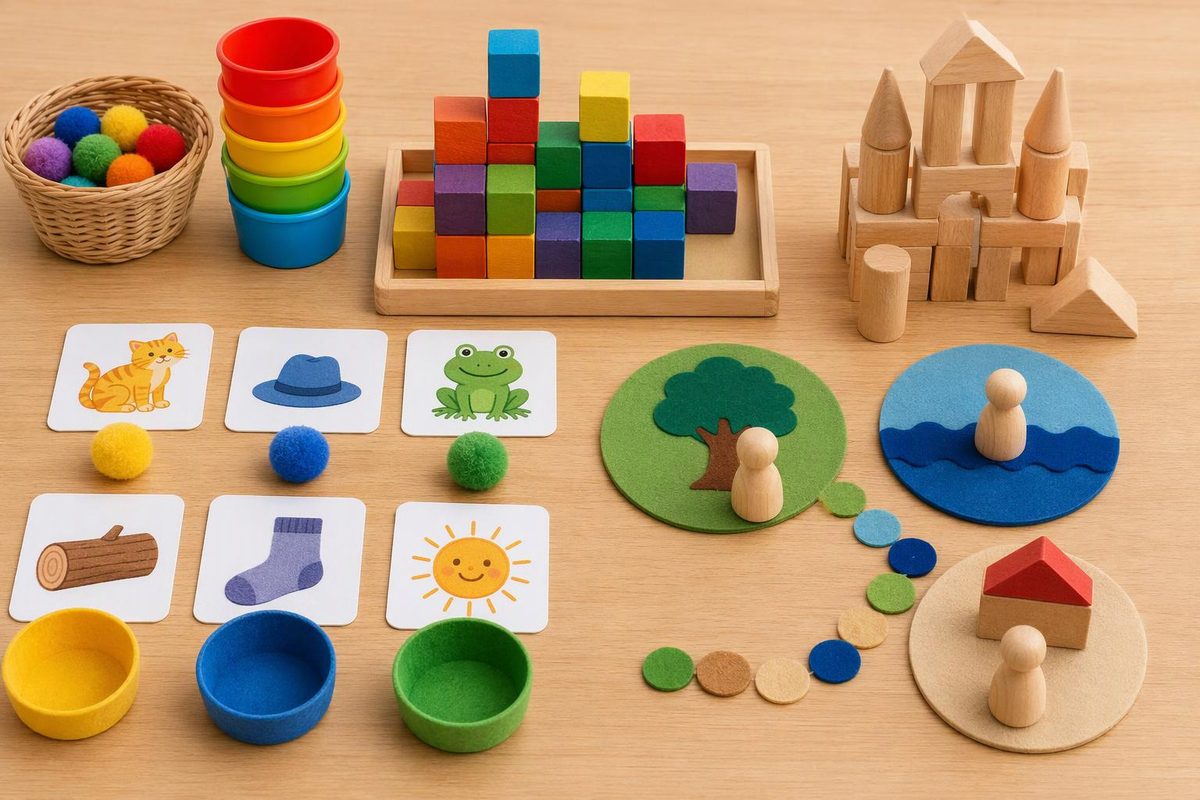
Choose a game for the next small challenge: hearing a rhyme, counting moves accurately, working out a hidden rule, putting story events in order, or planning a move. These educational games for 5-year-olds use paper, crayons and an adult play partner—not worksheets or independent reading.
The CDC’s guidance for age five includes simple rhymes, counting to 10, telling stories with at least two events, and following rules or taking turns in games. Use those skills as starting points, not requirements for joining. Demonstrate a turn, then choose the simpler or more challenging version to fit the child.
Before playing: Use child-appropriate drawing supplies and large paper cards. Follow toy age labels and keep small counters, toy parts and supplies out of younger siblings’ reach. The CPSC’s choking-prevention guidance recommends following age labels and keeping older children’s toys away from little ones.
1. Rhyme detective
Practice: Listening for words with the same ending sound.
Materials and setup: An adult draws three pictures on separate large cards: a cat, a hat and a dog. Prepare another set if wanted, such as boat, goat and sun. Name every picture together before playing.
Play: 1. Lay out one set of three cards. Say the words clearly: “Cat, hat, dog.” 2. Ask, “Two of these rhyme. Which two sound alike at the end?” 3. Let the child slide the rhyming pair together and move the outsider aside. 4. Say the pair together. Then switch roles: the child points to the pictures while you solve the next round.
Simplify: Put cat beside hat and say the pair yourself. Then offer hat and dog as two choices: “Which rhymes with cat?”
Extend: Ask for another word that belongs with the pair. A silly invented word can join if its ending sound matches.
Checkpoint: If the child groups pictures by meaning, acknowledge that idea: “Those are both animals. This time we’re listening to how the words end.”
For home-language play, choose familiar rhyming words with a speaker of that language rather than translating these English pairs word for word.
2. Number-trail rescue
Practice: Counting one move at a time and noticing written numbers.
Materials and setup: Draw a tabletop path with a START space followed by ten large spaces numbered 1–10. Draw a stranded animal beside space 10. Make six move cards: two each showing one, two or three large dots. Use a large paper pawn or an age-appropriate toy as the shared traveler.
Play: 1. Put the traveler on START. Shuffle the move cards face down. 2. Take turns drawing a card and counting its dots. 3. Move the traveler that many spaces, saying one count for each move. The first space you move into is “one”; do not count the space you are leaving. 4. Name the number where the traveler lands, supplying it if needed. 5. Work together to reach the animal. Stop at 10 even if a card offers extra moves; no exact final draw is needed. Reshuffle used cards if they run out.
Simplify: Use a five-space trail and only one- and two-dot cards. Point to each destination space as the child moves.
Extend: Before moving, ask, “You’re on four. Where might two moves take you?” Check the prediction by moving the pawn rather than requiring mental arithmetic.
Checkpoint: If the pawn skips spaces or the count gets ahead, slow down and touch each next space together. The goal is a shared rescue, not beating another player.
3. Guess my rule
Practice: Comparing features, testing an idea and changing a rule.
Materials and setup: Draw eight large cards: two red circles, two blue circles, two red squares and two blue squares. Color them clearly and name the shapes together. Mark two areas of the table with paper labels: “Fits” and “Doesn’t fit,” which the adult reads aloud.
Play: 1. Secretly choose a simple rule, such as “red shapes fit.” Place one red circle and one red square in Fits; place a blue circle in Doesn’t fit. 2. Invite the child to choose an unused card and predict where it belongs. 3. Confirm the placement or move it gently: “This blue square doesn’t fit my rule.” Keep all examples visible. 4. After a few guesses, ask, “What do the cards here have in common?” Reveal the rule if needed. 5. Reset the cards and change to a shape rule, such as “circles fit.” Explain that this is a new round with a new rule.
Simplify: Announce the rule and sort together before trying a hidden-rule round.
Extend: Let the child choose the secret rule while you test cards. Ask them to show examples before you guess.
Checkpoint: Use examples that separate color from shape, as above, rather than starting with two red circles. Harvard’s activity guide for ages five to seven includes Guess My Rule as an opportunity to hold earlier clues in mind and revise an idea.
4. Mixed-up story detective
Practice: Connecting events and explaining what happens first and next.
Materials and setup: Draw three simple story cards: a dog drops a ball into a puddle; a child retrieves it with a net; the dog has the ball again. Explain the pictured story once, then mix the cards.
Play: 1. Invite the child to arrange the cards to show what happened. 2. Ask them to tell or act out the story while pointing to each card. 3. Close your eyes while the child swaps two cards. Open your eyes and identify the change together. 4. Restore the original order—or tell a new version if the changed order suggests one.
Simplify: Use only a problem card and a solution card. Model “First…” and “Then…” while pointing.
Extend: Invite the child to draw another event or explain why the character chose the net.
Checkpoint: Ask, “How does this part lead to the next?” rather than demanding one memorized sentence. An unexpected order may still make a coherent story. Pointing, acting, home-language responses and adult narration can all be ways to participate. Telling connected events and answering story questions appear in the CDC’s age-five language guidance.
5. Talk-through tic-tac-toe
Practice: Taking turns and considering a move before making it.
Materials and setup: Draw a three-by-three grid on paper. One player uses X and the other uses O. The adult can make marks wherever the child points if writing distracts from play.
Play: 1. Explain that players alternate turns, placing one mark in an empty square. 2. Show how three matching marks across, down or diagonally form a winning line. 3. Play slowly, occasionally thinking aloud: “You have two O marks here. What could happen next?” 4. Stop when someone makes a line or every square is filled. A full board without a line is a draw. Start a fresh board and alternate who goes first.
Simplify: Before a full game, draw two matching marks in a line and invite the child to find the square that completes it.
Extend: Let the child play with fewer adult hints, then discuss one move after the round.
Checkpoint: Keep hints occasional; let the child make decisions. The CDC recommends tic-tac-toe among memory and attention games. A single round offers practice, not a promise of improved attention.
At home, set out one game at a time; in a classroom, model play before offering duplicate sets for pairs. If these rules feel like too much today, try a simpler option from our games for 4-year-olds, then return to a familiar game before adding another challenge.