
Turn Summer Words Into 8 Playable Preschool Puzzles
Make eight summer word puzzles with pictures, movement and reusable cards. Choose rhyme, syllable, letter, name or vocabulary play by readiness.
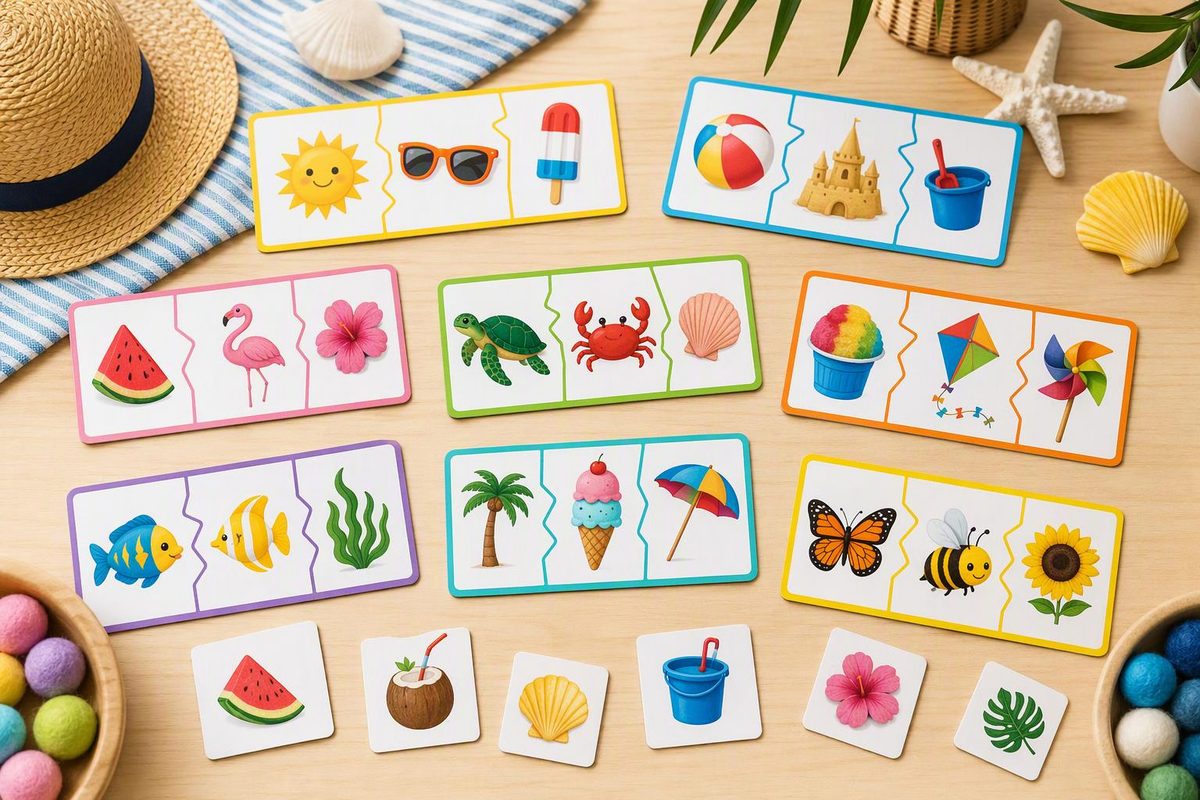
For preschoolers, a word puzzle does not have to be a crossword or word search. It can ask a child to match a picture, listen for a sound, clap a word or put the letters in their name in order.
These eight summer word puzzles use short, familiar words and hands-on play. Pick one skill at a time rather than setting out every puzzle at once.
Make one reusable summer word set
Materials
- Index cards or pieces of cereal-box cardboard
- Markers
- Summer photographs, magazine pictures or simple adult-drawn pictures
- Glue stick
- Scissors for adult use
- Paper bags, paper plates or shallow containers
- Optional: painter’s tape, sidewalk chalk or large clothespins
Make one set of picture cards for words such as sun, hat, fan, map, boat, pool, shell, flower, picnic, rainbow and watermelon. Make a separate set of cards with the matching words in clear lowercase print. You can also label each picture lightly on the back for quick checking.
Choose words and summer experiences familiar to the children rather than treating one kind of vacation or weather as universal.
Use large cards and inspect reused cardboard for staples or sharp edges. Skip clothespins and other small accessories when a child mouths objects. The CPSC defines a small part as an object that fits entirely inside its small-parts test cylinder and identifies such parts as a choking, aspiration or ingestion hazard in products intended for children under 3 (CPSC).
Choose a puzzle by skill
| Puzzle | Main practice | Easiest entry point |
|---|---|---|
| Beach-bag match | Pictures and print | Match identical pictures |
| Picnic sound sort | Beginning sounds | Sort two clearly different sounds |
| Rhyme hunt | Rhyming | Choose between two pictured answers |
| Syllable splash | Word parts | Clap names first |
| Name ice pop | Name-letter order | Copy from a name card |
| Mystery cooler | Vocabulary and clues | Point instead of naming |
| Compound-word pairs | Word meaning | Join two adult-named pictures |
| Secret summer word | Blending sounds | Watch the adult model |
The options range from picture matching to listening and letter work. Head Start’s preschool literacy progression includes enjoying and recognizing rhyme, counting syllables, noticing the connection between speech and print, recognizing familiar letters, and using drawing or letter-like marks. It describes increasingly complex examples across the preschool years rather than requiring every child to begin at the same point (Head Start).
1. Pack the beach-bag matches
Draw a beach bag on a paper bag or sheet of paper. Place three to five picture cards beside it and hold the corresponding word cards.
Read one word aloud, then invite the child to find its picture and “pack” the pair. Point beneath the printed word as you say it; do not quiz the child on a word you have not read.
Simplify: Make two copies of each picture and match picture to picture.
Extend: After reviewing the cards, match the printed words to familiar objects or pictures without adult help.
2. Sort a picnic by first sound
Choose two picnic baskets and label them with a picture-letter cue, such as sun, S and map, M. Say each card’s word slowly and emphasize its first sound: “ssssun” or “mmmmap.” Children place it with the matching basket.
Good starter sets include sun/sand/sock and map/mouse/mug. The cards do not all need to depict summer objects; the listening puzzle is finding what sounds alike.
Simplify: Offer one card at a time and say both basket words again.
Extend: Let the child search the room for another object beginning with the target sound.
3. Find the summer rhyme
Set out a summer picture with two possible matches. Ask, “What rhymes with sun: fun or fish?” Accept a spoken answer, a point or handing over the card.
Try these pairs:
- sun—fun
- pool—cool
- heat—feet
- sand—hand
- boat—goat
Nonsense answers count if they preserve the rhyme. Rhyming concerns sound, not spelling.
Simplify: Say the pair together with an exaggerated ending: “s-UN, f-UN.”
Extend: Invite children to invent a silly rhyme.
Rhyming and alliteration are forms of phonological awareness—attention to the sound structure of spoken language. NAEYC suggests playful practice through movement, songs and familiar routines, while including children’s home languages and cultural contexts (NAEYC). A rhyme that works in English may not rhyme after translation, so use natural examples from the child’s home language with help from a family member or speaker rather than translating the English list word for word.
4. Play syllable splash
Tape one, two, three and four large paper “puddles” to the floor. Show a picture, say its name naturally, then say it again while clapping the parts. The child jumps to the matching number.
Try:
- sun: 1
- picnic: 2
- butterfly: 3
- watermelon: 4
Say each word in the pronunciation familiar to your group and check it together. Start with children’s names if the themed words are unfamiliar.
No-jump adaptation: Tap the table, pat knees or place one large block for each syllable.
5. Build a name ice pop
Cut a large ice-pop shape from cardboard, then cut it into one section for each letter in the child’s name. Write one letter on each piece. Provide an intact name card as a model and invite the child to rebuild the ice pop.
Simplify: Use a photo-and-name model and keep the first letter in place.
Extend: Mix in one or two letters that are not in the name, or invite the child to write the name on a blank ice pop after building it.
Avoid requiring every child to write. Head Start’s preschool writing progression includes drawing, scribbling, letter-like forms and letters, so arranging, pointing or making marks can all offer a way into the puzzle (Head Start).
6. Solve the mystery cooler
Place three picture cards in a paper “cooler.” Give clues from broad to specific:
“I am thinking of something we use outside. It gives shade. It opens wide. What is it?”
Let children remove pictures that do not fit or select the answer when ready. Other useful contrasts are hat/towel/ball, shell/rock/leaf and cup/spoon/plate.
Simplify: Show two choices and add a gesture.
Extend: A child chooses the mystery card and gives the clues, with an adult supplying words when requested.
7. Join compound-word picture pairs
Draw or find separate pictures for sun + flower, rain + bow and sand + castle. Place the halves apart. Name each picture, slide the pair together and say the new word.
Then mix the pictures and let children test combinations. A “raincastle” can prompt laughter and a useful meaning check: “Is that a word we use? What might it be?”
Simplify: Present one complete pair and one unrelated picture.
Extend: Separate a familiar compound orally and ask which picture is missing: “I have sun. What do I need to make sunflower?”
8. Reveal a secret summer word
Hold your hands apart. Say the beginning sound and the remaining word part separately—“/s/ … un”—then bring your hands together and say “sun.” Repeat with /h/ … at, /m/ … ap, /f/ … an and /b/ … oat.
Give the child two pictures and blend one aloud. The puzzle is to select the word you made. NAEYC describes this hand movement as one way to make onset-rime blending visible with hands or objects (NAEYC).
Simplify: Model the whole sequence and let the child move the cards together.
Extend: Let the child say the two parts while you solve the puzzle. Keep it playful; this is listening practice, not a reading test.
A useful stopping point
End after a few successful turns or when attention shifts. Keep the cards available for another day, changing only one element: add a new word, reverse who gives the clue or move the sorting game outdoors.
For a longer themed day, pair one puzzle with a movement, art or water-play choice from these summer camp activities for preschoolers. At home, a single word game can also fit into a flexible summer schedule for preschoolers without turning the routine into a lesson block.