
4 Fourth of July Crafts for Preschool With Simple Supplies
Try four preschool Fourth of July crafts with paper, paint and glue, plus clear steps, skill opportunities, easy adaptations and safety checks.
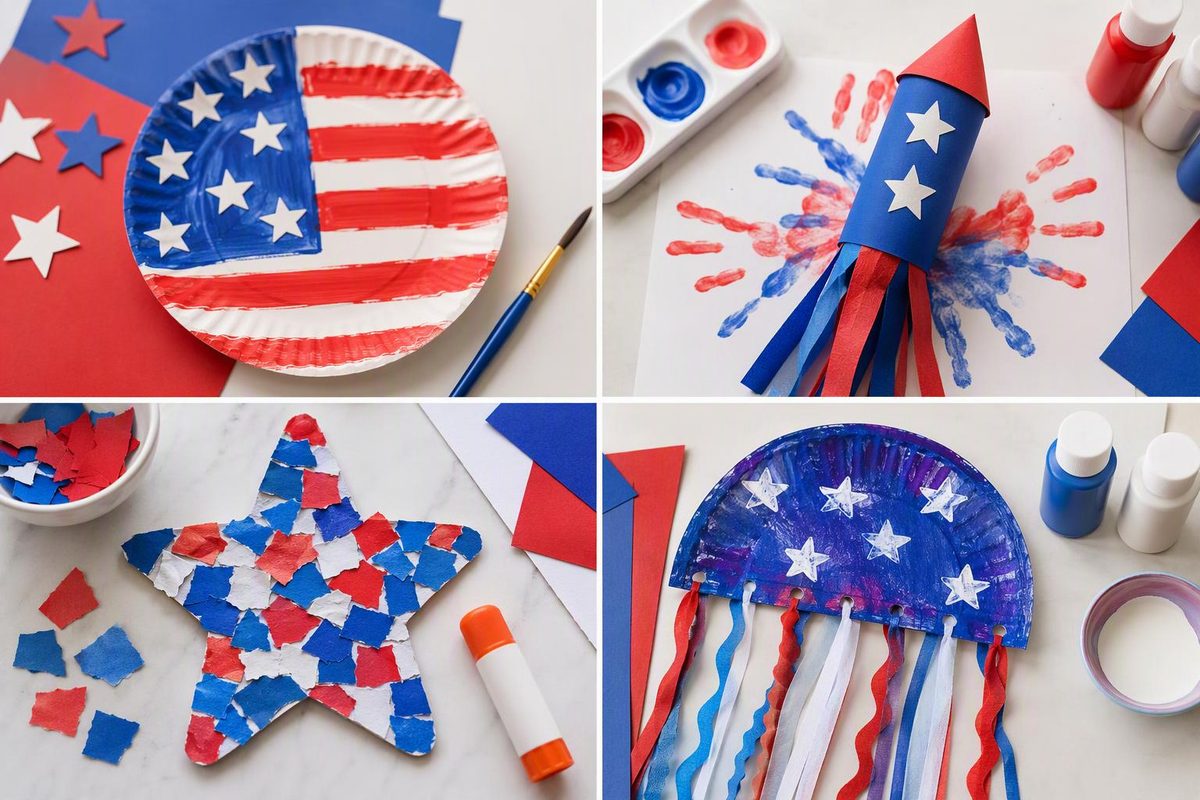
Make a torn-paper flag collage, paint firework bursts, decorate a plate with paper streamers, or fold a celebration card. These Fourth of July crafts offer children ages three to five different ways to tear, paint, arrange and tell a story—without needing a printable template.
Choose one activity rather than setting out everything at once:
| Craft | Opportunity to practice | Best choice when… |
|---|---|---|
| Flag-inspired collage | Tearing and placing paper | You want a paint-free activity |
| Painted firework bursts | Moving a brush in different directions | Children want to explore paint |
| Paper-plate streamer decoration | Arranging and repeating colors | You have paper scraps to use |
| Folded celebration card | Folding, drawing and dictating | You want a take-home keepsake |
Show children how a tool works, but leave room for their own arrangements. NAEYC’s guidance on process-focused art emphasizes children’s choices, exploration and ownership rather than copying an adult sample.
Gather supplies and check safety
For the whole selection, gather:
- Red, white and blue construction paper
- Plain drawing paper and uncoated paper plates
- Child-appropriate crayons, including white, and glue sticks
- Washable, child-appropriate paint and broad paintbrushes
- Shallow paint trays, a table covering and a drying space
- Scissors for adult preparation
- Optional tape for reinforcing the paper-plate decoration
Read age recommendations and directions on art supplies. Choose materials intended for children, without cautionary or warning labels; “non-toxic” does not mean edible. Supervise directly, keep food and drinks away from the art table, and wash hands afterward, as recommended in the CPSC Art and Craft Safety Guide.
These projects use paper and paint—not real fireworks. CPSC warns that young children should never play with or ignite fireworks, including sparklers.
For this set, skip loose glitter, beads and sequins. If a child mouths materials, offer closely supervised drawing instead of loose collage pieces.
1. Torn-paper flag-inspired collage
Materials: White paper, red paper, a blue paper rectangle, glue stick and a white crayon.
Setup: Put out broad red strips for children to tear. An adult can cut the blue rectangles beforehand.
- Invite the child to tear red paper into strips or patches. Demonstrate holding the paper with both hands and pulling gently in opposite directions.
- Let the child arrange red pieces across the white background, leaving white spaces wherever they choose.
- Glue down the pieces. Add a blue rectangle near the upper-left corner if the child wants a recognizable flag-inspired layout.
- Offer a white crayon for dots, stars or other marks on the blue paper.
Practice: Using both hands together to tear, then placing and pressing pieces.
Simplify: Provide ready-torn pieces and help steady the background paper.
Extend: Invite the child to tear longer and shorter strips and compare them before gluing.
Treat this as a flag-inspired collage, not an exact flag model. There is no need to correct the number of stripes or marks. A red, white and blue arrangement is a finished piece, too.
2. Brush-painted firework bursts
Materials: Drawing paper, red and blue washable paint, broad paintbrushes and shallow trays.
Setup: Cover the table and put a small amount of each paint color in separate trays. Keep another sheet nearby for experimenting.
- On scrap paper, demonstrate touching the brush down near a central spot and pulling it outward.
- Invite the child to make strokes pointing in different directions. They can turn the paper rather than twist their wrist.
- Add another burst elsewhere, or explore dots, swirls and overlapping colors.
- Lay the painting flat to dry.
Practice: Starting and stopping brush movements, changing direction and describing marks.
Simplify: Offer one paint color and a large sheet. Dabs and sweeping marks are welcome.
Extend: Ask, “How could you make one burst wide and another small?” Let the child decide how to try it.
If paint is unwelcome, use red and blue crayons instead. Keep the activity quiet; pretend explosions and loud sound effects are unnecessary.
3. Paper-plate streamer decoration
Materials: An uncoated paper plate, crayons, glue stick and short, wide red, white and blue paper strips; optional tape for adult use.
Setup: Adults prepare the strips. Leave the plate whole—there is no center to cut out.
- Decorate the front of the plate with crayon lines, dots or drawings.
- Turn it over and arrange strips along the lower edge, with one end of each strip overlapping the plate.
- Glue the overlapping ends and press them down. An adult can reinforce the joins with tape on the back if needed.
- Let the glue dry before gently lifting the decoration.
Practice: Positioning pieces, pressing joins and exploring color sequences.
Simplify: Offer just a few strips and help hold the plate still.
Extend: Start a red-white-blue sequence and ask which color might come next. Free arrangements are equally welcome.
Keep this as a flat decoration, not a necklace or wearable. Adults should handle wall display; no string or hanging loop is needed.
4. Folded Fourth of July celebration card
Materials: Drawing paper, red and blue crayons, optional paper scraps and glue.
Setup: Offer an unfolded sheet or a ready-folded card, depending on the child’s comfort with folding.
- Help bring the short edges together. Invite the child to press along the fold with a flat hand.
- Decorate the cover with a picnic, colorful bursts, a favorite summer activity or an abstract design.
- Ask, “What would you like your card to say?” Write the child’s words inside, or let them make their own marks.
- Invite the child to choose someone to give it to—or keep it.
Practice: Matching edges, pressing a crease, drawing and connecting spoken words with print.
Simplify: Fold the card beforehand. Let the child point to or describe their drawing without adding a message.
Extend: Invite them to sign their name, add a familiar letter or tell you more about the picture.
For a classroom display, ask whether each child wants to share their work. If you need activities without a holiday theme, these summer crafts offer more paper-and-paint choices.