
February Preschool Themes With a Four-Week Play Plan
Plan February preschool themes with a flexible four-week schedule, simple play activities, skill focuses and swaps for your weather and classroom.
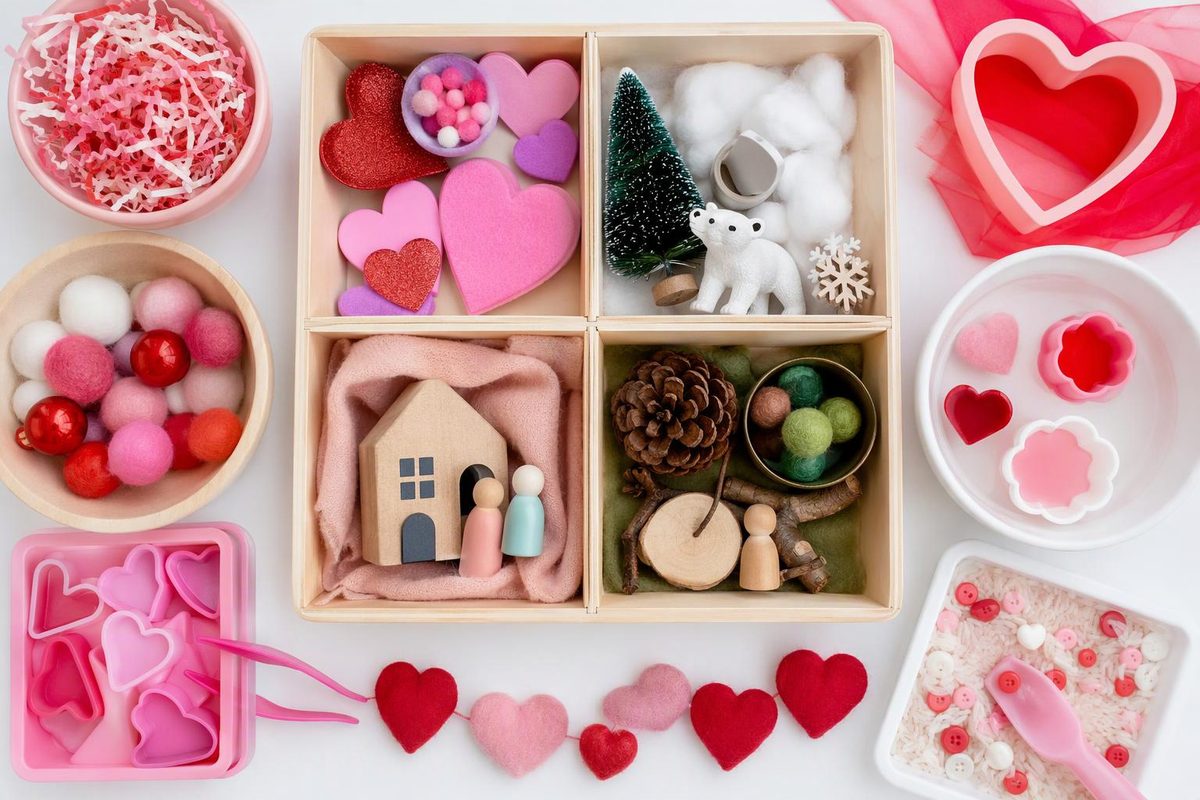
For February, try light and shadows, friendship, dental health, and local weather. These give you a mix of science, cooperative play, pretend play, and observation alongside any Valentine crafts you choose.
Choose two to four themes rather than changing everything each week. Keep a topic longer when children are still exploring it. NAEYC’s curriculum guidance supports planning around children’s interests, connecting learning experiences, and revisiting ideas rather than briefly skimming many topics.
A four-week February theme plan
This sample uses U.S. February observances. Move the blocks to fit your calendar, program expectations, and family traditions. Use your actual local weather rather than assuming February means snow.
| Planning block | Theme | Why choose it? | Play invitation | Skill focus |
|---|---|---|---|---|
| Early February | Light and shadows | A science connection to Groundhog Day on February 2 | Make block shadows with a flashlight | Observing and describing changes |
| Week containing February 14 | Friendship and kindness | A flexible Valentine’s Day option, with or without cards | Build a shared block neighborhood | Negotiating space and using helpful language |
| Third block | Teeth and dental helpers | February is National Children’s Dental Health Month | Open a pretend dental office | Sequencing and role-play vocabulary |
| Final block | Our February weather | Works in snowy, rainy, warm, or dry places | Compare entries on a picture weather chart | Comparing and counting observations |
Start the weather chart early in the month if you want several weeks of observations to compare in the final block. Other invitations can stay available across blocks, too.
Groundhog Day’s shadow prediction is a legend, so use it as an invitation to investigate shadows—not as a reliable forecast. The American Dental Association identifies February as National Children’s Dental Health Month.
One ready-to-play activity for each theme
1. Light and shadows: change a block’s shadow
Gather: A flashlight, a large block, and a clear wall or large sheet of white paper.
Set up and play: Leave enough light for children to move safely. Place the block between the flashlight and the wall. An adult holds the light steady so the block casts a shadow. Invite a child to move the block closer to or farther from the light. Pause after each move: “What changed?” Let children describe, point to, or trace the shadow’s outline with a finger.
Simplify: Keep the block still and let children watch as you move the light. Extend: Compare the shadows of two differently shaped blocks.
Keep the beam away from eyes; the adult handles the flashlight and checks that its battery compartment is secure.
2. Friendship: build a neighborhood together
Gather: Large blocks, paper, crayons, and a clear floor space.
Set up and play: Invite two or three children to build places beside one shared road. Ask, “How can we leave room for everyone’s building?” Offer useful phrases: “Can I use that next?” and “Where should this go?” Children can draw signs while an adult writes their dictated words.
Simplify: Offer two building spaces and help children connect them with a road. Extend: Add a shared park or library and invite children to decide where it belongs.
Keep friendship activities open to everyone. Offer waving, speaking, drawing, or helping instead of requiring hugs or personal compliments. If you want an art invitation alongside the block play, choose from these open-ended Valentine art activities.
3. Teeth and dental helpers: open a pretend office
Gather: A large paper tooth inside a reusable wipe-clean sleeve, washable markers intended for children, a damp cloth, a chair, and paper appointment cards.
Set up and play: Test that the marker wipes off the sleeve before setting it out, then draw a few marks on the covered tooth. Children take turns being the receptionist, dental helper, or patient. The helper wipes the model while describing what they are doing; the receptionist draws or writes an appointment card. Keep this clearly labeled as pretend play, not a demonstration of real toothbrushing technique.
Simplify: Offer only the tooth model and cloth. Extend: Make picture cards for “arrive,” “sit,” and “finish,” then put them in order.
Keep all props out of mouths and avoid shared mouth examinations. For real oral-care guidance or a family handout, use the ADA resource linked above.
4. Our February weather: make an observation chart
Gather: Paper, crayons, and large cards showing sun, clouds, rain, and snow. Add other symbols your group needs.
Set up and play: Look outside together at roughly the same time each day. Ask children what they notice, then draw or attach the matching symbols beside the date. Allow more than one symbol: a day may be sunny and cloudy. At the end of the week, compare the entries: “Which symbol did we use most?”
Simplify: Offer two relevant picture choices. Extend: Count the days showing each symbol or compare two weeks of entries.
Observe from a window when outdoor conditions are unsuitable. Weather talk can stay concrete: what children see, hear, and feel during ordinary supervised outdoor time.
More February themes to swap in
| Alternative theme | Choose it when… | Simple starting invitation |
|---|---|---|
| Mail and messages | Children are interested in Valentine cards or delivering things | Put paper, crayons, envelopes, and a cardboard mailbox in a writing area |
| Community helpers | Children enjoy the pretend dental office | Add a library desk or repair shop with blocks and drawn signs |
| Dinosaurs | You need a theme unrelated to holidays or weather | Build a block habitat for large dinosaur figures; try these dinosaur crafts alongside it |
| Colors and patterns | Children want more art or sorting | Arrange large colored paper shapes, then invite children to copy or change an arrangement |
Include Black history across the month—and beyond
In the United States, February is also Black History Month. Plan specific, respectful encounters with Black authors, artists, families, and community members rather than treating Black history as a decoration theme.
For example, ask your librarian for preschool picture books by Black authors to include in every week’s read-aloud choices. During an art invitation, introduce a named Black artist, show a work, and invite children to notice colors or shapes before making their own choices. Keep these books and materials available after February; no child or family needs to represent an entire community.
Before setting out the month’s materials, choose one main learning opportunity for each invitation. Then watch for the next adjustment: fewer choices, more space, an adult writing children’s words, or another day to revisit the same play.