
A Foldable Number Line to Make, Open and Explore
Make a paper accordion number line from 0 to 5, then use it for pointing, counting and one-more play, with simple preschool adaptations.
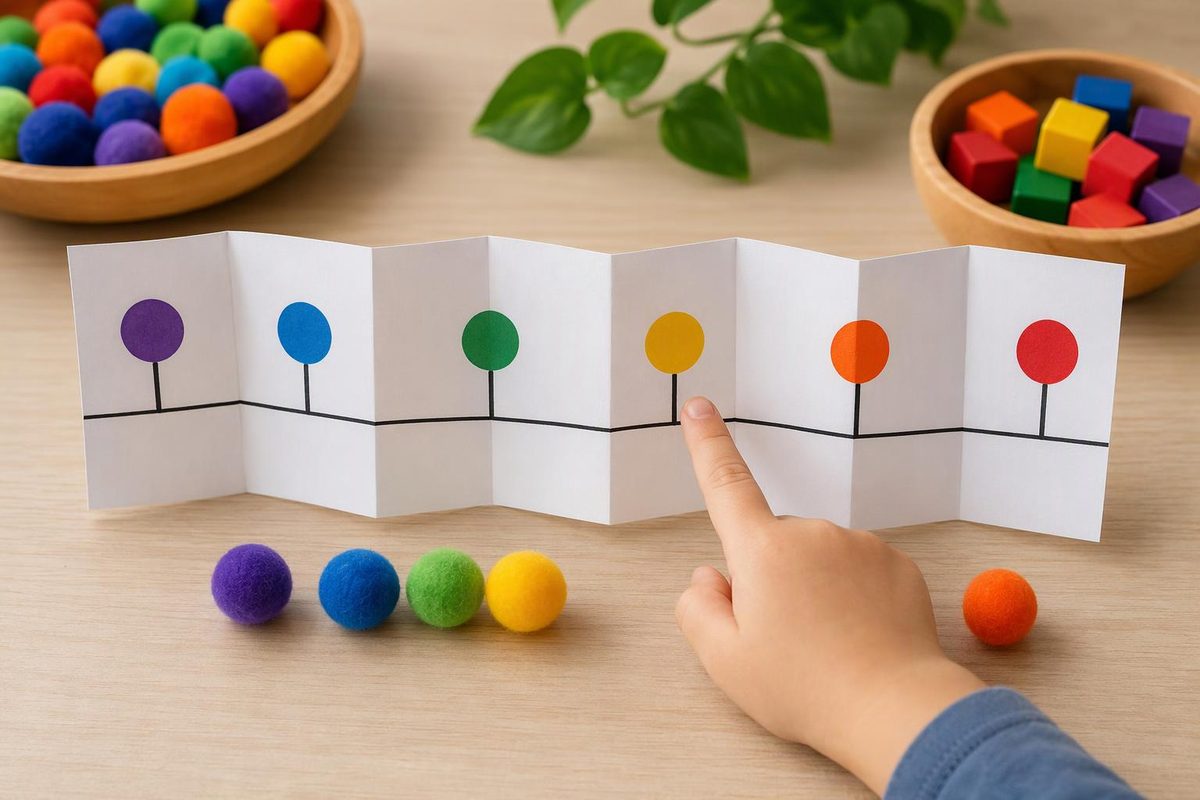
A foldable number line is a numbered paper strip that closes like an accordion. This tabletop version runs from 0 to 5: open it for a short counting activity, then fold it into a small stack for storage. No printable is needed.
Learning opportunity: Practice number order, connect written numerals with small quantities, and explore one more. These are related but distinct skills in Head Start’s preschool mathematics framework, so choose one prompt at a time rather than asking a child to do everything at once.
Materials
- Plain paper or lightweight cardstock
- Ruler and pencil
- Dark marker
- Scissors for adult preparation
- Clear tape
- Optional: a few large blocks for counting beside the line
Use a fingertip as the marker—there is no need for coins, beads or other small loose pieces. An adult can do the cutting and measuring; children can help press folds and decorate the back.
Make the accordion strip
- Cut two strips. Make each strip 3 inches wide and 9 inches long. Place them horizontally, with the short ends touching.
- Join them without overlapping. Tape the touching ends on both sides to make one strip approximately 18 inches long. Keep the tape smooth.
- Mark six equal panels. Measure along the long edge and mark boundaries at 3, 6, 9, 12 and 15 inches. The taped join is the middle boundary. Lightly draw a vertical guide at each boundary.
- Fold back and forth. Fold at the first guide in one direction, the next in the opposite direction, and continue alternating. Help the child press each crease. The six panels should stack together, not roll around one another.
- Open and label. Flatten the strip. Draw one horizontal line through the middle of all six panels. Put a short vertical tick in the center of each panel, crossing that line. Write 0, 1, 2, 3, 4, 5 above the ticks, from left to right.
The folds sit between the numbers; the ticks stay evenly spaced. Keep drawings away from the front line so the numerals remain easy to see.
Check before play: Open the strip fully. Are the numbers upright and in order? Is each tick the same distance from the next? If the accordion keeps springing up, gently press the creases open before placing it on the table.
Use it: touch, move and match
First, find a number
Lay the line flat with 0 at the child’s left. Point to a numeral and name it together, or ask, “Can you touch 2?” The child may point or use a number sign rather than speak.
If six choices are too many, fold the panels for 4 and 5 underneath the right end, leaving 0 through 3 flat and visible. Do not hide a middle number or change the spacing to make the task easier.
Next, count movements
Put a fingertip on 0. Say, “Let’s move to 3.” Move to the next tick with each count: “One, two, three.”
Count the moves, not the starting place. Starting on 0 and making three moves lands on 3. If the child’s finger travels faster than the words, model one slow move at a time.
Then, connect a number with a quantity
If using blocks, ask the child to touch 3, then count out three large blocks beside the strip, moving one block with each number word. Ask, “How many blocks altogether?” Keep the objects off the line so they do not cover the numbers.
For 0, leave the space empty: “Zero blocks—there aren’t any here.” Touching a written numeral and counting a collection are different tasks; help with whichever part is unfamiliar.
Simplify or extend
Simplify: Prepare the finished strip yourself, expose only 0–3, and name numbers together. A child can tell you where to point while you handle the paper.
Extend: Start a fingertip on 2 and ask, “What is one more?” Move one tick right to 3. For a concrete check, set out two blocks, add one and count the new total. Stay within the visible range rather than jumping off the strip.
If numeral identification is the sticking point, try a separate number recognition game before returning to the line.
Fold the strip along its existing creases when finished and store it flat. Replace it if the join separates or the labels become difficult to read.