
Check a Squishy Before It Enters the Classroom
Check a squishy toy’s seller, packaging, smell, texture, seams, and filling. Learn which warning signs mean pause use or remove it from preschool.
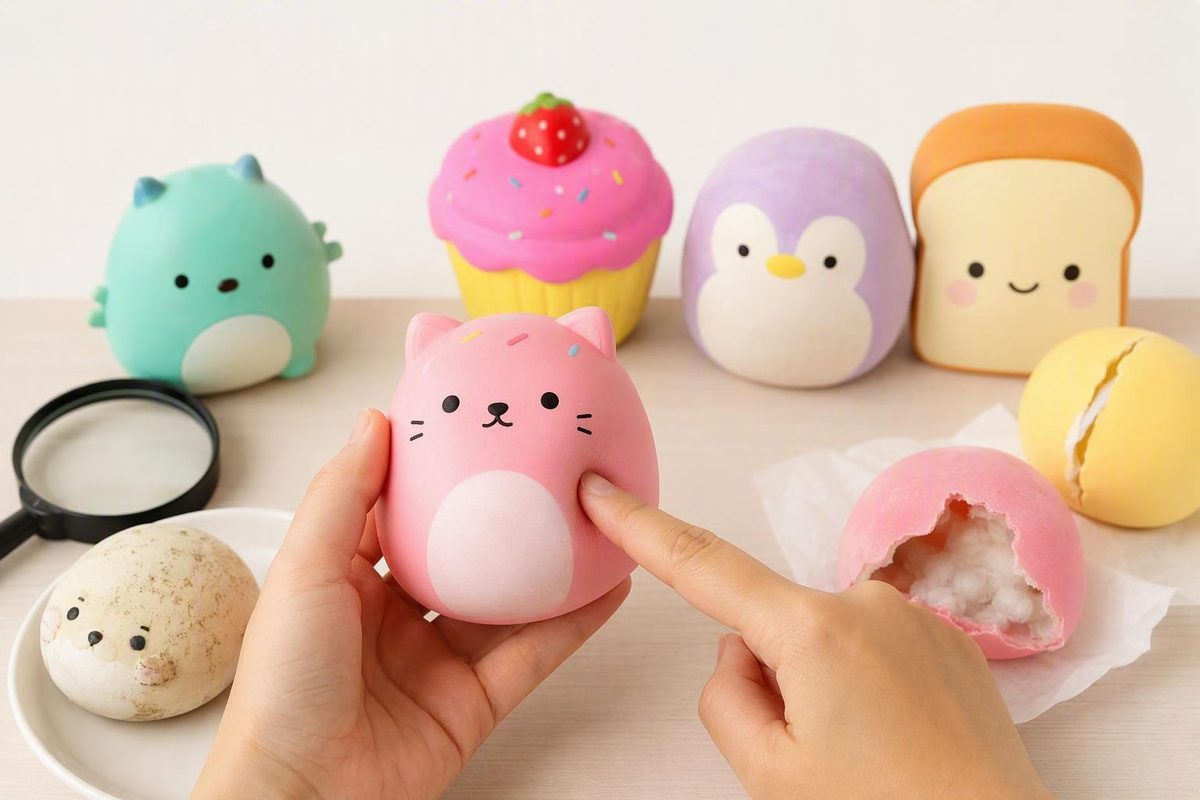
You usually cannot prove a squishy toy is fake by looking at it. For a preschool safety decision, remove any squishy that smells strongly, feels oily or unusually sticky, tears easily, leaks, exposes filling, or deteriorates. If only the seller or manufacturer is unknown, pause use while you verify it. An intact toy from a traceable source is lower concern, not certified safe.
A generic or look-alike toy is not automatically counterfeit. A noncompliant toy may fail safety requirements without copying a brand, while a genuine toy can become unsafe after a puncture, split seam, heat exposure, or ordinary wear.
The U.S. Consumer Product Safety Commission has warned about fake and counterfeit squishy toys and says never to heat them. Its alert provides warning signs, but not a universal home authentication test. Passing an inspection means only that no obvious reason to stop was found.
Answer all six checks; the result separates an immediate removal from a product that needs verification.
Choose Yes or No for the toy’s current condition. “Toss” here means remove it from play; disposal still depends on the product and filling.
Result: Answer all six checks
Any physical warning sign means removal from play. An unknown source by itself means pause and verify.
Mouthing rule: Keep filled squishies away from every child likely to bite, chew, or mouth toys; no universal numerical age cutoff is supplied.
How The Verdict Is Assigned
| Answers | Verdict | Action |
|---|---|---|
| Yes to odor, oiliness/stickiness, tearing, leaking, or visible filling | Toss from play | Isolate it; do not heat, cut, puncture, or keep testing it |
| No physical warning, but source is unknown | Pause | Keep it from children while verifying the seller or responsible business |
| No to all six checks | Keep with checks | Follow age guidance, supervise, and inspect before each shared use |
Source: CPSC warning signs and stop-use guidance summarized in the accompanying article. A passed check does not certify authenticity or safety.
Physical Damage Overrides the Real-or-Fake Question
Stop using a squishy immediately if it is leaking, punctured, torn, oily, unusually sticky, discolored, abnormally soft, strongly odorous, falling apart, or exposing its filling. Remove it from the play area and keep children and pets away from the toy and any released material.
These signs do not prove counterfeiting. They establish that the toy should not remain available while an adult investigates its origin. A familiar logo or previously good condition does not override present damage.
Inspect a newly opened toy with ordinary, light handling. Do not hold it close to your nose, squeeze it aggressively, or try to produce a leak. A strong odor noticeable during normal unpacking is enough reason to remove it.
Some squishies contain water beads, gels, liquids, powders, or sand. A damaged covering can give children access to the filling. Water beads can expand if swallowed and can cause intestinal blockage; they can also present choking or aspiration hazards. Reported CPSC guidance identifies unknown manufacturers, missing safety information, strong chemical odors, oily or unusually sticky surfaces, leakage, easy tearing, and deterioration as warning signs.
For children who bite, chew, or mouth toys, use behavior rather than a guessed age cutoff. The available guidance in the cited sources does not supply one universal numerical age rule. Keep filled squishies away from any child currently likely to mouth them, regardless of the age printed on the package.
Seller and Package Details Determine Whether a Toy Is Traceable
Start with the supply chain rather than small differences in a toy’s face, color, or shape. Listing photographs can be copied or edited. A seller’s identity, contact details, return terms, packaging photographs, and named responsible business provide more useful evidence.
Before buying, confirm:
- The actual seller’s business name, not only the marketplace name
- Usable contact and return information
- A named manufacturer or importer
- A specific product name and consistent brand details
- Photographs of every side of the retail package
- Age guidance, warnings, dimensions, and product details
- A price broadly consistent with established sellers of the claimed item
A substantially lower price is a warning sign, not proof. Clearance sales, old inventory, damaged packaging, and legitimate promotions can reduce a price. A deep discount becomes more concerning when the seller is untraceable, the package is hidden, or product details conflict.
Save the listing, seller profile, photographs, description, advertised brand and model, price, receipt, order confirmation, seller messages, and promised return terms. These records can support a refund, manufacturer inquiry, transaction dispute, or product-safety report if the listing changes or disappears.
Do not substitute ratings for traceability. Attractive photographs and favorable reviews cannot identify who manufactured or imported the particular item that arrives.
Complete Packaging Lowers Uncertainty but Cannot Prove Authenticity
Packaging should identify a manufacturer or importer and provide usable contact information, age grading, warnings, a product name or model, and any batch, lot, date, or tracking details supplied for that product. Branding and printing should be consistent and legible across the package.
Misspellings, blurry printing, mismatched logos, absent age guidance, and missing manufacturer or importer details increase uncertainty. Compare the physical package with materials obtained directly from the claimed manufacturer rather than relying on the marketplace listing.
Logos, polished boxes, safety statements, and conformity marks can be copied. Complete packaging is useful because it gives you a business and product identity to verify; it is not a certificate of authenticity.
For U.S. purchases, children’s toys generally must be tested by a CPSC-accepted third-party laboratory and certified for the federal requirements that apply. That obligation belongs to the manufacturer or importer. A consumer cannot validate the full testing and certification process from a logo or certificate reference printed on a retail package. The CPSC identifies testing, certification, warnings, tracking information, and manufacturer identification among the relevant compliance issues.
For UK purchases, look for the manufacturer or importer’s identity and UK address. A CE or UKCA mark is only one screening detail because a mark can be copied or misapplied. Reporting about genuine NeeDoh products identified Bigjigs Toys as the UK importer, but that narrow example should not be generalized to other brands or countries. UK reporting also cautions that packaging and conformity marks may be copied.
Three Outcomes Are More Reliable Than a Fake-or-Real Guess
| Assessment | Signs | Classroom Action |
|---|---|---|
| Lower concern | Traceable source, complete package, intact toy, no abnormal odor or texture | Follow its guidance, supervise, and inspect before use |
| Uncertain | Unknown seller, unverifiable maker, hidden package, conflicting details, unexplained discount | Pause use and seek verification |
| Stop use | Leak, tear, puncture, oiliness, stickiness, strong odor, discoloration, exposed filling, deterioration | Remove it and prevent contact with the filling |
For an uncertain toy, keep it intact and retain its packaging and receipt. Photograph every panel, warning, label, code, and identifying mark. Contact the named manufacturer or importer through independently located official contact information and ask whether it can verify the product, packaging, batch information, or seller.
Search the applicable official recall or product-safety database using the exact product name, model, batch, or code. A similar-looking toy is not necessarily the same model, and a recall affecting one batch does not automatically cover every squishy.
If the responsible business remains unverifiable, you do not need to prove counterfeiting before excluding the toy from a preschool room.
Heating or Cutting a Squishy Is Never an Authentication Test
Never microwave, heat, freeze, puncture, cut open, or deliberately over-squeeze a squishy. None of these actions identifies its manufacturer or establishes compliance. They can instead rupture the covering and release the filling.
Keep squishies away from microwaves, heaters, hot cars, prolonged direct sunlight, and other high-temperature environments. Heating can cause a toy to expand or burst, releasing hot, sticky filling capable of serious burns. The rule applies to counterfeit, generic, and authentic toys.
Consumer Reports investigated the hazard under controlled testing; it did not provide a home test for readers to repeat. Some samples reportedly burst after about 15 seconds in a microwave and reached approximately 200°F. Those results support avoiding microwave experiments entirely.
Squishies should remain ordinary supervised play objects. Do not use them for microwave demonstrations, hot-car experiments, freezer activities, cutting practice, filling extraction, or sensory bins made from their contents. That remains true when an activity is presented as science or sensory exploration.
Counterfeit and Damaged Toys Present Different Hazards
It would be inaccurate to say every counterfeit squishy contains lead, phthalates, water beads, or another hazardous substance. The CPSC says some counterfeit toys may fail requirements involving small parts, lead, phthalates, water beads, warnings, tracking information, manufacturer identification, testing, or certification.
The particular hazard depends on the contents and the way the toy fails. Released filling or detached pieces may create ingestion, inhalation, aspiration, choking, or other exposure concerns.
The CPSC reported identifying 55 shipments and preventing 355,683 violative squishy toys from entering the United States. That enforcement figure does not reveal what percentage of all squishy toys are fake. It shows why source and condition checks matter without establishing that every unfamiliar squishy is dangerous.
A Leak or Burn Requires Immediate Adult Action
If a squishy leaks or bursts, stop play, move children and pets away, and avoid unnecessary contact with the unknown filling. Prevent it from spreading to other toys, carpets, or play surfaces. Isolate the toy and package without squeezing or puncturing it further.
For filling on intact skin, Consumer Reports advises gently cleaning the area promptly with water and a mild cleanser. Petroleum jelly or mineral oil may help remove sticky material. That limited guidance applies to cleanup from intact skin.
Do not apply that cleanup advice to eye exposure, swallowing, inhalation, vomiting, headache, breathing problems, or other significant symptoms. Obtain case-specific guidance from an appropriate medical or poison-information professional.
If hot filling causes a thermal burn, place the burn under cool running water for at least 20 minutes and use mild soap to help remove material. Do not apply ice. After cooling, cover it with a nonstick sterile dressing. Seek medical attention for a severe burn, a burn involving a young child, or signs of infection. These burn-care steps accompany the CPSC warning about hot, sticky filling.
When it will not delay first aid, photograph the toy, damage, labels, package, listing, seller identity, and proof of purchase. Do not assume one disposal method suits every filling. Keep the item isolated and follow product-specific instructions from the maker, retailer, regulator, or local waste authority.
Preschool Rooms Need a Before-Each-Use Check
Record where each classroom squishy came from and retain its packaging or photographs of every package panel. Note the product name, manufacturer or importer, warnings, and any model, batch, or tracking details.
Before each use, check shared squishies for weak seams, tears, punctures, leaks, sticky or oily areas, discoloration, unusual softness, deterioration, strong odor, or exposed filling. Shared calm-down and sensory materials receive more handling than a collectible kept on a shelf.
Remove a questionable toy before children investigate it. Do not ask them to compare smells, squeeze harder, inspect a leak, or vote on whether it looks fake. Store it beyond the reach of children and pets and document what you observed.
A squishy appropriate for one supervised child may not suit a group that includes children who mouth objects or need close support with play materials. Age labels are a starting point; current behavior and developmental needs also determine whether a filled toy belongs in shared play.
If families need an explanation, use a factual statement such as: “We removed a filled squishy after noticing a split seam and are no longer using it.” Do not call the toy counterfeit unless a rights holder or authority has confirmed that conclusion.
Institutions may impose stricter rules. Martin County School District said squishies would not be used in classroom activities after the CPSC warning. That was one district’s decision, not a universal school policy. WPBF reported the district’s warning to families.
The classroom rule is concise: identify the source, inspect before use, supervise play, remove damage, and document concerns.