
A Playful Plan for Learning C Through Sounds, Shapes, and Movement
Pre-writers can point, match, build, finger-trace, drive along or walk around C. Each idea is sorted by goal, materials, setting and readiness.
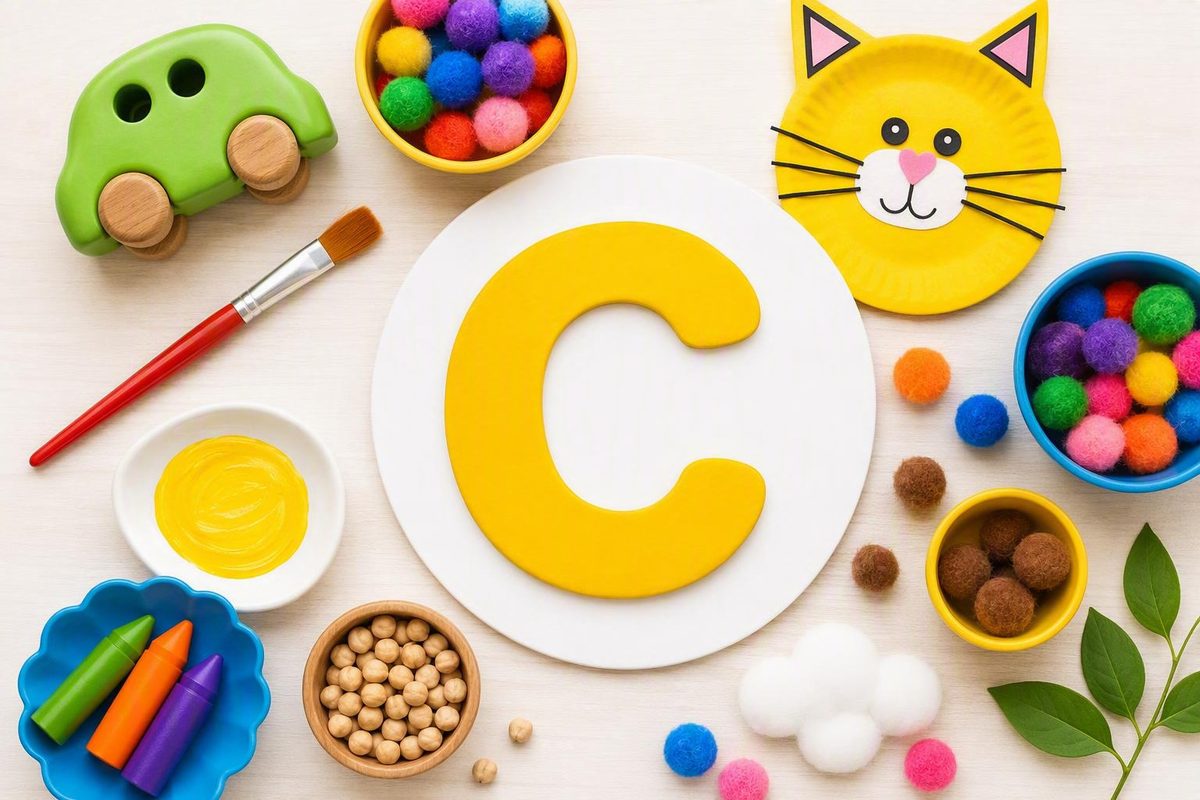
Learn C through sounds, shapes, crafts, games, and movement.
Letter C activities for preschool can focus on three concrete goals:
- Recognize uppercase C and lowercase c
- Hear the initial hard /k/ sound in familiar words such as cat and car
- Follow or form an open curved shape
Children do not need to complete all 18 activities—or use a pencil—to practice these goals. A pre-writer can point, match, build, finger-trace, drive along, or walk around C. An emerging writer can trace a broad model or try forming the letter beside an example.
The key is to make the target visible. A caterpillar glued onto a C becomes a more direct letter lesson when an adult asks, “Can you find the C?” A car activity becomes phonics practice when the child hears and repeats the clipped initial /k/. The goal is not a decorative product alone, but repeated opportunities to notice the letter, sound, and open curve.
Start Here: Choose an Activity for the Skill You Want to Practice
The 18 activities fall into four practical categories:
- Recognition games: Activities 1–4
- Formation practice: Activities 5–8
- Crafts and fine-motor work: Activities 9–12
- Cross-curricular play: Activities 13–18
Use the table to choose an activity based on the target skill, available materials, setting, and child’s readiness. Mess levels are relative: “low” still assumes ordinary cleanup, while “medium” or “higher” may involve glue, paint, water, or sensory material.
The supervision column is a planning reminder rather than a guarantee that a material is suitable for every child. Activity sources advise adult supervision for crafts and identify small objects as possible choking concerns; adults should select materials according to the children and setting (ABCmouse; Growing Hands-On Kids).
| Activity | Primary goal | Pre-writer or emerging-writer pathway | Basic supplies | No-print? | Mess | Setting | Supervision considerations |
|---|---|---|---|---|---|---|---|
| 1. C/c search and match | Case recognition | Find, point, and match | Handmade C/c cards | Yes | Low | Individual or group | Use large, sturdy cards |
| 2. Dot or cover the C | Visual discrimination | Cover or circle instead of writing | Paper, marker, covers | Yes | Low | Individual or center | Replace small counters with paper squares when needed |
| 3. Environmental C hunt | Recognition in real print | Point and compare | Model C card | Yes | Low | Individual or group | Keep the search area manageable |
| 4. Object and picture sort | Initial-sound listening | Name, point, and sort | Familiar objects or pictures | Yes | Low | Individual or small group | Use large objects and teach their names first |
| 5. Playdough C | Shape construction | Build C with a rope | Playdough | Yes | Low–medium | Individual or center | Monitor material use |
| 6. Car-track C | Formation path | Drive rather than draw | Paper or chalk, toy car | Yes | Low | Individual or center | Choose a suitably sized toy |
| 7. Tactile tray | Finger formation | Trace a broad path | Sand, sealed bag, or textured paper | Yes | Medium | Individual or supervised center | Choose contained materials when loose filler is unsuitable |
| 8. Whole-body C | Large-motor formation | Walk, hop, or roll along C | Tape or chalk | Yes | Low | Individual or group | Clear the route and space children apart |
| 9. Caterpillar C collage | Recognition and placement | Place large pieces on C | Paper, glue, tissue or circles | Yes | Medium | Individual or center | Prepare cutting and small decorations as needed |
| 10. C-shaped cat | Recognition after transformation | Add pre-cut features | Paper C, glue, drawing tools | Yes | Medium | Individual or center | Supervise scissors and collage pieces |
| 11. Cotton cloud C | Letter identification | Place material along outline | Paper, glue, cotton or paper | Yes | Medium | Individual or center | Substitute paper if loose fibers are unsuitable |
| 12. Carrot stamping | Hard-C sound and shape | Stamp around a C | Prepared carrot or sponge, paint | Yes | Higher | Individual or small group | Adult prepares produce and checks material suitability |
| 13. Count the Cs | Counting and recognition | Place large paper Cs | Paper C pieces, numbered areas | Yes | Low | Individual or small group | Prefer large pieces when small manipulatives are unsuitable |
| 14. Circle collage and count | Shape placement and counting | Place and count circles | Paper circles, glue | Yes | Medium | Individual or center | Use large paper shapes when needed |
| 15. Hard-C scavenger hunt | Initial /k/ recognition | Find or point to objects | Cup, coat, comb, car | Yes | Low | Individual or group | Preplace familiar objects in safe locations |
| 16. Pretend cooking | Oral vocabulary | Name and use pretend items | Empty dishes, spoons, water | Yes | Medium | Individual, group, or center | Supervise water and inspect props |
| 17. Car wash or car play | Sound, movement, and formation | Wash or drive cars along C | Toy cars, shallow water, towels | Yes | Medium–higher | Individual or center | Supervise water and limit materials |
| 18. Read and move | Sound listening | Respond with a motion | Book or oral story | Yes if told orally | Low | Individual or group | Provide room for movement |
A no-print activity does not have to be equipment-free. A handwritten model card, chalk C, paper cutout, or spoken word list is enough. Reusable classroom centers can use sturdy handwritten cards. Lamination may help materials last longer, but it is not required.
Do not treat one activity as universally best. A child who avoids glue may respond to movement; another may prefer object sorting to a group listening game. Change the pathway without changing the target: find C, match C with c, hear /k/, or follow the open curve.
Teach the Sound Clearly: Hard C First, Soft C Briefly
C can represent more than one sound. For an introductory preschool lesson, concentrate on the hard /k/ heard at the beginning of cat and car. Say it as a short, clipped sound: /k/. Avoid stretching it into “kuh,” which adds a vowel not present in the consonant sound. This clipped-sound guidance also appears in ABCJesusLovesMe’s Letter C suggestions.
Use the same routine repeatedly:
- Say the whole word naturally: “cat.”
- Isolate the beginning sound: “/k/, cat.”
- Ask: “Do you hear /k/ at the beginning?”
- Let the child answer verbally, point, clap, or make an agreed movement.
Hard-C word bank
- cat
- car
- cow
- cup
- corn
- carrot
- coat
- comb
- camel
- caterpillar
- cookie
- crab
Choose words the child understands. Before asking multilingual learners to identify an initial sound in an English word, show or explain the object and teach its English name.
What about soft C?
Briefly explain: “C sometimes makes a different sound. In city, it sounds like /s/. Today we are listening for the /k/ sound.”
Label city and celery as soft-C examples, not hard-C models. Words such as cheese, chicken, chips, Cheerios, and chocolate begin with the written letter C, but their opening sound is not the target /k/. They can appear in a visual letter hunt, but they should not be placed in a hard-C listening group. Introductory guidance from Katie Roltgen Teaching likewise starts with familiar hard-C words while acknowledging that C can represent another sound.
Try a listening round
Tell children to clap, tap their knees, stand, or make another agreed movement only when they hear a word beginning with /k/.
Say this mixed list slowly:
- cat
- moon
- cup
- sun
- car
- fish
- coat
- dog
- crab
- leaf
Repeat with fewer words if the listening or language demand is too high. For a challenge, ask, “Why did you clap for cup?” A suitable answer is, “It starts with /k/.”
Four Recognition Games for Uppercase C and Lowercase c
Visual recognition and sound recognition are related but distinct. Finding a printed C does not by itself show that a child hears /k/ at the beginning of cat. Include both visual prompts—“Find C”—and oral prompts—“Which word begins with /k/?”
Activity 1 — C/c search and match
Learning prompt: “Find a letter. Is it uppercase C or lowercase c? Put it under its match.”
Materials: Large paper cards marked C or c, plus one uppercase and one lowercase model.
Setup: Display the two model cards. Hide the remaining cards in visible, reachable locations. A reusable center version can use sturdy paper or laminated cards; hidden-note matching is one of the activities documented by ABCDee Learning.
Steps:
- Point to the models and name each one.
- Find one hidden card.
- Compare it with both models.
- Place it beneath the matching letter.
- Say “uppercase C” or “lowercase c” together.
Easier variation: Use two C cards and two c cards, all placed in sight.
Challenge: Mix in another curved letter, such as O, or ask the child to explain the match.
Activity 2 — Dot or cover the C
Learning prompt: “Mark only C and c. Leave the other letters uncovered.”
Materials: Paper, marker, and a dot marker, crayon, reusable cover, or large paper square.
Setup: Write several uppercase and lowercase Cs among a small number of distractors. Begin with clearly different letters such as T, X, and L before adding similar rounded forms.
Steps:
- Show the target models.
- Point to the first letter and compare it with the model.
- Dot, circle, or cover it only if it is C or c.
- Name each target as it is marked.
- Review the marked Cs and unmarked distractors.
Easier variation: Present three choices and place one C first.
Challenge: Use one mark for uppercase C and another for lowercase c, or ask the child to name each case.
Activity 3 — No-print environmental hunt
Learning prompt: “Can you find a printed C and check it against our model?”
Materials: One handwritten C/c model card; optional clipboard or sticky notes.
Setup: Choose a small area containing book covers, labels, signs, names, packages, or classroom print.
Steps:
- Study the model card together.
- Scan one small area rather than the whole room.
- Point to a possible C.
- Compare its open curve with the model.
- Decide whether it is uppercase C, lowercase c, or another letter.
Easier variation: Preselect two books or labels and indicate where to look.
Challenge: Find both cases or explain why O is not C: O closes, while C stays open.
This is visual recognition. If the printed word is city or cheese, the child has still found the written letter C, but the word does not provide the target initial /k/. Use a separate hard-C word for the sound prompt.
Activity 4 — Object and picture sort
Learning prompt: “Say the name. Listen to the first sound. Does it begin with /k/?”
Materials: Familiar objects or pictures such as a cup, car, comb, cat, and coat, plus items beginning with other sounds.
Setup: Limit the first round to a few clearly named items. Name every item before asking the child to sort.
Steps:
- Pick up one object and say its name naturally.
- Repeat it with the first sound isolated: “/k/, cup.”
- Decide whether it belongs in the hard-C group.
- Place non-/k/ objects in a second group.
- Review the hard-C objects by naming them again.
Easier variation: Preplace one hard-C object and offer one new object at a time.
Challenge: Label the sorting areas C and c, or ask, “Why does comb belong here?”
Four Ways to Build and Form the Open C Curve
Uppercase C and lowercase c use the same basic open curve, although their size and position differ. A simple practical demonstration is:
Begin near the top, curve left and around, and stop before the line closes.
This is a usable activity model, not a clinical handwriting rule. Pre-writers can follow a large route or build the shape. Emerging tracers can follow a bold or tactile outline. Children ready to use a drawing tool can try forming C beside a visible model.
Activity 5 — Playdough C
Roll one long playdough rope and bend it into uppercase C. Roll a shorter rope and form lowercase c beside it.
- Prompt: “Where is the open part? Which C is uppercase?”
- Pre-writer pathway: Bend a prepared rope or place it over a large model.
- Emerging-writer pathway: Build C, then try drawing it beside the model.
- Variation: Use a strip of fabric or folded paper instead of dough.
If the letter closes, compare it with O and gently reopen the gap.
Activity 6 — Car-track C
Draw a wide C-shaped road on paper, cardboard, pavement, or a wipe-clean board. Place a toy car near the top.
- Say, “Start near the top.”
- Drive left and around the curve.
- Stop before the road closes.
- Name C or say one clipped /k/ while driving.
- Repeat with a smaller lowercase route if appropriate.
Easier variation: Make the track broad and add a start marker.
Challenge: Place uppercase and lowercase tracks side by side and ask the child to choose one by name.
Activity 7 — Tactile tray
Make a broad C in a shallow layer of material selected for the setting. Possible options include damp sand, a sealed sensory bag containing a small amount of gel or paint, textured paper, or a raised glue outline.
- Model the route with one finger.
- Reset the surface if necessary.
- Invite the child to trace from near the top.
- Say “C” or a clipped /k/ during the motion.
- Compare the finished curve with a model.
Do not require independent tracing. A child can watch the demonstration, follow a preformed path, or move an object around the curve. Use a sealed or paper-based option when loose sensory material is not appropriate for the group.
Activity 8 — Whole-body C
Use painter’s tape indoors or chalk outdoors to make a large C.
- Walk from the top around the curve.
- Hop along spaced marks.
- Push or roll a ball along the route.
- Drive a larger toy beside the line.
- Stand inside the C and point toward its open side.
Keep the route clear, space children apart, and take turns in a group. A supervised center can use a shorter taped C for toy movement rather than whole-body travel.
If a child forms a recognizable C in another direction, calmly model the intended motion again and offer another large-motor or tactile turn. There is no need to turn the activity into a correction drill, therapy exercise, or developmental conclusion.
Four Letter C Crafts With a Built-In Learning Prompt
Each craft includes a prompt that keeps C visible. Children may tear, place, stamp, glue, draw, or identify; no guaranteed learning or developmental outcome is implied.
Googly eyes, small collage pieces, pipe cleaners, scissors, paint, and prepared food materials call for setting-appropriate adult preparation or supervision. Published Letter C craft instructions likewise direct adults to supervise projects involving cut produce, paint, glue, and optional decorations.
Activity 9 — Caterpillar C collage
Materials: Large paper C, tissue paper or large paper circles, glue, paper face, and drawing tools; optional antennae.
Adult preparation: Draw or cut a broad C. Prepare large pieces if the child is not using scissors.
Steps:
- Point to and name the uncovered C.
- Scrunch tissue or choose a paper circle.
- Glue pieces along the C without closing its open side.
- Add a face and drawn antennae.
- Point to the open part and identify C again.
Learning prompt: “Show me where the C stays open. What letter is under the caterpillar?”
Lower-mess or large-piece substitution: Use large paper circles with a glue stick. Draw the antennae rather than attaching extra pieces.
Activity 10 — C-shaped cat
Materials: Block-letter C, paper ears and tail, crayons, glue, and drawn or paper facial features.
Adult preparation: Cut the C and features when children are not ready to use scissors.
Steps:
- Ask the child to identify the plain C.
- Add ears near the top.
- Add a tail, eyes, nose, stripes, and whiskers.
- Keep part of the original curve visible.
- Ask the child to find C after it becomes a cat.
Learning prompt: “It looks like a cat now, but can you still find the C? What sound begins cat?”
Substitution: Draw the face and details rather than using small collage pieces. Turning a block-letter C into a cat is also documented in the ABCmouse Letter C craft collection cited above.
Activity 11 — Cotton cloud C
Materials: Large C outline, glue, and cotton or white paper pieces.
Adult preparation: Draw a thick C and portion the chosen material.
Steps:
- Name the letter before covering it.
- Pull apart or pick up the collage material.
- Place it along the curve.
- Leave the open side visible.
- Point to and name the finished C.
Learning prompt: “Find the C under the cloud material.”
Keep this craft’s main prompt on identifying the letter and following its curve.
Reduced-sensory substitution: Use torn white paper, broad paper strips, or white crayon marks instead of cotton.
Activity 12 — Carrot stamping
Materials: Large C outline, washable tempera paint, paper, green paper or crayons, and an adult-prepared carrot section or sponge stamp.
Adult preparation: An adult washes and cuts the carrot, prepares a stable stamping surface, and determines whether food use is appropriate for the group.
Steps:
- Name carrot and isolate its first sound: “/k/, carrot.”
- Dip the prepared stamp lightly in orange paint.
- Stamp along or around the C outline.
- Add drawn or paper leaves.
- Find the C and repeat the hard-C word.
Learning prompt: “Does carrot begin with /k/? Can you show me the open C?”
Nonfood or lower-mess substitution: Use a sponge shape, orange paper circles, or crayon marks. Before using produce, adults should consider allergies, dietary restrictions, hygiene, sanitation, choking concerns, and program rules; food-based activity sources do not establish suitability for every group.
Six More Ideas for Movement, Math, Sensory Play, and Everyday Learning
Math, movement, practical-life play, and sensory exploration can extend a Letter C lesson, but the C prompt should remain visible. Continue asking children to identify the letter, hear the sound, or follow the curve.
Activity 13 — Count the Cs
Divide paper or a tray into sections numbered 1 through 5. Prepare large paper C pieces.
- Point to a numeral.
- Count out that many Cs.
- Place each C in the section.
- Touch and recount the pieces.
- Say, “These are all Cs.”
For an individual activity, use all five sections. In a small group, give each child one section. At a center, provide only the quantities needed for that round.
Simpler version: Use sections 1 and 2.
Visible Letter C prompt: “Before you count it, show me the open part of each C.”
Activity 14 — Circle collage and count
Place large paper circles along a C outline, then count them.
- Individual: One child places and counts all the circles.
- Small group: Children take turns adding one circle.
- Center: Supply a limited set of reusable paper circles for covering the outline.
The pieces should follow the C without closing the gap. Use large paper shapes instead of small stickers when larger materials better suit the children or cleanup plan.
Visible prompt: “Are the circles making an open C or a closed O?”
Activity 15 — Hard-C scavenger hunt
Search for familiar objects whose English names begin with /k/: cup, coat, comb, car, cap, or a picture of a cat.
- Review the object names first.
- Show a model C.
- Find or reveal one item.
- Say its name naturally.
- Isolate the first sound and decide whether it belongs.
For an individual child, offer a choice between two visible objects. A small group can find one item at a time. For a center, preplace a few familiar objects in a defined area and limit how many children search at once.
Visible prompt: “What is it called? Do you hear /k/ at the beginning?”
Activity 16 — Pretend cooking
Set out empty dishes, spoons, cups, and water or dry pretend materials selected for the setting. Outdoor pretend cooking with water, spoons, and dishes appears in this family Letter C activity theme.
Use oral C vocabulary intentionally:
- cook
- cup
- count
- carry
- clean
Not every cooking-related word begins with hard C, so do not imply that the entire play theme is phonics practice. Pause occasionally for a visible target: “You picked up the cup. Cup begins with /k/.”
For a group, assign roles and rotate turns. At a center, limit the number of dishes and supervise any water use. For one child, narrate actions using one or two target words rather than interrupting the play with frequent questions.
Activity 17 — Car wash or car sensory play
Create a simple wash station with toy cars, a shallow container of water, a cloth or sponge, and towels. Alternatively, skip the water and drive cars through a C-shaped route.
- Identify the C route or model card.
- Say “/k/, car.”
- Drive around the open curve.
- Wash and dry the car if using water.
- Park it beside uppercase C or lowercase c.
For one child, offer one or two cars. In a small group, assign washing, drying, and parking turns. At a supervised center, limit the cars and water tools, place towels nearby, and keep the C route visible.
Loose rice, dried beans, or similar fillers are not necessary. A dry version can use an empty tray, fabric strips, paper, or a simple drawn road.
Activity 18 — Read and move
Pair a C-themed read-aloud or oral story with motions for selected hard-C words:
- Curl like a cat
- Crawl like a caterpillar
- Pretend to drive a car
- Make horns for a cow
- Hold an imaginary cup
- Open and close hands like a crab
Documented book options include The Very Hungry Caterpillar, Click, Clack, Moo: Cows That Type, and If You Give a Cat a Cupcake. The Carrot Seed also appears in the ABCJesusLovesMe Letter C book list. Check current classroom, library, or bookseller availability rather than assuming a particular title is accessible.
For an individual child, choose two motions. In a small group, assign one movement to everyone. At a center, use familiar picture cues and supervise turn-taking. If no book is available, tell a short oral story using cat, car, cup, and crab.
A Flexible Five-Day Letter C Plan
This sequence is an optional planning framework, not a mandatory timetable or a promise that children will master C within five days. A teacher can rotate activities through centers, while a family can choose one warm-up or hands-on component rather than completing the full plan.
Day 1 — Recognition
- Warm-up: Display uppercase C and lowercase c. Notice that both are open curves.
- Main activity: Complete the C/c search-and-match game, then look for C in environmental print.
- Optional movement break: Walk around the room and point to a hidden C.
- Closing review: Hold up one C and one c; ask the child to name or match them.
- No-print option: Write C and c on scrap paper and search for them on book covers or labels.
Day 2 — Sound
- Warm-up: Model the short, clipped /k/.
- Main activity: Name a small set of familiar hard-C objects and play the listening-and-clapping round. Add a related read-aloud or oral story.
- Optional movement break: Curl for cat, crawl for caterpillar, or pretend to drive a car.
- Closing review: Ask which of two spoken words begins with /k/.
- No-print option: Use household objects and spoken words instead of cards.
Day 3 — Formation
- Warm-up: Demonstrate: start near the top, curve left and around, and stop before closing.
- Main activity: Build uppercase C and lowercase c with playdough.
- Optional movement break: Follow a taped, chalked, imaginary, or car-track C.
- Closing review: Ask the child to show where C is open.
- No-print option: Form C with dough, a fabric strip, finger movement in the air, or a toy car route.
Day 4 — Application
- Warm-up: Review one visual prompt and one sound prompt.
- Main activity: Choose one craft, such as the caterpillar collage or C-shaped cat.
- Extension: Add one counting, sorting, sensory, or pretend-play activity.
- Optional movement break: Carry one large C at a time to a matching station.
- Closing review: Repeat the prompt used during the craft: “Find C,” “Say /k/,” or “Follow the curve.”
- No-print option: Draw C by hand and use torn paper, found objects, or pretend play.
Day 5 — Review
- Warm-up: Repeat a favorite C song, word list, or movement.
- Main activity: Play a favorite game, then complete the four-part informal check below.
- Optional movement break: Walk the whole-body C or act out one hard-C word.
- Closing review: Note whether the next activity should focus on recognition, sound, or formation.
- No-print option: Use handmade letters, spoken word pairs, and finger formation in the air or on a table.
In a classroom, place recognition cards at one center, playdough or a car track at another, and a supervised collage or object sort at a third. Rotate small groups instead of expecting every child to complete every task simultaneously. At home, one search, one sound question, or one trip around a chalk C can be the entire activity.
Adaptations, Material Substitutions, and Safety Notes
Select materials for the particular children, setting, and available supervision. Coins, beads, LEGO pieces, pom-poms, googly eyes, dried beans, gravel, mini erasers, stickers, and similar manipulatives can be small enough to require close supervision or replacement. Scissors, paper punches, cut produce, pipe cleaners, paint, and small collage materials also call for age-appropriate adult preparation or supervision. The cited tot-school guidance specifically notes adult supervision and choking concerns around small objects.
Before using food, consider:
- Allergies and dietary restrictions
- Hygiene and sanitation
- Whether the material could become a choking concern
- Family, classroom, and program rules
- Whether a nonfood material would avoid unnecessary waste
Useful nonfood substitutions include:
- Paper circles instead of cereal
- Sponge shapes instead of carrot stamps
- Colored paper instead of sprinkles
- Paper pictures instead of snack sorting
- Fabric strips instead of edible letter shapes
- Empty, clean containers instead of food packages
For children who benefit from larger or easier-to-grasp materials, try:
- Large paper pieces instead of beads or mini erasers
- Chunky crayons or an appropriate adaptive drawing tool
- Broad tactile outlines
- Large model cards
- Pre-cut materials
- Wide toy-car tracks
- Oversized C shapes for matching
For reduced-sensory options, use:
- A sealed sensory bag instead of an open tray
- Paper collage instead of cotton
- Washable tempera instead of acrylic craft paint
- An empty tray instead of rice, salt, or beans
- Picture sorting instead of messy fillers
- Movement or air tracing instead of finger paint
- A dry car route instead of a water station
Reduce language and visual demands by introducing unfamiliar vocabulary before sound sorting. Offer two objects instead of six, place matching models close together, or preplace the first item. A child can answer by pointing, moving an object, or making an agreed gesture rather than speaking.
These are general activity adaptations, not individualized occupational therapy, speech-language, medical, or developmental advice. When a child needs individualized support, follow the procedures and professional guidance appropriate to the family or educational setting.
A Four-Part Check for Recognition, Sound, and Formation
Use this as an informal observation, not a validated assessment, score, or diagnostic measure. Keep it playful and stop before frustration.
Check 1 — Recognition
Place C among a few other letters and ask, “Can you point to C?”
Use clearly different distractors first. Note whether the child responds independently or uses a model or reminder.
Check 2 — Case matching
Place uppercase C and lowercase c among a small number of cards. Ask the child to pair C with c.
The child does not need to name both cases aloud. Pointing or placing the cards together can show the response.
Check 3 — Sound listening
Say one hard-C word and one word beginning with another sound—for example, “cat” and “dog.” Ask, “Which word begins with /k/?”
Name pictures or objects before checking the sound contrast. Avoid unfamiliar vocabulary and soft-C examples.
Check 4 — Formation
Invite the child to make C in a readiness-appropriate way:
- Draw it with a finger in the air
- Follow a large tactile outline
- Bend a playdough rope
- Drive a toy car around a C route
- Use a crayon or marker beside a model
Record observations with simple labels:
- Independent
- Completed with a prompt
- Not yet demonstrated
Avoid totals, pass/fail language, or developmental conclusions. Use the observation only to choose what to do next:
- If recognition was not yet demonstrated, repeat C hunts and matching.
- If case matching was difficult, compare one C and one c at a time.
- If sound listening needs practice, use oral games with familiar objects.
- If formation needs support, return to large-motor, construction, or tactile paths.
Revisit the target through play rather than demanding mastery within a fixed number of sessions.
Frequently Asked Questions
What are the easiest no-print Letter C activities for preschoolers?
Try an environmental C hunt, household-object scavenger hunt, oral listening and clapping, air tracing, whole-body C movement, pretend cooking with cups, or driving a toy car along an imaginary C. Handmade cards and chalk lines also count as no-print options because they require no download or commercial resource.
For a simple combination, find one printed C on a book, clap for cat but not dog, and make a C in the air.
Should preschoolers learn hard C or soft C first?
An introductory activity can focus on hard C, the /k/ heard in cat, car, and cup. It is still accurate to mention briefly that C can sound different in a word such as city. Preschoolers do not need to master the spelling pattern during this lesson.
Keep the examples clearly labeled. Celery and city are soft-C words. Cheese, chicken, and chocolate begin with written C but do not model the target hard /k/.
How do you teach Letter C to a child who is not ready to write?
Let the child point to C, match C with c, build the curve with playdough, finger-trace a broad path, drive a car around the shape, or walk along a taped C. These responses provide observable practice without requiring pencil control.
If tracing is introduced, make the path broad and optional. A child can follow a model visually or build the shape before attempting to draw it.
Which Letter C activity materials require extra supervision?
Scissors, paper punches, paint, glue, cut produce, pipe cleaners, water stations, and small parts require setting-appropriate adult preparation or supervision. Potential small parts include beads, coins, LEGO pieces, pom-poms, googly eyes, dried beans, gravel, mini erasers, stickers, and small collage pieces.
Food materials also require checks for allergies, dietary restrictions, hygiene, sanitation, choking concerns, and waste. Substitute large paper pieces, sponge stamps, washable materials, sealed sensory bags, or pre-cut components when those better suit the setting.
How can I tell whether a preschooler recognizes C instead of only remembering the craft?
Show C in a new context. Place it among a few other letters, ask the child to find it on a book cover, or match a fresh uppercase C card to lowercase c. Check sound separately by asking which of two familiar words begins with /k/.
Changing the color, size, location, and surrounding letters provides another informal opportunity to observe letter recognition.
There is no need to attempt every idea at once. Choose one recognition activity, one sound game, and one way to make the open curve. Keep the goal observable: finding C, matching C with c, hearing initial /k/, and forming or following the curve. Safe materials, readiness-sensitive choices, and playful repetition matter more than completing a worksheet or producing a perfect craft.