
Turn Letter Practice Into Hunting, Building, Moving, and Making
Pick one current goal instead of covering the full alphabet at once, with playful options for recognition, beginning sounds, case matching and formation.
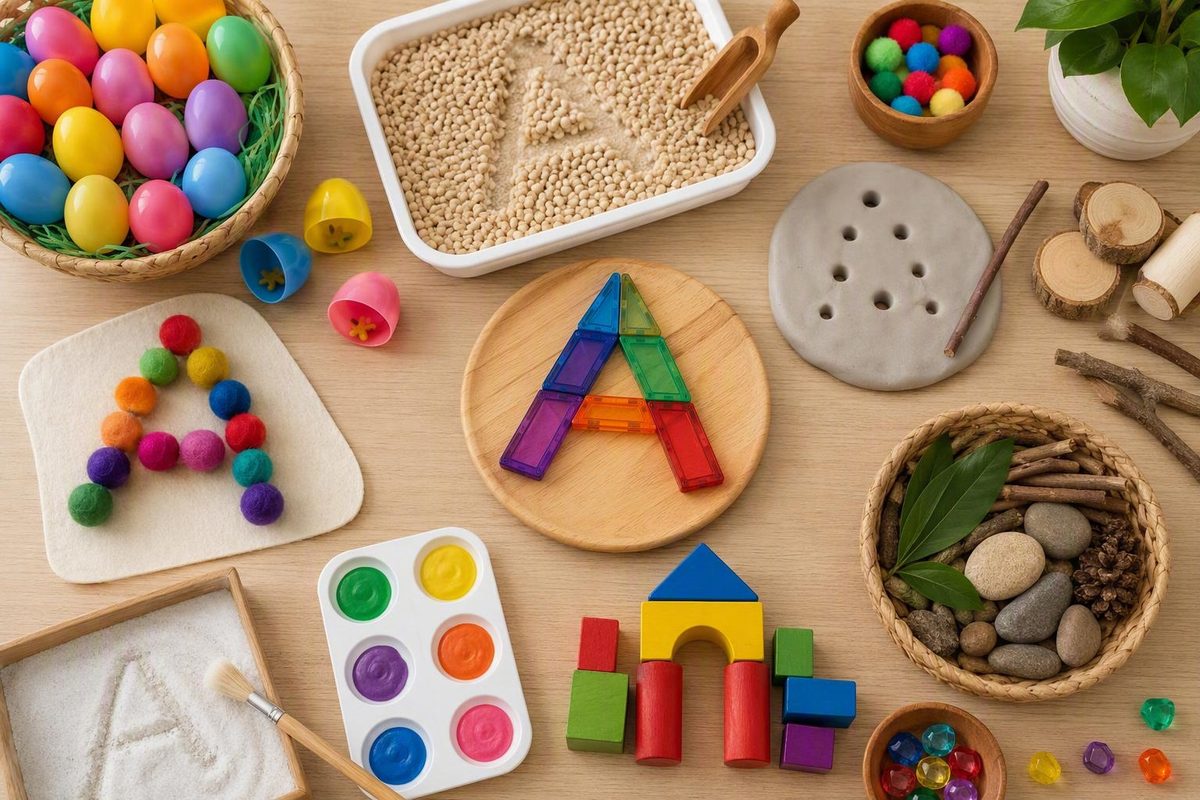
Turn letter practice into hunting, building, moving, and making.
Letter activities for preschoolers do not require a full alphabet worksheet, an expensive manipulative set, or a formal lesson. A paper-letter hunt can practice recognition. Familiar objects can draw attention to beginning sounds. Homemade cards can pair uppercase and lowercase forms. Dough, water, chalk, and cardboard can turn formation into building and making.
The key is to choose one primary goal. That keeps a playful invitation from quietly becoming a test of letter names, sounds, handwriting, vocabulary, and memory all at once.
Choose the Letter Skill Before You Choose the Activity
Use this table to match an activity to the skill you want to practice. An activity may involve other skills, but its primary goal is the one to emphasize first.
| # | Activity | Primary goal |
|---|---|---|
| 1 | Name-Letter Hunt | Letter recognition |
| 2 | Environmental Print Walk | Letter recognition |
| 3 | Letter Hide-and-Seek | Letter recognition |
| 4 | Lines-and-Curves Sort | Letter recognition |
| 5 | Letter I Spy | Letter recognition |
| 6 | Small-Board Letter Bingo | Letter recognition |
| 7 | Sound Scavenger Hunt | Common letter-sound association |
| 8 | Object-to-Letter Sort | Common letter-sound association |
| 9 | Three-Part Picture Match | Common letter-sound association |
| 10 | Find, Write, and Draw | Common letter-sound association |
| 11 | Case Card Match | Uppercase-lowercase matching |
| 12 | Alphabet Parking | Uppercase-lowercase matching |
| 13 | Cooperative Letter Memory | Uppercase-lowercase matching |
| 14 | Playdough Letters | Letter formation |
| 15 | Texture Tracing | Letter formation |
| 16 | Sensory Writing Tray | Letter formation |
| 17 | Water-or-Chalk Letters | Letter formation |
| 18 | Reusable Loose-Parts Mat | Letter formation |
| 19 | Letter Hop | Letter recognition |
| 20 | Alphabet Bowling | Letter recognition |
| 21 | Letter Collage | Letter formation |
Letter recognition can involve naming a displayed letter, finding a named letter among several choices, or connecting a familiar sound with a letter. These tasks are related but not interchangeable.
Letter formation means making a letter’s shape. A child might trace with a finger, arrange dough over a model, paint with water, or use a crayon.
Alphabet knowledge at kindergarten entry has been associated with later reading and spelling outcomes in published research summarized by Piasta and colleagues. An association does not establish that any particular game causes later reading success or that one kind of activity is best for every child.
Each activity below includes:
- Primary skill
- Materials
- Preparation
- Mess
- Setting
- Group format
- Supervision
- Directions
- Simpler version
- Extension
Everything can be made with ordinary supplies: paper, cardboard, tape, chalk, dough, recycled containers, water, natural objects, and materials already available at home or in a classroom. Printables and commercial products may be convenient, but none is required.
Start With a Small, Meaningful Set of Letters
Letters in a child’s name make a practical starting set. ABCJesusLovesMe likewise recommends beginning with name letters and introducing only a few letters at a time.
Reduce the number of visible choices if a large display leads to random grabbing, distraction, or frustration. In one sponsored activity example, Busy Toddler limits dough-mat choices to groups of five letters. That is an activity-specific model, not a universal rule. Two choices may be enough for one child, while another may comfortably scan six or eight.
The supplied activity sources propose several different sequences:
- letters from the child’s name;
- letters grouped for early phonics;
- uppercase letters before lowercase;
- letters grouped by straight, curved, or diagonal strokes;
- uppercase and lowercase forms introduced together;
- or the traditional ABC sequence.
For example, How Wee Learn recommends a phonics-oriented order beginning with s, a, t, i, p, n, while Learning Without Tears recommends capitals first and groups them partly by formation features. These are instructional recommendations, not evidence that either sequence is universally best.
If a preschool or chosen curriculum follows a particular order, using the same sequence at home can provide consistent language and models. Home practice can still remain playful and low pressure. The sequence is an organizational choice, not a guarantee.
To introduce a target letter during play:
- Display the letter where the child can see it.
- Say its name naturally: “This is S.”
- Model a common sound accurately: “It can represent /sss/, as in sun.”
- Connect it to a familiar person, object, place, or word.
- Invite participation: “Would you like to find another S?”
This creates an opening rather than a quiz. If the child points, matches, repeats, or simply watches, the activity can continue without demanding a performance.
Use clear, familiar examples in beginning-sound games. For S, sun is more straightforward than sugar. Avoid suggesting that a letter always represents only one sound.
Letter Recognition Games for Finding, Sorting, and Naming
The first six activities focus on noticing, finding, matching, and naming letters. Keep these prompts distinct:
- Matching prompt: “Find the one that looks the same.”
- Naming prompt: “Can you find M?”
Matching is a useful entry point. Naming can be added when appropriate.
Activity 1: Name-Letter Hunt
- Primary skill: Letter recognition
- Materials: Large paper or cardboard letters from the child’s name; a written name model
- Preparation: Low—cut or tear out the letters
- Mess: None
- Setting: Home, classroom, or quiet hallway
- Group format: One child; adaptable for partners
- Supervision: Place letters in visible, reachable locations appropriate to the setting
- Directions: Hide the name letters around the space. As each is found, place it beside the written model. Begin with matching; name the letter if that suits the child’s current level. Arrange the completed set in name order. Make a separate card for every repeated letter.
- Simpler version: Put each found letter directly on top of its match.
- Extension: Add two or three non-name letters and ask which ones belong in the name.
Do not require the child to recite the full name or alphabet. The immediate task is recognizing the selected letters.
Activity 2: Environmental Print Walk
- Primary skill: Letter recognition
- Materials: Packages, labels, signs, book covers, menus, or classroom displays
- Preparation: None
- Mess: None
- Setting: Indoors, outdoors, or during an errand
- Group format: One child, partners, or a small group
- Supervision: Select a safe route and keep attention on the surroundings
- Directions: Choose one familiar target letter. Look for it in several places and describe where it appears: “There is T at the top of that title.” Compare examples in different colors, sizes, and simple typefaces.
- Simpler version: Hold up a paper model and compare it directly with one nearby example.
- Extension: Photograph or sketch examples, then sort them by uppercase and lowercase.
Font variation can be offered as additional comparison practice. Introduce unfamiliar forms beside a known model rather than assuming that a child will recognize them immediately. A rotated object or unrelated shape can prompt discussion, but it should not be labeled as the actual letter.
Activity 3: Letter Hide-and-Seek
- Primary skill: Letter recognition
- Materials: Large paper, foam, cardboard, or washable letters
- Preparation: Low
- Mess: None unless combined with a sensory material
- Setting: Room, play area, or classroom center
- Group format: One child or a small cooperative group
- Supervision: Use age-appropriate pieces and accessible hiding places
- Directions: Hide a small letter set in easy-to-see locations. Give each child a matching model. When a letter is found, compare it with the model before placing it in a basket. Hide-and-seek appears among the matching and recognition ideas in ABCmouse’s collection of preschool letter activities.
- Simpler version: Hide several identical copies of one target letter.
- Extension: Ask for the letter’s name or a familiar word beginning with a common sound it represents.
Keep the search cooperative. There is no need to reward the child who finds the most.
Activity 4: Lines-and-Curves Sort
- Primary skill: Letter recognition through visual comparison
- Materials: Selected paper letters; mats labeled “lines,” “curves,” and “both”
- Preparation: Low
- Mess: None
- Setting: Table or floor
- Group format: Individual, partners, or a teacher-led small group
- Supervision: Help children examine the displayed forms without turning the task into a trick question
- Directions: Look at one letter at a time. Decide whether it contains straight lines, curves, or both, then place it on the corresponding mat. Describe visible features: “B has a straight line and curves.”
- Simpler version: Use two clearly contrasting letters and two categories.
- Extension: Sort uppercase and lowercase versions separately, then compare the pair.
The goal is visual comparison, not sound recall. Lowercase fonts may make some classifications debatable; use those examples for comparison rather than marking one observation as a failure.
Activity 5: Letter I Spy
- Primary skill: Letter recognition
- Materials: Several visible letter cards or letters in the environment
- Preparation: None to low
- Mess: None
- Setting: Table, circle area, waiting room, or book corner
- Group format: Especially useful with partners
- Supervision: Position cards so everyone can see and reach them comfortably
- Directions: Give one direct clue: “I spy the letter M,” “I spy a letter with three straight lines,” or “I spy the letter at the start of Maya.” Children may point, pick up a card, touch it, look toward it, or otherwise indicate a choice.
- Simpler version: Offer two choices and display a matching model.
- Extension: Let the child choose a letter and give a clue to a partner.
Treat pointing, gesturing, eye-gazing, or handing over a card as optional response formats, not as evidence of any particular developmental ability.
Activity 6: Small-Board Letter Bingo
- Primary skill: Letter recognition
- Materials: Homemade boards with a few familiar letters; large paper covers or fingers for pointing
- Preparation: Moderate the first time; boards can be reused
- Mess: None
- Setting: Table, rug, or circle area
- Group format: Small group
- Supervision: Choose markers appropriate to the children and setting
- Directions: Call one letter name and show its card after a short pause. Players cover or point to the matching letter. Continue cooperatively until every space on every board is covered.
- Simpler version: Use identical layouts and show each called letter immediately.
- Extension: Vary the font or occasionally give a clear beginning-sound clue.
Use only currently familiar letters.
Beginning-Sound Activities That Connect Letters With Words
The target is the first sound in the spoken word—not whether a letter appears somewhere later in its spelling.
A sound game does not need to become a handwriting task. Keep formation optional unless it is the intended goal.
Activity 7: Sound Scavenger Hunt
- Primary skill: Common letter-sound association
- Materials: One large target-letter card; familiar objects in the room
- Preparation: None
- Mess: None
- Setting: Home, classroom, or outdoors
- Group format: Individual, partners, or a small group
- Supervision: Establish which objects may be carried and which should only be indicated
- Directions: Choose one letter and model a familiar common sound. Search for objects whose spoken names begin with that sound. Say each word aloud before accepting it: “Marker begins with /m/.”
- Simpler version: Place one matching and one nonmatching object beside the letter.
- Extension: Collect several objects, then think of additional words without finding the objects.
Do not accept lamp for P merely because p appears later in the written word. The activity concerns the initial sound children hear.
Activity 8: Object-to-Letter Sort
- Primary skill: Common letter-sound association
- Materials: Two or three large letter cards; safe objects or clear pictures
- Preparation: Moderate—choose unambiguous examples
- Mess: None
- Setting: Table, rug, or literacy center
- Group format: One child or a teacher-led small group
- Supervision: Use pictures or larger items when miniature objects are unsuitable
- Directions: Name each object naturally. Emphasize the initial sound without distorting the word, then place the object beside the corresponding letter. Use familiar contrasts such as M with moon and S with sun.
- Simpler version: Use one target card, one contrasting card, and two objects.
- Extension: Add a third letter or find another item for one category.
If a spoken response is not appropriate, invite the child to point, match, gesture, or choose between pictures.
Activity 9: Three-Part Picture Match
- Primary skill: Common letter-sound association
- Materials: For each set, one complete model card showing a picture and written word; one matching picture card; one initial-letter card
- Preparation: Moderate
- Mess: None
- Setting: Table or quiet floor area
- Group format: Individual or partners
- Supervision: Choose familiar pictures with clear, unmistakable names
- Directions: Match the loose picture to the picture on the complete model. Read the printed word aloud and discuss its initial sound. Then place the corresponding letter beside the model and picture.
- Simpler version: Use one complete model and one loose picture before adding the letter card.
- Extension: Mix two or three sets and assemble each group.
The printed word offers an opportunity to notice its first letter, but the child is not expected to read the full label independently.
Activity 10: Find, Write, and Draw
- Primary skill: Common letter-sound association
- Materials: Target-letter cards, paper, crayons, stickers, or a tracing model
- Preparation: Low
- Mess: Low
- Setting: Table or art center
- Group format: Individual or small group
- Supervision: Provide tools appropriate to the setup and assist with caps or adhesive backing as needed
- Directions: Find the target letter among a small selection. Discuss a familiar word beginning with a common sound it represents, then invite the child to draw that item. Attempting the letter is optional.
- Simpler version: Trace the model with a finger, place stickers along it, or dictate a label to an adult.
- Extension: Copy the letter beside the model or add another beginning-sound drawing.
The three parts need not carry equal demands. A child may identify and draw without writing independently.
Uppercase and Lowercase Matching Without Drills
Uppercase and lowercase forms share a letter name, but some pairs look quite different: A/a, D/d, and G/g, for example. Matching makes the relationship visible without requiring repeated flashcard questioning.
Some instructional publishers recommend capitals first because they consider their shapes simpler. Other activities introduce both cases together through pairing. These are teaching options, not settled proof that one sequence works best for every preschooler.
Activity 11: Case Card Match
- Primary skill: Uppercase-lowercase matching
- Materials: Homemade uppercase and lowercase paper cards
- Preparation: Low
- Mess: None
- Setting: Table, rug, or wall display
- Group format: Individual or partners
- Supervision: Make cards large and easy to handle
- Directions: Spread out a few uppercase cards. Hand the child one lowercase card at a time and invite them to place it beside its partner. State the shared name: “Uppercase B and lowercase b are both B.”
- Simpler version: Display one or two distinctive pairs together before separating them.
- Extension: Add more pairs or display lowercase cards first.
If mismatches become frequent, show the pair together or return to matching identical forms. Treat a mismatch as information about the activity’s current difficulty, not as failure.
Activity 12: Alphabet Parking
- Primary skill: Uppercase-lowercase matching
- Materials: Cardboard parking spaces, toy cars or paper car shapes, removable letter labels
- Preparation: Moderate
- Mess: None
- Setting: Floor, low table, or block center
- Group format: Individual or partners
- Supervision: Use sturdy, age-appropriate vehicles or paper substitutes
- Directions: Label parking spaces with uppercase letters and cars with lowercase partners. The child drives each car to its matching space. Say the shared letter name as the pair comes together.
- Simpler version: Use two spaces with strongly contrasting letters.
- Extension: Reverse the cases another day or create a route using letters from a familiar name.
Reversing the setup is an optional way to provide practice responding to either case; it is not a guarantee that recognition will transfer automatically.
Activity 13: Cooperative Letter Memory
- Primary skill: Uppercase-lowercase matching
- Materials: Homemade uppercase and lowercase card pairs
- Preparation: Low to moderate
- Mess: None
- Setting: Table or floor
- Group format: Partners or a small group
- Supervision: Keep the deck manageable and establish turn-taking
- Directions: Place the cards face down. Players turn over two at a time and decide together whether they represent the same letter. Leave matching pairs visible and work toward finding them all rather than naming a winner.
- Simpler version: Begin with two or three pairs, or leave the cards face up.
- Extension: Increase the deck gradually or add a second familiar font.
One commercial activity describes a complete uppercase-lowercase memory deck containing 52 cards, but beginners need not use the entire alphabet. A much smaller deck reduces the number of cards to remember and scan.
Once basic pairs are familiar, introduce font variation carefully. Printed and handwritten a or g can look different. Show the unfamiliar form beside a known version instead of asking the child to infer the relationship without support.
Form Letters With Fingers, Dough, Water, and Loose Parts
Formation can happen without conventional handwriting. Children can trace, build, cover, paint, and copy letter shapes while an adult models the starting point and movement.
One optional progression is:
- Watch an adult model the letter.
- Trace the model with a finger.
- Build directly over the model.
- Copy the letter beside the model.
- Use a writing tool if interested and able to control it comfortably.
This is not a mandated schedule. The supplied activity sources do not establish a universal readiness threshold or prove that sensory formation is superior to other approaches.
Activity 14: Playdough Letters
- Primary skill: Letter formation
- Materials: Dough and one large paper or cardboard letter model
- Preparation: Low
- Mess: Low to moderate
- Setting: Washable table or tray
- Group format: Individual or small group
- Supervision: Use age-appropriate dough and supervise according to the child and setup
- Directions: Roll dough into lines and curves. Model how to place the parts over or beside the letter. Name the letter while building, but keep sound and vocabulary questions optional.
- Simpler version: Cover a large straight-line letter such as L with one thick dough roll.
- Extension: Build the letter beside the model or compare uppercase and lowercase forms.
Modeling a starting point and direction provides information about how the letter can be made. Do not present the activity as a way to prevent all future reversals.
Activity 15: Texture Tracing
- Primary skill: Letter formation
- Materials: Cardboard plus textured card, fabric, yarn, or dried non-toxic glue securely attached in a letter shape
- Preparation: Moderate
- Mess: Low after preparation
- Setting: Table, lap, or quiet center
- Group format: Individual or teacher-led small group
- Supervision: Check that the surface is intact and the materials remain attached
- Directions: Show the starting point and slowly trace the letter with one finger. Invite the child to follow the same path, stop, repeat, or simply examine the shape.
- Simpler version: Trace one large straight or curved section.
- Extension: Trace the model, then try the movement on plain fabric or in the air.
Loose glitter is unnecessary. Fabric, corrugated cardboard, or dried glue can provide texture with less cleanup.
Activity 16: Sensory Writing Tray
- Primary skill: Letter formation
- Materials: Shallow tray and a thin layer of an age-appropriate material
- Preparation: Low
- Mess: Moderate
- Setting: Washable table or floor mat
- Group format: Individual or closely supervised pair
- Supervision: Select material suitable for the child and setting; discontinue the setup if it is used unsafely
- Directions: Smooth the material. Model one large letter with a finger, then reset the tray by gently shaking or smoothing it. Keep the layer thin enough for the tray bottom to appear through the mark.
- Simpler version: Make one line or curve, or trace directly over an adult’s mark.
- Extension: Copy a letter beside a standing model card.
For a dry alternative, use finger tracing on fabric, corrugated cardboard, or a textured board. Sensory filler is optional.
Activity 17: Water-or-Chalk Letters
- Primary skill: Letter formation
- Materials: Brush and water on pavement, or chalk and a chalkboard
- Preparation: Very low
- Mess: Low
- Setting: Outdoors or at a chalkboard
- Group format: Individual, partners, or small group
- Supervision: Select a suitable surface and manage water and movement closely
- Directions: Paint or draw a large target letter. Let the child make broad movements, retrace, erase, and try again. Temporary marks reduce emphasis on producing a finished page.
- Simpler version: Paint over an adult-made chalk outline.
- Extension: Copy the letter beside the model or make uppercase and lowercase forms at different sizes.
Prioritize experimentation over neatness. If a letter becomes a swirl or picture, acknowledge the exploration and offer the model again without treating the result as failure.
Activity 18: Reusable Loose-Parts Mat
- Primary skill: Letter formation
- Materials: Large cardboard letter; selected blocks, fabric strips, craft sticks, leaves, or stones appropriate to the child and setting
- Preparation: Low
- Mess: Low
- Setting: Table or floor
- Group format: Individual or small group
- Supervision: Inspect the pieces and supervise their use
- Directions: Cover the letter with loose pieces without glue. Follow its straight and curved sections, then clear the mat for reuse. Plain cardboard works; lamination is optional.
- Simpler version: Use a straight-line letter and one type of material.
- Extension: Compare which pieces fit straight sections and which can follow curves, then build beside the model.
This is a formation activity because the pieces follow the letter’s structure. Beginning-sound discussion may be added, but it should not displace the shape-building goal.
Add Movement and Art to the Letter Rotation
Movement activities suit open indoor areas or outdoor spaces. Collage works at a seated individual or small-group center. Neither format automatically improves memory, reading, handwriting, or learning; each offers another way to practice a chosen skill.
Activity 19: Letter Hop
- Primary skill: Letter recognition
- Materials: Chalk letters outdoors or paper letters secured indoors
- Preparation: Low
- Mess: None to low
- Setting: Open indoor space or outdoors
- Group format: Individual, partners, or small group
- Supervision: Arrange the space to reduce slipping, tripping, and collisions
- Directions: Place a small letter set on the ground. Name one and invite the child to move to it. Repeat without racing. Walking, wheeling, rolling a toy, pointing, or tossing a soft object can replace jumping.
- Simpler version: Use two large, widely spaced letters and show the matching card.
- Extension: Give a shape clue or familiar beginning-sound clue instead of the name.
Avoid elimination rounds. Work together to visit every letter or collect those needed for a shared name.
Activity 20: Alphabet Bowling
- Primary skill: Letter recognition
- Materials: Lightweight empty containers, paper letter labels, and a soft ball
- Preparation: Low
- Mess: None
- Setting: Open indoor space or outdoors
- Group format: Individual, partners, or small group
- Supervision: Establish a rolling line and keep the path clear
- Directions: Label a small target set of containers. Roll the ball, then identify or match the letters on the containers that fell. Reset them together. Alphabet bowling with letter-labeled empty bottles also appears in Brightly’s alphabet activity collection.
- Simpler version: Match each fallen container to a visible card without naming it.
- Extension: Use the fallen letters to build a familiar name or sort them by visual features.
If rolling and resetting are enough for the moment, remove the naming demand. Movement and recognition can occur in separate turns.
Activity 21: Letter Collage
- Primary skill: Letter formation through attention to shape
- Materials: Large hand-drawn bubble letter; paper scraps, fabric, stickers, washable glue, or selected natural materials
- Preparation: Low to moderate
- Mess: Low to high, depending on adhesive
- Setting: Seated individual or small-group center
- Group format: Individual or small group
- Supervision: Select materials and tools appropriate to the children and setup
- Directions: Place or glue materials within the letter outline. Discuss where the letter is straight, curved, open, or closed. Decorative materials do not all need to begin with the target sound.
- Simpler version: Use pre-torn paper and a glue sponge, or arrange pieces without glue.
- Extension: Include some materials whose names begin with the target sound and discuss them without requiring every item to match.
For an optional seasonal variation, older preschoolers interested in writing can label paper craft pieces. Younger children can work with pre-cut pieces or dictate labels to an adult, as demonstrated in Total Preschool’s age-adjusted Thanksgiving craft.
Art and movement games can be cooperative. Complete every match, collect letters for a shared word, or take turns choosing the next movement. Racing, slapping cards, taking another child’s pieces, and removing players are unnecessary.
Reuse the Activities, Adapt the Challenge, and Keep Play Safe
One homemade letter set can support repeated practice in different formats. This five-day rotation is a planning example, not an evidence-based ideal schedule:
| Day | Activity | Main prompt |
|---|---|---|
| 1 | Hunt and identify | “Find the letter that matches this one.” |
| 2 | Match cases | “Which lowercase letter belongs with this uppercase letter?” |
| 3 | Sort pictures by initial sound | “Which picture starts with /m/?” |
| 4 | Build letters with dough or large objects | “Can we follow this shape?” |
| 5 | Play Letter Hop or Alphabet Bowling | “Move to the letter I name.” |
The supplied evidence does not establish an optimal activity length or repetition frequency. Watch the child rather than the clock. Continue while the child is engaged, simplify if responses become random, and stop or change the activity before frustration becomes persistent. A brief spontaneous search and a longer child-chosen building session can both be reasonable invitations.
Adults can record concise, non-diagnostic observations:
- matched identical letters;
- found a named letter among several choices;
- named a displayed letter;
- connected a clear initial sound with a letter;
- paired uppercase and lowercase forms;
- followed part of a formation model;
- attempted to build, trace, copy, or write a letter;
- responded by pointing, choosing, gesturing, eye-gazing, or speaking.
These notes are not a validated assessment or diagnostic tool. They simply help an adult remember what happened and select the next activity.
Adjust the activity before increasing pressure
When play becomes difficult, change one element at a time:
- Reduce the number of choices.
- Enlarge cards, tools, or loose pieces.
- Return from case matching to identical-form matching.
- Remove the timer, race, or winner.
- Demonstrate one complete turn.
- Permit pointing instead of speaking.
- Show the answer and invite the child to match it.
- Change or remove the sensory material.
- Move from the floor to a table, or from a table to an open floor.
- Separate sound practice from formation.
- Use a more familiar word or picture.
- Stop and return another day.
No-mess and no-print options include environmental print walks, spoken I Spy, finger tracing on fabric, air tracing, water painting outdoors, body movements that follow a letter’s lines, and letters built from suitable natural objects.
Keep essential supplies separate from optional products
Essential materials are simple: handwritten cards, cardboard, tape, chalk, dough, recycled containers, familiar pictures, and selected objects. A printable may save preparation time, and a commercial manipulative may be durable, but neither changes the underlying activity.
Every idea in this guide can be completed without a subscription, purchase, affiliate product, or email-gated download.
Safety check
These activities are general ideas, not comprehensive safety protocols. Choose materials for the individual child, follow product instructions and site rules, and remain close enough to stop unsafe use.
- Substitute large paper cards, fabric pieces, or adult-made pictures when loose objects are unsuitable.
- Exclude magnets, cords, food, tools, sensory fillers, or other materials unless an adult has determined that the setup is appropriate and can supervise it closely.
- Check food-based activities for individual allergy and eating-safety concerns, or use pictures instead.
- Offer pre-cut materials when scissors are not appropriate. Brightly specifically advises adults to stay nearby during scissor use and to supervise water play.
- Use only shallow, controlled amounts of water and address spills promptly.
- Replace striking or hard-throwing equipment with pointing, hand taps, or a soft rolling ball.
- Before movement play, inspect the route or surface and remove avoidable obstacles.
- Stop the activity if any material is mouthed, thrown, wrapped around the body, used to hit, or otherwise handled unsafely.
Sensory activities are optional. If a child avoids a texture or cannot use it safely, choose large dry materials, visual matching, books, movement, water-free tracing, or adult modeling. The learning goal matters more than the filler, adhesive, or tactile effect.
For a quick choice:
- Use hunts, environmental print, I Spy, bingo, hopping, or bowling for recognition.
- Use object and picture sorting for common beginning sounds.
- Use cards, parking, or cooperative memory for uppercase-lowercase matching.
- Use dough, textured surfaces, trays, water, chalk, or loose parts for formation.
Should preschoolers learn letters in alphabetical order?
They can, but they do not have to. Alphabetical order is familiar and useful for songs and displays. Other approaches begin with name letters, group letters for phonics, or organize them by formation features. The supplied sources propose several sequences without establishing one as universally superior.
If the child’s preschool follows a sequence, using it at home may provide consistency. Otherwise, begin with a small, meaningful set and keep ABC order available through books and songs without making it the only route.
Should I teach uppercase or lowercase letters first?
Either approach can be workable. Some instructional programs teach uppercase first, while other activities introduce both cases as matching pairs. The supplied evidence does not settle which approach is best for every child.
If you start with uppercase, gradually display the lowercase partner. If you introduce both, begin with a few distinctive pairs rather than the whole alphabet. Follow the classroom sequence when consistency is useful, and return to identical matching when case differences lead to persistent guessing.
How long should a preschool letter activity last?
The supplied sources do not establish an evidence-based ideal duration. Let engagement guide the session. Continue while the child is looking, choosing, building, talking, or returning to the task. Simplify or stop when participation shifts to repeated guessing, avoidance, conflict, or sustained frustration.
A letter activity does not need to fill a scheduled block. One successful match during cleanup or a short search during a walk can be enough for that invitation.
What signs suggest a child may be ready to move from building letters to tracing or writing?
There are no validated readiness criteria in the supplied evidence. Instead of treating specific behaviors as proof that a child is developmentally ready, use ordinary observations to decide what to offer next.
For example, an adult might offer tracing or copying when a child shows interest in writing tools, watches a model, follows part of a line or curve, or tries to copy beside a large example. These are optional planning observations, not a checklist, assessment, or age-based threshold.
Keep earlier options available. Finger tracing, building over a model, copying beside it, and using chalk or crayons can coexist. If a writing tool creates tension or frustration, return to larger movements or construction rather than treating the attempt as a test.
How can I make sensory and movement-based letter activities safer?
Preserve the learning goal while changing the setup. Large paper letters can replace loose objects. Fabric can replace tray filler. Pictures can replace food. Pointing or rolling a soft ball can replace jumping or striking. A textured board can replace messy or irritating materials.
Supervise according to the actual activity. Consider the surface, water, tools, loose pieces, food, movement, and how the child is using the materials. Offer a non-sensory alternative, and stop when the setup is no longer being used safely.
Choose one current goal and one simple activity rather than trying to cover the full alphabet at once. A name-letter hunt, cooperative match, sound scavenger hunt, or dough-building invitation can be repeated and adjusted as the letters become more familiar.
The practical measure of a useful activity is not whether it follows a rigid sequence or promises a guaranteed outcome. It is whether the child receives an appropriate opportunity to notice, match, name, sound, or form letters through manageable, supervised play.