
5 Play-Based Letter M Activities for Preschool
Try five preschool letter M activities for recognition, M/m matching, beginning sounds and formation, with simple supplies and easy adaptations.
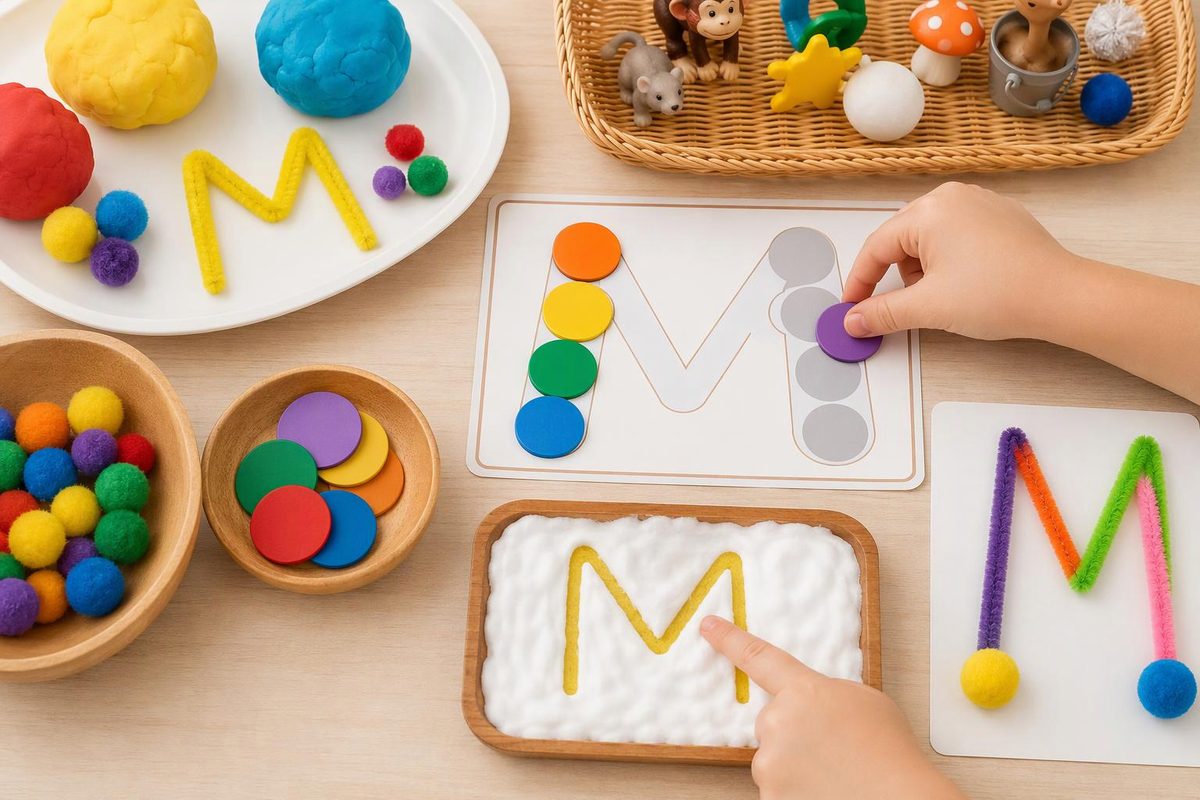
Find M around the room, deliver lowercase m mail, sort beginning-sound pictures or build the letter with paper strips. These letter M activities for preschool use everyday supplies and give children different ways to join in—pointing and matching count, too.
Choose by the opportunity you want to offer:
| Activity | Main focus |
|---|---|
| M card hunt | Recognizing uppercase M |
| Lowercase-letter mail | Connecting M with m |
| M sound picnic | Hearing /m/ at the beginning of words |
| Build an M | Noticing the letter’s parts |
| Big-letter finger paths | Exploring M and m formation |
Set out a simple M m model
Write M m clearly on a card. Uppercase M has two outside uprights and two slants that meet low in the middle. Lowercase m has a short stem and two rounded humps.
Say, “This letter’s name is em. Listen to its sound in moon: mmmmoon.” Model mmm, not “muh.” M’s sound can be held without adding a vowel; Reading Rockets’ alphabetic-principle guidance identifies m among consonants whose sounds can be pronounced in isolation with little distortion.
Letter recognition, letter–sound connections and early writing are related but different opportunities. Head Start’s alphabet knowledge guidance describes both upper- and lowercase recognition and writing that progresses from marks toward letters. A child can explore these games without writing M independently.
Adults can prepare all cut pieces. Use large paper cards rather than small loose objects, supervise materials, and keep walking routes clear.
1. Find M around the room
Materials and setup: Make three large M cards and three cards showing familiar, clearly different letters, such as O and T. Place them upright in easy-to-see spots within children’s reach. Keep your M model available.
Play: Invite the child to find a card that matches the model. Bring each M to a collection spot, or point while an adult collects it. Name the letter together: “You found M.” Compare its straight lines and middle dip with the model.
Simplify: Put just M and O side by side on a table.
Extend: Add lowercase m cards and invite children to find either form. Introduce the new shape before hiding it.
Watch for: Whether the child can match the shape with support. There is no need to turn the hunt into a speed contest or require a spoken answer.
2. Deliver lowercase-letter mail
Materials and setup: Label two open baskets or small boxes M and T. Make several paper “letters” showing lowercase m or t. Place an M m model beside the M mailbox and a T t model beside the other.
Play: Hand the child one letter at a time. Say, “This is lowercase m. Which mailbox belongs to the same letter?” Let them deliver it, then check the model together. M and m share the name em, even though they look different.
Simplify: Use only the M mailbox and m cards. Match each card to the model before delivering it.
Extend: Mix uppercase and lowercase cards and send both forms to their matching mailbox.
Watch for: A child may match m to m before remembering its connection with M. Keep the paired model visible rather than withholding help.
3. Pack an M sound picnic
Materials and setup: Draw simple pictures of a moon, mouse, mitten, monkey, sun and fish on large cards. Set out one paper mat labeled M m and another plain mat. Explain that the plain mat holds words that start with a different sound.
Play: Name every picture together first. Then say one word slowly, emphasizing its beginning: “Mmmmitten. Does it start with mmm?” Invite the child to place it on the M mat or the other mat. Keep the cards picture-only so this stays a listening game rather than a search for printed m.
Simplify: Offer just moon and sun, and model the choice aloud.
Extend: Ask the child to suggest another familiar /m/ word for you to draw.
Watch for: Use the word the child actually says. If they call the monkey an “animal,” supply “monkey” before asking about its beginning sound. This round explores the English names; welcome home-language names without treating a different starting sound as a mistake.
4. Build M with four paper strips
Materials and setup: Offer four broad paper strips, a tabletop and the M model. No glue is needed.
Play: Place two strips upright for M’s outside lines. Invite the child to arrange the other two as slants, meeting at a low point between them. Say, “The middle points down.” Compare the construction with the model, then take it apart and rebuild it.
Simplify: Draw an M on paper and let the child place strips over its lines.
Extend: Offer an N model too. Compare the two letters’ slanting lines and build each in turn.
Watch for: Keep the model upright. If the arrangement turns into another shape, describe what you see and offer to rebuild M together—not every construction needs correcting.
5. Follow big M and m finger paths
Materials and setup: Draw a large M and m on separate sheets. Add a starting dot at the top of each left stem. Place the sheets on a stable table.
Play: Demonstrate slowly, then invite the child to follow with a finger. Here is one way to move along each letter:
- M: Down the left upright; lift and return to its top; slant down to the middle, slant up to the right top, then go down the right upright.
- m: Down the short stem, back up, over and down for one hump; back up along that downstroke, then over and down for the second hump.
Simplify: Trace only one letter, or watch an adult demonstrate before joining in.
Extend: Offer paper and a crayon for copying beside the model, if the child wants to try.
Watch for: Treat this as a movement invitation, not a handwriting test. Stop or return to matching if tracing becomes frustrating.
For a painting or collage option, choose one of these letter M art activities. Keep the plain M m card nearby so children can explore their artwork without having to preserve a perfect letter shape.