
6 Letter N Activities for Finding, Matching, Listening and Writing
Try six preschool activities for letter N, with N/n matching, beginning-sound play, letter building and tracing, plus easy readiness-based adaptations.
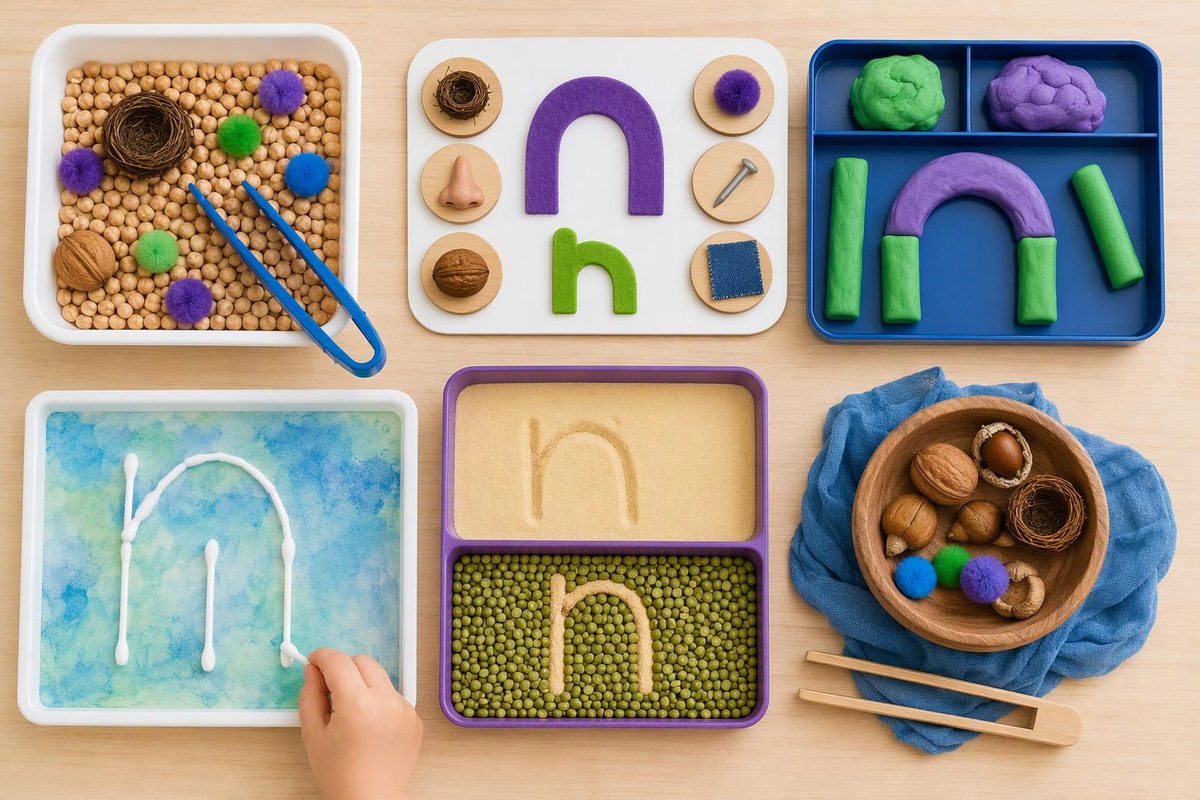
A child can hunt for N, pair it with n, listen for its beginning sound or explore how to make its shape. Choose one of these activities for letter N according to what you want to practice—not as a checklist to finish in one sitting.
- Recognizing N: Try the letter hunt.
- Matching uppercase and lowercase: Make N/n pairs.
- Hearing /n/: Sort spoken picture names.
- Exploring letter shape: Build N or finger-trace N/n.
- Using letters in meaningful play: Open a pretend news desk.
For paint, collage and drawing projects instead, see our four letter N art activities.
Prepare a simple N/n card
Write a large N and lowercase n on plain paper. Say, “These are both the letter N. Its name is en.” Use clear, unembellished letters throughout the games.
Keep recognition, sounds and writing as separate invitations. Head Start’s preschool literacy guidance describes these as related skills, while also recognizing drawing, scribbling and letter-like forms as early writing. A child need not write N before joining the other activities.
Most ideas below need only paper and crayons. Adults can prepare cut pieces; use large cards rather than tiny letter pieces, and supervise materials and movement.
1. Find N: a tabletop letter hunt
Skill opportunity: Recognizing the uppercase letter among other shapes.
Materials and setup: Make six large cards: three with N and three with familiar letters such as O, T and M. Spread them face up on a table, with the letters oriented toward the child, and keep the N/n reference card nearby.
Play: 1. Point to the reference N and name it. 2. Invite the child to find another N and place it beside the model. 3. Look together at the two upright lines and the diagonal joining them. 4. Rearrange the cards for another turn if the child wants one.
Simplify: Offer just N and O. The child may point while you move the card.
Extend: Hide the cards in easy-to-reach places around a clear room. Walk together to find them, then sort N from the other letters. Keep cards off climbing surfaces.
Notice: Is the child matching to the visible model, or finding N without looking back? Both are useful entry points.
2. Pair N with n
Skill opportunity: Connecting the two forms of the same letter.
Materials and setup: Make two N cards and two n cards. Place one N/n pair together as a reference; leave the other two cards apart.
Play: 1. Say, “N and n look different, but both are the letter N.” 2. Invite the child to make another pair like yours. 3. Mix all four cards face up and make two pairs. 4. Name each letter as the child places it.
Simplify: Give the child an n card and ask them to place it beside your N. Model the connection rather than asking them to discover it alone.
Extend: Add an O/o pair. Ask the child to sort the cards into letter families before making pairs. Keep them face up so memory does not become the main challenge.
3. Listen for /n/: picture sorting
Skill opportunity: Noticing the first sound in a spoken word.
Materials and setup: Draw simple pictures of a nest, nose, net, cat and sun on large cards. Make two sorting spaces: “starts like nest” and “starts differently.”
Before sorting, say each picture’s name together. Supply the intended word if a child calls the net a “basket,” for example; the sound task depends on the word being spoken.
Play: 1. Show N/n and model “/nnn/, nest.” The /n/ sound can be drawn out, as explained in Reading Universe’s pronunciation guide. Model the sound itself rather than “nuh.” 2. Say “nose” slowly, emphasizing its beginning. Place it with nest. 3. Say the next picture name and invite the child to choose a space. 4. Repeat the word and its first sound as you place the card together.
Simplify: Compare only nest and cat. Children can listen and point without repeating the sound.
Extend: Invite another word that starts like nest. Keep the focus on the beginning: sun contains /n/ at the end, but does not begin with it.
4. Build uppercase N with paper strips
Skill opportunity: Exploring the parts and arrangement of uppercase N.
Materials and setup: Prepare two broad paper strips of equal length and a longer strip for the diagonal. Draw a large N model sized so the strips can lie over its lines.
Play: 1. Place the two shorter strips over the upright lines of the model. 2. Lay the longer strip from the top of the left strip to the bottom of the right strip. 3. Look together at how the three parts make N. 4. Take it apart and invite the child to rebuild it. No glue is needed.
Simplify: Set out the upright strips and let the child add the diagonal.
Extend: Move the model beside, rather than underneath, the work. Ask, “Where does the slanting part start and finish?”
5. Finger-trace, then choose a writing tool
Skill opportunity: Exploring letter formation without requiring pencil control.
Materials and setup: Draw a large N and n on paper. Add a starting dot at the top left of each. Have a crayon available, but optional.
The sequence below follows Waterford’s letter-formation guide. If the classroom uses a handwriting program, follow its formation cues consistently instead.
Play: 1. Model uppercase N: start at the top left and move down; lift, return to the top left and slant down to the bottom right; continue straight up to the top right. 2. Invite the child to follow the lines with a finger. 3. Model lowercase n: start at the top of the upright, move down, retrace up, curve over to the right and move down. 4. Offer air-writing or a crayon turn if the child wants it.
Simplify: Explore one letter at a time. The child can watch or point to the starting dot.
Extend: Keep the model visible and offer blank paper for copying.
6. Open a pretend N news desk
Skill opportunity: Connecting letters and marks with a real message.
Materials and setup: Put paper and crayons at a table with a sign reading News. Circle its first letter and leave the N/n card nearby.
Play: 1. Say, “News starts with /n/. What news would you like to tell?” 2. Invite a report about a toy, a drawing or something that happened today. 3. Let the child draw, scribble or add letters. Offer to write their spoken message underneath. 4. Read the message back and invite them to share it with a willing listener.
Simplify: The child tells the news while you record it; they can point to N on the sign.
Extend: Offer an optional N for the news heading or help the child label a picture. Their report does not need to contain only N words.
Accept the message even when the page has no recognizable letters. Head Start’s early-writing overview describes marks, scribbles, drawings and letter formation as part of developing writing—not a reason to exclude a child from writing play.