
6 Letter J Games for Finding, Matching, Sounds and Formation
Try six preschool letter J activities for recognition, J/j matching, beginning sounds and formation, with simple supplies and easy adaptations.
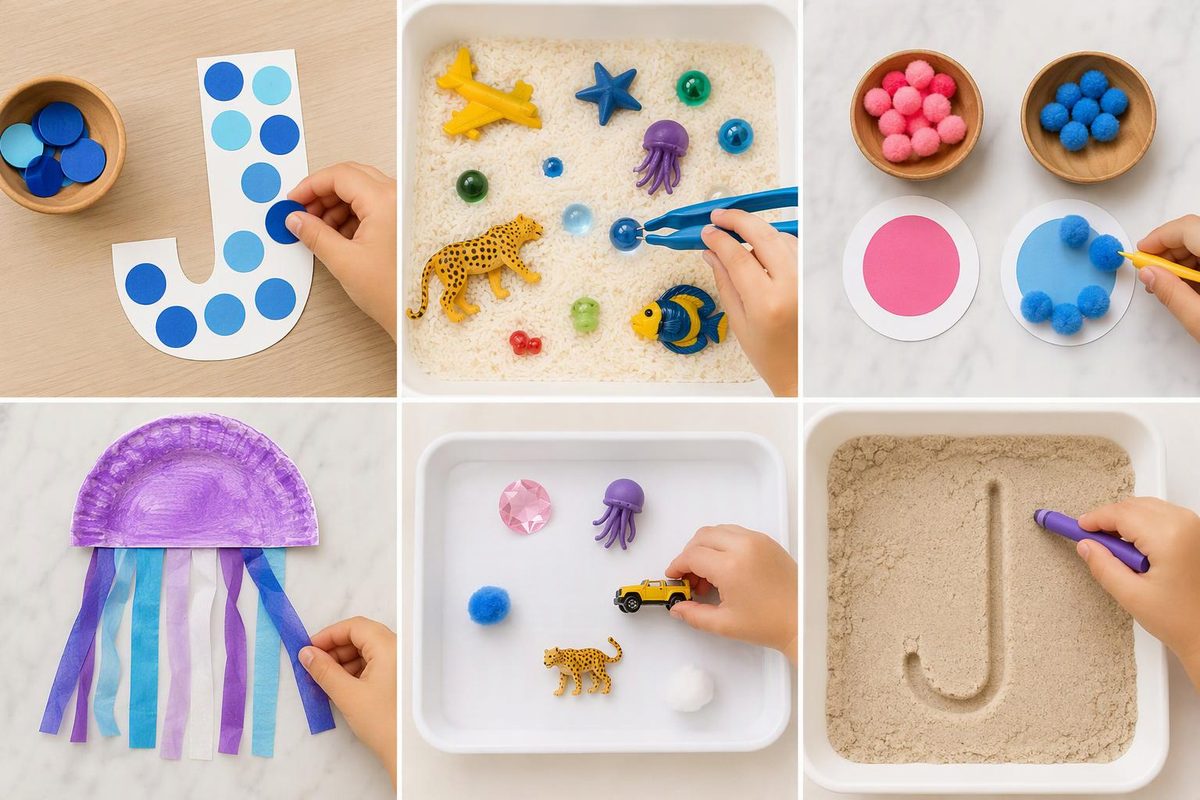
Choose a letter J game for the next thing your child is exploring: finding J, matching J with j, hearing the beginning sound in jump, or making the letter’s shape. These activities use homemade cards, paper and crayons—not worksheets or finished crafts.
Recognizing letters, connecting them with sounds and forming them are related but different learning opportunities. Head Start’s alphabet guidance describes these alongside early writing that begins with marks and scribbles. A child can join a finding game without being ready to write J.
Set up a small J kit
Gather paper, an adult-use marker, thick crayons and two sheets to use as sorting mats. Adults can cut the cards beforehand. Use large paper pieces rather than small counters or loose craft decorations.
Make a clear J j model card. For these games, use an uppercase J with a long stem that curves left at the bottom. Some print styles add a top bar; keep your first cards consistent. Show lowercase j with its dot and a curved stem extending below a writing line.
Say, “This letter’s name is J. Listen to the first sound in jump.” Model that brief beginning sound rather than the letter name or “juh.” Reading Universe’s J sound model offers a pronunciation reference and describes its quick stop. Use familiar English examples such as jump, jacket, juice, jam and jet. Pictures are enough; no food is needed.
1. Find J around the room
Focus: Letter recognition.
Materials and setup: Make three J cards and two other letter cards, such as L and T. Place them in visible, easy-to-reach spots. Keep the model card with you.
Invite the child to walk around and find a card that matches the model. Bring it back and compare: “Here’s the long part, and here’s the curve at the bottom.” Repeat while the child is interested. There is no timer or race.
Simplify: Put one J and one other letter on the table instead of hiding cards.
Extend: Add lowercase j cards and invite the child to find either form. Later, look for J or j together in a book, without expecting every page to contain one.
Notice: Does the child match the shape with a model, or recognize it without looking back?
2. Deliver J and j cards
Focus: Uppercase–lowercase connection.
Materials and setup: Label one sorting mat J and the other j. Make several cards of each form, all in the same color so color does not give away the answer.
Pretend the cards are letters waiting for delivery. The child places each one on its matching mat. Name both forms: “Uppercase J. Lowercase j. Both are the letter J.” Then take one card from each mat and place them together as a pair.
Simplify: Offer just one uppercase and one lowercase card, with the model visible.
Extend: Mix J, j, L and l cards. Ask the child to choose only the two forms of J before pairing them.
Notice: Can the child connect the two forms even though only lowercase j has a dot?
3. Sort pictures by beginning sound
Focus: Listening for the sound at the start of a word.
Materials and setup: Draw simple pictures of a jacket, jet and juice, plus a sun and ball. Label one mat J j; leave the other blank.
Name each picture together before sorting so the intended word is clear. Say, “Jacket starts like jump. Does sun start like jump?” Put matching beginning sounds on the J mat and the others on the blank mat.
Head Start recommends sorting toys or pictures by beginning sound as a way families can support preschool alphabet learning.
Simplify: Compare only jacket and sun, modeling the first sounds yourself.
Extend: Ask the child to suggest another word that starts like jump. Say it together before deciding.
Notice: If the picture gets a different name, agree on a label first. A child calling juice “a drink” is naming the picture differently, not necessarily mishearing its sound.
4. Listen, then jump—or tap
Focus: Beginning-sound listening with movement.
Materials and setup: Keep the J j card nearby and clear a space for comfortable movement.
Say one word at a time: jump, sun, jacket, ball, juice. Invite a small jump when a word starts like jump, and a pause when it does not. Model the first two turns. Children can tap their knees or raise a hand instead of jumping.
Keep the words spoken, not printed: this game is about hearing their beginnings.
Simplify: Alternate jump and sun, saying the beginning sounds clearly.
Extend: Let the child choose words for the adult to respond to.
Safety: Stay in place, leave space between children and avoid jumping from furniture.
5. Follow a J road
Focus: Exploring formation without a pencil.
Materials and setup: Draw a broad uppercase J on paper, using the same form as your model card. Add a starting dot at the top of its stem.
Demonstrate with your finger: “Start here. Down, then curve left.” Invite the child to follow the route with a finger, then make the movement in the air. The dot is a starting cue, not part of uppercase J.
Simplify: Use a larger letter and let the child watch before trying.
Extend: Offer a thick crayon to trace the path, then blank paper to try beside the model. Keep copying optional.
Notice: Following a visible path and making a letter beside a model are different tasks. Return to finger play if copying becomes frustrating.
6. Build and repair lowercase j
Focus: Noticing lowercase j’s parts and position.
Materials and setup: An adult cuts a large curved-stem piece and a large paper dot. Draw a writing line on a separate sheet. Beside it, draw a complete j model on the same line.
Invite the child to arrange the stem beside the model, with its upper part above the line and its bottom curve below it, then place the dot above the stem. Move the dot to the side and ask, “Does this match our j? What could we move?” Let the child repair it by comparing with the model.
Simplify: Position the stem yourself; the child adds the dot.
Extend: Invite the child to draw j beside the paper version, or compare it with uppercase J and describe what changes.
Notice: Look for attention to the dot and lower curve, not a perfectly proportioned letter.
Choose one game rather than treating all six as a checklist. If the child wants a making activity afterward, these letter J art projects offer collage, painting and paper design options.