
Preschool Letter K Activities for Finding, Matching, Listening and Formation
Try six preschool letter K activities for recognition, K/k matching, beginning sounds and formation, with simple supplies and readiness-based adaptations.
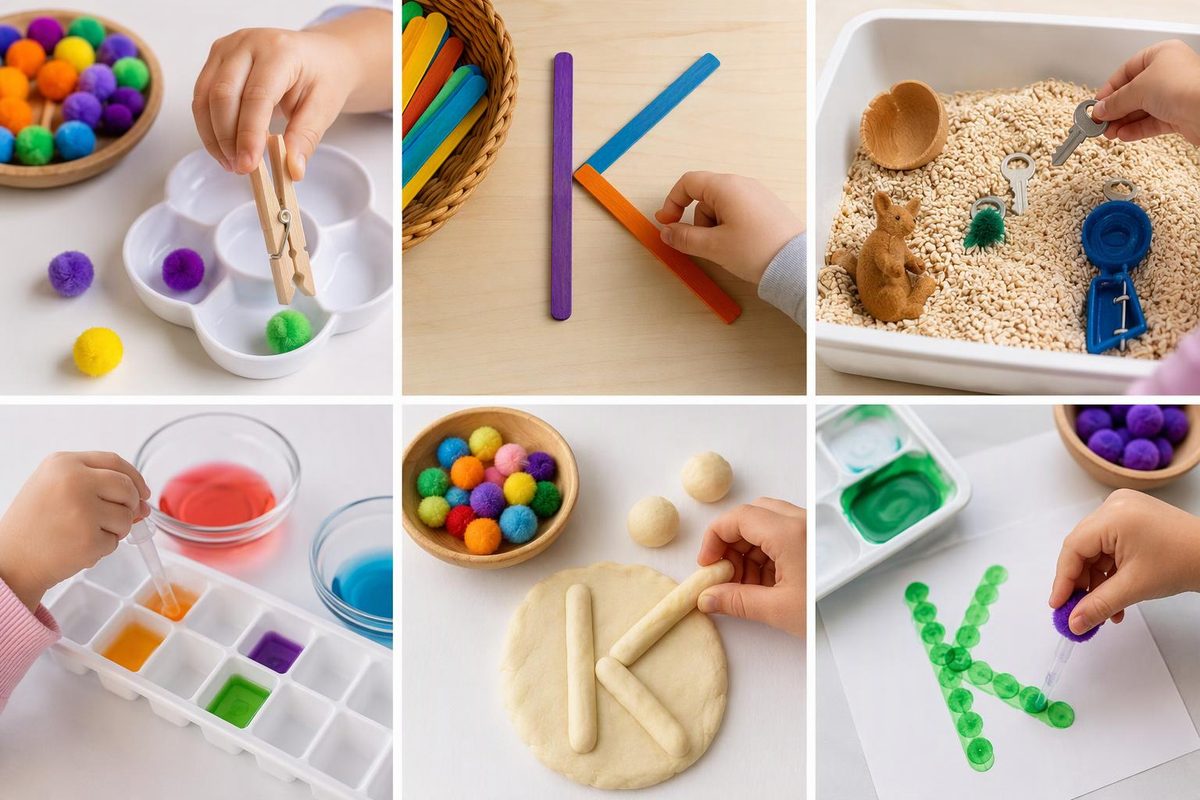
A child can find K without being ready to write it, or hear the beginning sound in kite without recognizing the printed letter. Choose one activity below for the practice you want—not a whole set to finish in one sitting.
These ideas combine brief adult modeling with choices, movement and play. That approach fits NAEYC’s guidance on developmentally appropriate teaching, which recommends a mix of guided play, self-directed play and direct instruction, with challenges adjusted to individual children.
| Choose this activity | Main practice opportunity |
|---|---|
| Find the K cards | Recognizing uppercase K |
| Deliver the letter mail | Connecting K with lowercase k |
| Pack a beginning-sound basket | Hearing /k/ at the start of words |
| Finger-trace K and k | Exploring letter formation |
| Kangaroo listening game | Responding to beginning sounds through movement |
| Find K in a book | Noticing letters in everyday print |
Prepare a small K kit
Gather paper, a marker, a basket, two envelopes or folded-paper pockets, crayons and a picture book. Adults can cut the cards in advance. Use large paper cards rather than small objects such as real keys or beads. For a child who mouths materials, keep loose cards in the adult’s hands and invite pointing instead of collecting or posting.
Choose non-toxic markers and crayons intended for children, follow their labels and supervise use closely, as recommended in the CPSC Art and Craft Safety Guide.
Write a clear K k reference card. Say, “This letter’s name is K. Here is uppercase K, and here is lowercase k. Kite starts with /k/.” Model a brief /k/, rather than adding “uh” or stretching it: /k/ is a stop sound.
Showing both cases, linking a letter to a keyword and modeling formation are strategies described in Reading Universe’s letter-name-and-sound lesson guidance for kindergarten and early readers. The preschool activities below let children point, move or finger-trace instead of completing written work.
1. Find the K cards
Materials and setup: Make three K cards, one H card and one X card. Write every letter in the same color and size. Spread them face up on a table, with the K reference card nearby.
Play: Ask the child to find a card that matches the reference K and place it in the basket. After each choice, compare the shapes together. Continue while the child wants to search.
Checkpoint: Notice whether the child compares the letter shapes rather than choosing by color or position. Say, “You found the tall line with two slanting lines meeting it.”
Simplify: Offer only K and H, and leave the reference beside them.
Extend: Add lowercase k after naming it. Invite the child to collect both forms of K.
2. Deliver the letter mail
Materials and setup: Label one large envelope K k and another H h. Make separate cards showing K, k, H and h. Keep the envelopes open on the table.
Play: The child becomes the mail carrier. Hand over one card at a time and invite them to deliver it to the matching letter home. Model the first lowercase match: “This is lowercase k. It belongs with uppercase K.”
Checkpoint: Matching k with k on the label is a useful entry point, but it does not yet show that the child can connect the two cases without help.
Simplify: Use only the K/k envelope and let the child post either form as you name it.
Extend: Cover the lowercase letters on the envelope labels. Now the child delivers k to K and h to H. Keep a separate reference card available if needed.
3. Pack a beginning-sound basket
Materials and setup: Draw or gather large pictures of a kite, key, kitten, sun and ball. You do not need printed worksheets; simple adult sketches work if you name them together first.
Play: Say each picture’s name aloud. Invite the child to put pictures beginning with /k/ into the basket. Model one choice: “Kite. I hear /k/ first.” Keep this a listening task; the child does not need to read the words.
Checkpoint: Agree on each picture’s name before sorting. A child who calls the kitten a “baby animal” is working with a different spoken word.
Simplify: Offer just kite and sun, naming both before asking for a choice.
Extend: Add a cat picture. Explain that cat also begins with /k/, even though its first written letter is C. Call this a /k/ sound basket, not a basket of words all spelled with K. Save silent-K words such as knife for another conversation.
4. Finger-trace K and k
Materials and setup: Draw a large K and k on separate sheets. Add a starting dot at the top of each upright line. For lowercase k, keep the upright tall and its two slanting strokes in the lower half.
Play: Demonstrate with your finger, then invite the child to follow:
- K: Start at the top and move down the upright. Lift. Start at the upper right and slant down to the middle of the upright, then slant out to the lower right.
- k: Start at the top and move down the tall upright. Lift. Begin at the upper right of the shorter section, slant down to meet the upright, then slant out to the bottom right.
Checkpoint: Look for the two slanting parts meeting the upright. Keep your wording and model consistent with the handwriting style used in the child’s classroom.
Simplify: Trace only the upright, then watch the adult complete the letter.
Extend: Offer a crayon and blank paper for copying beside the model. Naming or tracing the letter can remain the activity if copying is not inviting yet.
5. Play the kangaroo listening game
Materials and setup: Use the pictures from the sound basket and a clear movement space. Explain that children can make kangaroo paws with their hands, take a small hop or respond while seated.
Play: Show and name one picture at a time. Children make their chosen movement when the word starts with /k/ and rest when it does not. Begin with kite and ball before mixing in the other pictures. This is cooperative listening, not an elimination game.
Checkpoint: In a group, some children may copy their neighbors. Offer an occasional individual choice of two pictures to hear their own response.
Simplify: Let everyone make kangaroo paws while you name only the /k/ pictures.
Extend: Say familiar words without showing pictures. Keep the words short and clearly spoken; avoid turning the game into a speed test.
6. Find K in a picture book
Materials and setup: Choose a book the child enjoys. Check a few pages in advance for a clear printed K or k; place the reference card beside the book.
Play: Read normally, then pause on one selected page. Ask, “Can you find a letter that looks like this?” Let the child point. Name the letter together and read the whole word so the pause has meaning. K can be anywhere in the word for this shape-finding activity.
Checkpoint: Keep finding a printed letter separate from hearing a beginning sound. A k at the end of a word still counts as a letter find.
Simplify: Point to a single word and offer to find K together.
Extend: Look for the other case in the title, a label or another page. Do not require a hunt on every page.
For a separate making-and-decorating session, choose one of these four letter K art activities. For the next literacy session, repeat a favorite game with less help or change the skill target—not necessarily the supplies.