
Sing the Twos, Then Build the Pairs
Use an original counting-by-twos chant and a visual group counter, then try the same pairs on paper. Explore groups of 2, 5 or 10.
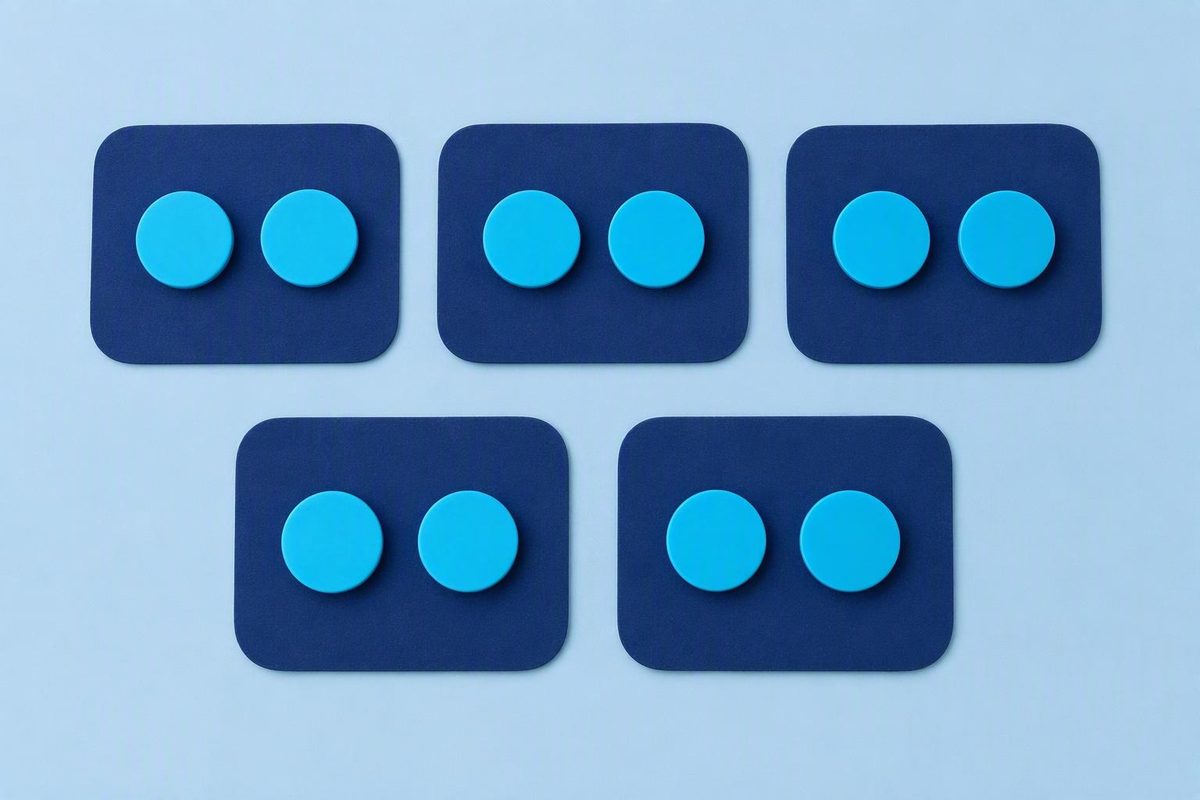
Use this original skip counting chant while showing equal groups of two. Start with 2, 4, 6, 8, 10. Each number names the total dots so far, not just the newest pair.
Press “Start Over,” then add one group at a time as you say each total. The tool also lets you explore groups of 5 or 10.
Build A Skip-Counting Pattern
2, 4, 6, 8, 10
Point to each pair, then say the totals together. Explore up to 10 groups.
Original Counting-By-Twos Chant
Two, four, six, eight, ten.
Tap two beats, then count again.
Twelve, fourteen, sixteen, eighteen,
Twenty—ten pairs on our screen.
Speak it rhythmically or make up your own tune. This is an original chant; no audio recording is included.
Try It Away From The Screen
Draw two dots in each of five boxes. Count all ten dots one at a time, then point to each box as you say 2, 4, 6, 8, 10.
For a simpler version, count one object at a time. Skip counting is optional exploration, not a required preschool milestone.
Background: NAEYC: playful number patterns.
Speak the chant and show each pair
Two, four, six, eight, ten. Tap two beats, then count again. Twelve, fourteen, sixteen, eighteen, Twenty—ten pairs on our screen.
This is an original spoken chant; no tune or audio recording is included. Say it with a steady pulse or make up your own tune. Begin with the first line and five pairs. Add the longer sequence only when the child wants to continue.
As you say 2, reveal one pair. At 4, reveal a second pair and point across both pairs. At 6, show three pairs. Continue until five pairs make 10. For the longer version, add the sixth pair at 12 and continue to ten pairs at 20. Pause the chant whenever you need time to point or count.
The second line is a rhythmic pause; it does not add a new pair. Keep the number words matched to what is visible. If tapping distracts from the groups, skip the taps and speak the sequence slowly.
Try it with paper instead of a screen
You need ten large dots drawn on paper, or ten suitable objects, and five circles or small mats.
- Count the ten objects one by one, touching each once.
- Put two objects in each circle. Keep the five pairs in a waiting row.
- Move one pair into a separate counting area and say 2.
- Move the next pair in and say 4, pointing across all four objects.
- Continue through 6, 8, 10. After each move, the spoken number describes everything in the counting area.
| Pairs in the counting area | Objects in each pair | Total |
|---|---|---|
| 1 | 2 | 2 |
| 2 | 2 | 4 |
| 3 | 2 | 6 |
| 4 | 2 | 8 |
| 5 | 2 | 10 |
For a shorter round, use three pairs and say 2, 4, 6. For a classroom round, pairs of children can enter a marked area while an adult points across the running total. Let children choose a pointing or helper role if they prefer not to move into the group.
Start with ordinary counting when needed
Skip counting is optional exploration, not a milestone every preschool child must meet. First look for whether the child can say an ordinary counting sequence, touch each object once, and tell how many objects are in a small collection.
If a child misses objects or counts the same one twice, keep practicing one-by-one counting. They can still listen, clap, or join repeated words without being tested. Starting with 2s is convenient because pairs are easy to show; it is not a rule that every learner must start there.
NAEYC suggests songs, fingers, and everyday objects for playful number patterns. Its separate guidance on number composition discusses exploring how quantities can be made and separated. These are foundations for the activity, not evidence that this particular chant produces a measured learning gain.
Check the quantities, not just the song
A child may remember 2, 4, 6, 8, 10 without understanding equal groups. Choose one short question after a round:
- “Can you build 6 using pairs?” Look for three groups of two.
- “How many pairs make 8?” Build or point to four pairs.
- “What comes after 8?” Add another pair before answering.
| What you notice | What to try |
|---|---|
| Sings the sequence but cannot build the total | Reveal one pair at a time and count all the objects |
| Counts the objects but loses the chant | Slow down and use only 2, 4, 6 |
| Builds and explains the pairs | Draw the groups or extend the pattern |
| Becomes frustrated | Stop the sequence and return to ordinary counting or free play |
Five groups of two can later connect to 5 × 2 = 10, but formal multiplication notation is unnecessary here. The immediate task is connecting the spoken total to visible objects.
Explore 5s and 10s without changing the rule
Choose 5 In Each Group to build 5, 10, 15, 20…, or 10 In Each Group for 10, 20, 30, 40…. Changing the group size resets the tool to zero, so you can start with one group and build the total again. Each mode stops at ten groups.
The chant remains a counting-by-twos chant. For 5s or 10s, simply say the totals shown on the screen. The mathematical rule is the same: add one equal group, then name the new total.
For an easier activity away from the screen, use ordinary counting and matching. Keep the number of objects small and let the child explain, point, or draw rather than perform a song alone.