
Make a Reusable Three Little Pigs Story Set
Make three paper houses and movable pig puppets with simple supplies, clear steps and a reusable fold-out story scene.
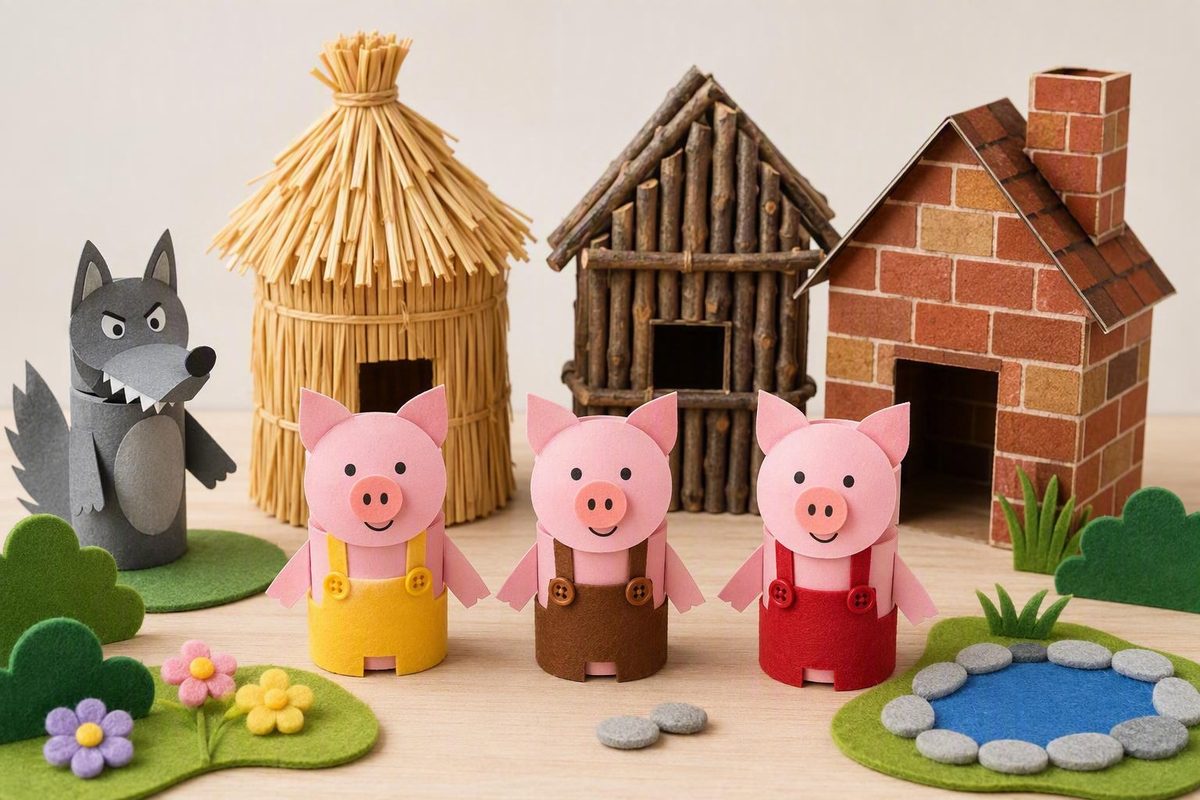
A three little pigs craft turns the familiar folktale into a hands-on activity featuring the pigs, the wolf, and houses made to look like straw, sticks, and bricks. This version makes a compact retelling set children can assemble, arrange in story order, and use for imaginative play. A fold-out paper backdrop with movable characters offers a practical balance of easy preparation, creative choice, and repeat use.
Choose a Retelling Set
The phrase “three little pigs craft” can describe several different projects: pig masks, paper-plate faces, puppets, model houses, sequencing cards, or a complete story scene. Before choosing one, decide what the finished craft should do.
If the goal is a quick art activity, one pig face or mask may be enough. If the goal is to explore the story, children need a way to represent the three houses and move the characters from one scene to another. A retelling set therefore provides more value than three unrelated pig decorations.
A simple set can include:
- Three paper houses
- Three pig characters
- One wolf character
- Yellow strips representing straw
- Brown strips representing sticks
- Red rectangles representing bricks
- A folder, large sheet of paper, or cardboard base
The materials do not need to imitate real building supplies. Paper substitutes are usually easier to prepare, attach, store, and clean up. Children can still compare the visual textures and discuss why the houses differ.
The craft also does not need to enforce one “correct” ending. Versions of traditional stories vary, and children may know different retellings. Let them follow the version they have heard, invent a cooperative solution, or redesign the houses after discussing what happened.
Build the Story Scene
Begin by reading or telling a version of the story. Keep the characters and main events clear, but avoid making children memorize every detail before they start creating.
Next, introduce the craft as a problem to explore: each pig needs a house, and each house should look as though it uses a different material. Show the available paper, card, crayons, and collage pieces without presenting a finished model that everyone must copy exactly.
Children then make the houses. They can draw three simple house shapes or decorate house outlines prepared by an adult. Yellow paper strips suggest straw, irregular brown strips suggest sticks, and stamped or drawn red rectangles create a brick pattern.
The characters can be simple circles with ears and faces. Attach them to wide paper handles, folded card stands, or craft sticks if those materials suit the setting. Movable characters make it possible to act out knocking at doors, moving between houses, and changing the ending.
Once the glue is set enough for handling, place the houses in story order. Invite the child to move each pig through the scene and explain what happens. If the sequence becomes mixed up, treat that as an opportunity to revisit the story rather than a mistake in the artwork.
Finish by storing the characters in an envelope attached to the back of the scene. This turns the project into a reusable storytelling resource instead of a one-time display.
Choose a Format
Different formats solve different planning problems. Compare them by preparation, creative freedom, and what children can do with the result.
| Approach | Best suited to | Main advantage | Main tradeoff |
|---|---|---|---|
| Pig face or paper plate | A short art session | Simple and visually clear | Does not represent the full story |
| Character puppets | Dramatic play and dialogue | Easy to move during retelling | Houses must be added separately |
| Collage houses | Texture and material comparison | Allows varied decorating choices | Characters may feel secondary |
| Fold-out story set | Sequencing and repeated play | Combines houses and characters | Requires more preparation and storage |
A template-led version can help when time is limited or when children benefit from larger, ready-to-use shapes. Pre-cut pieces also let participants focus on arranging, gluing, decorating, and storytelling.
A more open-ended version begins with blank paper and loose materials. Children decide what their pigs, wolf, and buildings look like. This increases choice but may require more adult support for children who are unsure how to begin.
A useful middle path is to provide basic house and character shapes while leaving faces, colors, textures, doors, scenery, and construction details open to interpretation. The underlying story remains recognizable without producing a row of identical crafts.
Supplies and Steps
For one set, gather one large backing sheet, three house outlines, three pig shapes, one wolf shape, colored paper scraps, crayons, a glue stick, child-appropriate scissors and one storage envelope. An adult can cut the house and character shapes in advance. These are materials for this suggested activity, not a required classroom standard. Add a large backing sheet if you want one connected scene. Prepare materials according to the children’s current ability: some may work with pre-cut shapes, while others can draw, trace, or cut their own.
Then follow this process:
- Make the background. Fold a large sheet into panels or divide it into spaces for the houses. Add a road, grass, trees, or sky if desired.
- Create the houses. Draw or attach three house shapes with visible doors. Keep the shapes large enough to decorate without crowding.
- Add the materials. Glue yellow strips to the straw house, brown strips to the stick house, and red paper rectangles to the brick house.
- Make the characters. Draw pigs and a wolf on card, or assemble them from basic shapes. Give each character a stand or handle if it will be moved.
- Arrange the story. Put the houses in the order used in the chosen version. Move the pigs and wolf through the scene.
- Retell and revise. Ask what happened first, what changed, and what the characters might do differently.
- Store the pieces. Place loose characters in a labeled envelope or small reusable container.
For a low-mess version, use crayons to draw straw, sticks, and brick patterns instead of making a collage. For a group, divide supplies into house-material stations so children do not all need the same items at once.
Useful prompts include:
- How can we make each house look different?
- What do you think will happen at this door?
- Which part of the story comes next?
- How could the pigs change their designs?
- Could the characters solve the problem another way?
These questions keep the conversation connected to the child’s decisions rather than testing for a single expected answer.
Adapt the Craft
The most common mistake is choosing a project that looks appealing but does not match the intended activity. A pig face may be ideal for a brief craft, but it offers little support for sequencing the whole tale. Conversely, a detailed model village may demand more preparation than the group can comfortably manage.
Another problem is preparing either too much or too little. If every piece is already cut, colored, and labeled, children may have few meaningful choices. If nothing is prepared, some may spend the session waiting for help. Prepare the parts that would otherwise become barriers while leaving visible decisions to the child.
Skip beads, buttons and loose plastic eyes for children who mouth objects; draw the faces instead. CPSC advises keeping toys with small parts away from children under three (toy-safety guidance). Use art materials labeled for children and follow their age and handling instructions (CPSC art-and-craft safety guide). Favor large paper components, keep loose pieces controlled, and match tools and materials to the individual child. An adult should manage any task or tool the child cannot use safely and confidently.
Real straw and twigs provide natural texture, but they can shed, snag, or be difficult to attach. Colored paper strips give a cleaner, more predictable result. Real building materials create stronger sensory contrast; paper substitutes make classroom organization easier.
Templates have a similar tradeoff. They save planning time and can make the activity more accessible, but rigid instructions may suggest that all pigs and houses should look alike. Treat outlines as starting points, not rules.
Finally, avoid correcting imaginative retellings unnecessarily. A blue brick house, friendly wolf, or shared home does not ruin the activity. If story recall matters, separate the questions: first ask what happened in the version you read, then ask what the child would change.
Use the Finished Set
Choose the format by working backward from your goal.
Select a pig face or mask when you need a short, self-contained art project. Choose puppets when conversation, voices, and dramatic play matter most. Focus on collage houses when the central idea is comparing how materials look and behave. Use a fold-out retelling set when you want one project that combines art, sequencing, and later play.
Also consider the practical limits:
- How much preparation can the adult complete?
- Will the project need drying or storage space?
- Can children cut independently, or should some pieces be prepared?
- Is the activity for one child, a small group, or a full class?
- Should the finished work be displayed, taken home, or reused?
- Would reduced mess or fewer textures help anyone participate?
For most beginners, the best next step is a simple fold-out scene made with drawn house outlines, paper-strip textures, and movable card characters. Prepare the backing and a few large shapes, then let the child decide how the characters and scenery should look. Read the story, build the set, and use it immediately for a retelling.