
Find B, Hear /b/ and Explore Writing With Six Preschool Activities
Try six preschool letter B activities for recognition, beginning sounds, B/b matching and formation, with simple supplies and readiness-based adaptations.
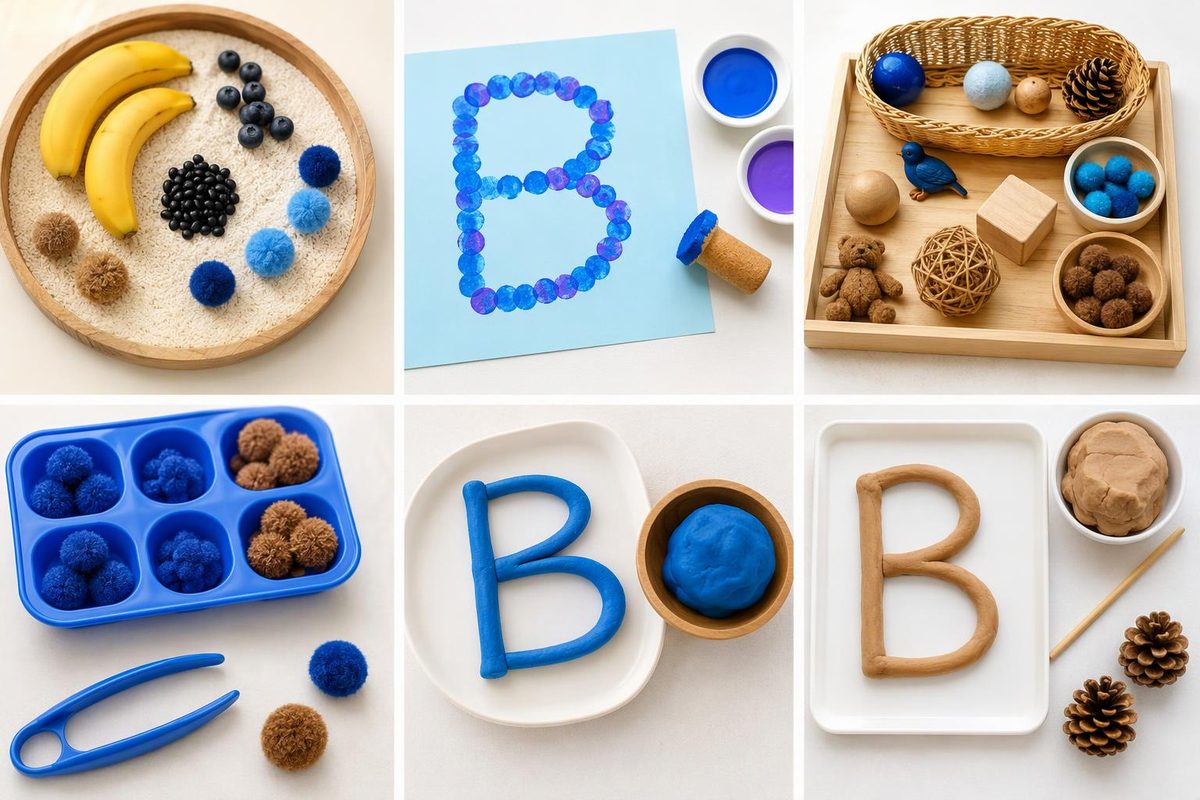
Choose a letter B activity for what the child is practicing now: finding B, hearing the beginning sound /b/, matching B with b, or making the letter’s shape. A child can join by pointing, moving a card or finger-tracing; independent writing is not an entry requirement.
These six invitations use paper cards, familiar pictures and crayons rather than a worksheet packet. For painting and collage instead, see our separate letter B art activities.
Choose your starting point
| If you want to practice… | Try… |
|---|---|
| Finding a named letter | B card hunt |
| Connecting uppercase and lowercase | B/b mail delivery |
| Linking /b/ to B | Beginning-sound basket |
| Listening for /b/ without print | Bounce-or-stay game |
| Exploring the strokes | Big B and little b finger paths |
| Trying a letter in purposeful writing | Block-area labels |
Planned opportunities to see, play with and compare letters—including uppercase and lowercase forms—are recommended in the Texas Education Agency’s alphabetic-principle guidance, published by Reading Rockets. The activities below are ways to offer that practice, not a promise of a particular outcome.
Make a small reusable kit
Write clear B and b models on separate paper cards. Gather extra cards, a marker, paper, chunky crayons, two open boxes and a few familiar pictures. Use the same plain letter style at first, with cards facing the child.
For sound games, start with ball, bear, bed, boat and bus. Say: “This letter is B. Ball starts with /b/.” Keep /b/ brief rather than adding an “uh” to make “buh.” The University of Florida Literacy Institute’s glossary recommends avoiding an added “uh” when modeling consonant sounds for blending.
Choose one game at a time. Use pictures instead of small loose objects, place materials within easy reach and supervise play.
1. B card hunt
Main skill: finding uppercase B.
Materials and setup: make four B cards and one each of M and O. Place them visibly around a safe play space; keep a separate B model in your hand.
- Show the model and say, “This is B. Let’s find another B.”
- Invite the child to bring back a card or point to it.
- Compare the chosen card with the model before looking for another.
If the child brings M, respond with the shapes: “This is M. Our B has a straight side and two rounded parts. Let’s look together.”
Simplify: put one B and one O on the table and hold the B model beside them.
Extend: remove the model and ask for B by name, or repeat the hunt with lowercase b.
Notice: finding an identical shape with a model is different from finding B by its spoken name. Keep track of which prompt you used.
2. B/b mail delivery
Main skill: connecting the two forms of the same letter.
Materials and setup: label one open box B and another b. Make several paper “letters” bearing either form, all upright.
- Place the labels together briefly: “These are both the letter B. This is uppercase B; this is lowercase b.”
- Invite the child to deliver each card to the box with the matching shape.
- Take one card from each box and put them side by side: “B and b belong together.”
The delivery step practices same-form matching; the final pairing makes the uppercase–lowercase connection explicit.
Simplify: deliver only uppercase B cards to one box, then introduce the b box.
Extend: spread uppercase B and M cards on the table. Hand over lowercase b and invite the child to find its uppercase partner.
3. Beginning-sound basket
Main skill: connecting the beginning sound /b/ with B.
Materials and setup: place a B/b card beside an open box. Gather pictures of ball, bear, bed and bus, plus sun and moon.
- Name every picture together before sorting. Agree on the word you will use—a boat picture might otherwise be called a ship.
- Model one choice: “Bear starts with /b/. I’ll put bear beside B.”
- Offer the remaining pictures one at a time. Invite the child to place /b/ pictures in the box and leave the others outside.
If a choice is unexpected, say the word again and model its first sound rather than asking repeatedly for the right answer.
Simplify: use only ball and sun, and sort them together.
Extend: ask the child to suggest another familiar /b/ word. For children using another home language, name the pictures in that language too; be clear that this round uses the English words.
4. Bounce-or-stay listening game
Main skill: hearing /b/ at the start of a spoken word, without needing to recognize print.
Materials and setup: no supplies; leave enough space for gentle movement.
- Explain: “When a word starts with /b/, bend your knees for a little bounce. Otherwise, stay still.”
- Demonstrate with bus and sun.
- Say a short mixed set: bear, moon, bed, boat, cat. Pause after each word.
Bounce together at first. No one is eliminated for a different response.
Simplify: say the word and its beginning sound, then model the movement.
Extend: let the child choose words for the adult to respond to.
Adapt the movement: use a hand tap instead of bouncing. The listening task stays the same.
5. Big B and little b finger paths
Main skill: exploring letter formation.
Materials and setup: draw a large B and b on separate sheets. Secure the paper to the table. The steps below offer one tracing route; if the child’s preschool uses a different handwriting model, follow that route instead. Add a starting dot and arrows to match your demonstration.
- Explore B first: trace down its straight left side. Return to the top and trace the two rounded parts on the right.
- Explore b: trace down the tall stem, back up to the middle, then around the lower-right rounded part.
- Invite the child to trace with a finger, watching your demonstration or following the arrows.
Compare the finished shapes: uppercase B has two rounded parts; lowercase b has one at the bottom right.
Simplify: trace just the straight stem together, then watch the adult complete the curve or curves.
Extend: offer a crayon and blank paper beside the model for a voluntary copying attempt. Keep the model upright if the child reverses the shape, and demonstrate again without requiring a page of corrections.
6. Make labels for the block area
Main skill: trying letter formation in writing that has a purpose.
Materials and setup: gather blocks, paper label strips, crayons and B/b models.
- Invite the child to make a place where blocks belong—a shelf, box or pretend shop.
- Ask, “Would a label help people find the blocks?” Write blocks in front of the child, naming the first letter and pointing to b.
- Offer a label strip. The child may copy b, try the whole word, make their own marks or ask you to write it.
- Place the label where the child chooses and return to building.
This follows NAEYC’s emergent-writing guidance: model meaningful writing, include it in play areas and welcome attempts appropriate to the child’s current abilities.
Simplify: let the child choose a ready-made b card to place beside the adult-written label.
Extend: invite a second label for a bed or bus built from blocks. Writing the entire word is optional; the B practice can remain one letter.