
Gross Motor vs. Fine Motor: A Practical Preschool Guide
See the difference between gross and fine motor skills in preschool play, then try one adaptable activity that gives children practice with both.
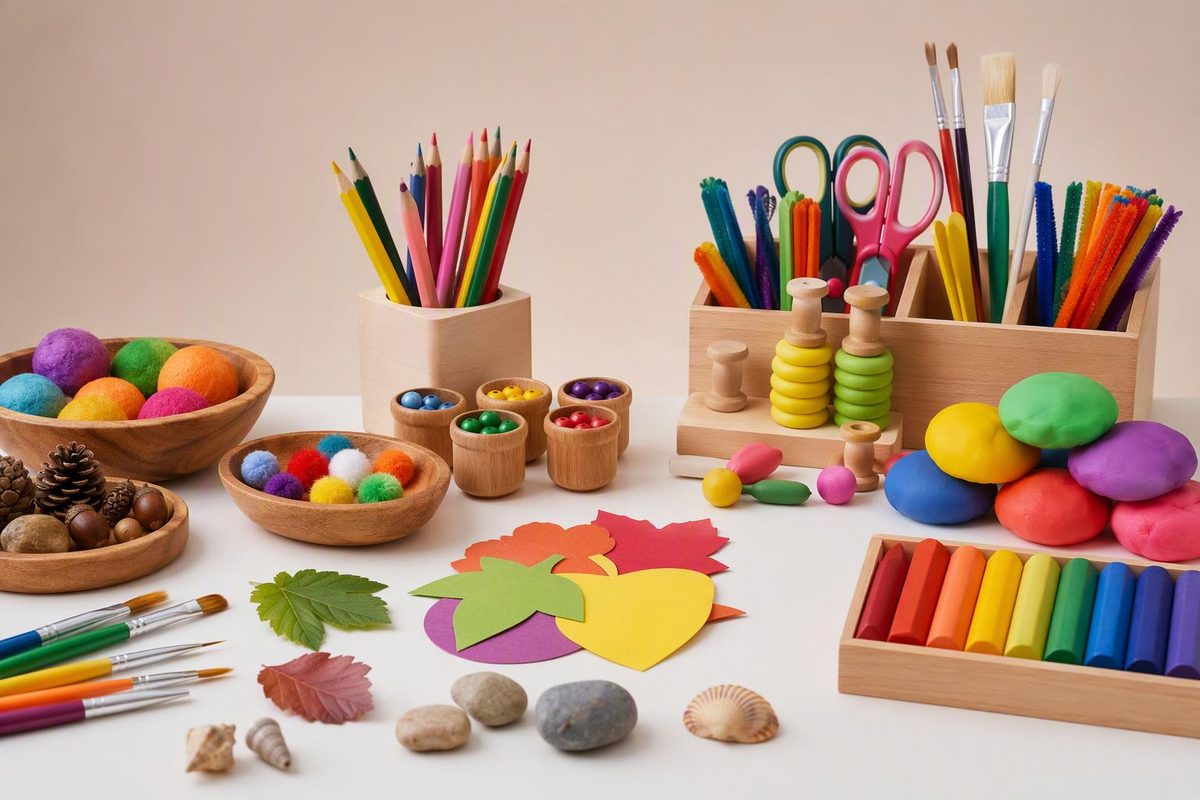
The simplest difference between gross motor and fine motor skills is the scale of the movement:
- Gross motor skills use larger muscles and whole-body movements for actions such as walking, jumping, balancing, throwing and climbing.
- Fine motor skills use smaller, more precise movements—especially in the hands, fingers and wrists—to draw, fasten clothing, turn pages and handle tools.
Head Start defines gross motor skills as whole-body and large-muscle movements. It describes fine motor skills as using small muscles to grasp, hold and manipulate objects or tools. Both belong to the broader area of perceptual, motor and physical development (Head Start).
Gross motor vs. fine motor at a glance
| If a child is… | The main motor demand is… |
|---|---|
| Running to a marker | Gross motor |
| Jumping over a tape line | Gross motor |
| Balancing on one foot | Gross motor |
| Rolling or catching a large ball | Gross motor |
| Pinching and shaping play dough | Fine motor |
| Turning puzzle pieces | Fine motor |
| Drawing with chalk or crayons | Fine motor |
| Using a glue stick or child scissors | Fine motor |
The categories often overlap. Catching a ball involves the arms and body, but the hands must also close around the ball. Drawing at a vertical easel combines control of the tool with shoulder and trunk stability. Dressing can require balance, reaching and bending as well as the precise work of buttons or zippers.
To classify an activity, ask: What is the main movement challenge? Moving the body through space usually points to gross motor work. Controlling a tool or small object usually points to fine motor work.
What each type looks like in preschool play
Gross motor play
Gross motor opportunities do not need to look like organized exercise. Preschoolers use these skills when they:
- march, dance or freeze to music;
- crawl under a table or through a cardboard-box tunnel;
- squat to gather toys;
- push a wagon;
- kick, roll or throw a ball;
- move around playground equipment; or
- step over puddles and walk on changing outdoor surfaces.
For a weather-friendly example, the movement choices in these outdoor rain play activities can be adjusted for the available space and each child’s preferred way of participating.
Fine motor play
Fine motor practice also happens throughout the day, not only during pencil tasks. Children use it when they:
- build with blocks;
- open containers;
- peel and place stickers;
- pour water;
- dress dolls;
- manipulate dough;
- paint, paste, tear or cut paper; or
- turn book pages.
The American Academy of Pediatrics’ HealthyChildren guidance lists activities including blocks, simple puzzles, large beads, crayons, sand play and pouring for 3-year-olds. For ages 4 to 5, it also lists drawing, painting, clay, construction and cutting with safety scissors (HealthyChildren.org). An open-ended project such as a preschool color wheel lets children stir, brush and make marks without requiring a worksheet or a uniform finished product.
Try both: Move-and-Make Shape Trail
This short activity joins whole-body movement with placing, pressing and drawing. It can work with one child, a small group or as a turn-taking center.
Materials
- Painter’s tape
- Four to six large paper or cardstock shapes
- A basket or shallow tray
- One large sheet of paper
- Washable crayons or markers
- Glue sticks, optional
Choose shapes that are easy for the children present to grasp. Beads, buttons and other tiny loose pieces are not needed. This is particularly important in a mixed-age space: the CPSC says children’s products intended for children under 3 are banned when small parts present choking, aspiration or ingestion hazards (U.S. Consumer Product Safety Commission). Follow material age labels and account for children who still mouth objects.
Setup
- Test the painter’s tape on an inconspicuous area of the floor, then make a short route with a straight line, a gentle curve and two taped stopping marks.
- Put the paper shapes in a basket at one end.
- Place the large paper and art tools on a stable table or on the floor at the other end.
- Check that the route is clear and does not cross a doorway or busy walkway. Press the tape flat and stop using the route if an edge begins to lift.
Play
- Invite the child to choose a shape from the basket.
- Ask them to carry it along the path in any comfortable way: walk, wheel, step, crawl or move with adult support.
- Offer one optional movement prompt, such as “Pause and reach high” or “Bend down low.” Keep the focus on movement rather than speed.
- At the art station, the child places the shape on the large paper.
- They can glue it down, trace around it or hold it while adding lines and marks.
- Repeat while interest lasts. The finished page can become a picture, a design or simply a record of the shapes collected.
Gross motor opportunity: traveling, stopping, reaching, bending and changing body position.
Fine motor opportunity: grasping a paper shape, uncapping a marker, positioning the shape, gluing, tracing and drawing.
Simplify it
- Shorten the route to one or two steps.
- Place the shape basket on a raised surface to reduce bending.
- Offer thick crayons and very large shapes.
- Replace glue with contact paper secured sticky-side up on a table, allowing the child to press shapes into place.
- Let the child complete the art portion seated. Bring the basket within reach or move it to different places around the table.
- Remove the movement prompt and let the child choose how to travel.
Extend it
- Add movement cards: reach, turn, march, tiptoe or take two side steps.
- Invite the child to carry one shape in each hand.
- Sort the collected shapes by color or form before gluing.
- Ask the child to draw a path connecting two shapes.
- Let children design the next route and explain how someone can travel along it safely.
Use milestones as reference points, not activity scores
Children may show different physical skills at different times. Current CDC examples include stringing large items and using a fork by age 3; catching a large ball most of the time and holding a crayon between the fingers and thumb by age 4; and hopping on one foot and buttoning some buttons by age 5 (CDC age 3 milestones, age 4 milestones, age 5 milestones).
These examples are more useful for noticing a pattern than for grading a craft or comparing classmates. The CDC says its milestone checklists are communication tools—not developmental standards, screening tools or diagnostic tools. If a child is missing a milestone, has lost a skill or an adult has another concern, CDC advises talking with the child’s doctor and asking about developmental screening (CDC milestone guidance).
For everyday planning, offer both kinds of movement without requiring one particular performance. A child can participate by choosing a tool, directing a partner, making one mark, taking a shorter route or repeating a favorite movement. The useful question is not whether an activity is perfectly “gross” or “fine,” but whether its movement demands are clear and adjustable for the children who will use it.