
5 Playful Letter H Activities for Preschoolers
Try five letter H activities for preschoolers: a letter hunt, H/h matching, beginning-sound sorting, movement and formation play—with easy adaptations.
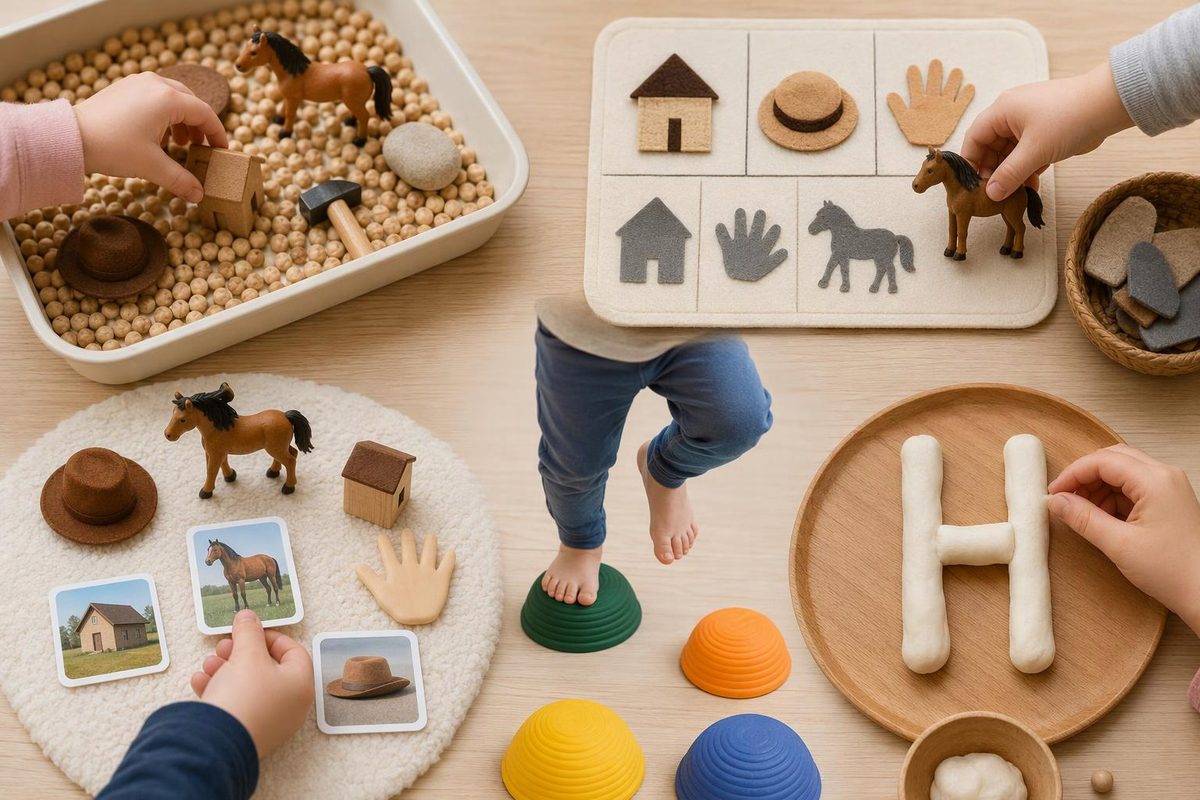
Choose a letter H activity for the job you want to explore: recognizing H, matching H with h, hearing /h/, or making the letter’s shape. These five games use handwritten cards and everyday supplies—no printer or finished craft needed.
Start with one game. A child can point, carry a card, move or finger-trace without being asked to write. For a making-and-decorating invitation instead, try these letter H art activities.
Set up your H/h model
Write a clear H h on a card. Use plain manuscript letters, with two upright lines and a middle crossbar for H, and a tall stem with a rounded hump for h.
Say, “These are both the letter H. This is uppercase H; this is lowercase h.” Keep the card available during play. Reading Rockets’ preschool print guidance recommends naming letters, showing their uppercase and lowercase forms, and finding letters in everyday print.
For sound play, model the breathy /h/ at the beginning of hat, rather than adding “uh” to make “huh.” Oxford Owl’s phonics guidance explains the use of pure sounds to connect letters with their sounds.
1. Find H: a room hunt
Learning opportunity: Recognizing H among other letter shapes.
Materials: Large paper cards, a marker and the H/h model.
Setup: Make three H cards and three cards showing other letters the child has met, such as M and T. Place them in easy-to-reach, visible spots—not inside cupboards or up high.
- Show the H model: “We’re looking for this letter.”
- Walk together while the child finds and collects H cards.
- Compare each find with the model. Say its name before looking for another.
If the child brings M, place it beside H: “This is M. Let’s look at the middle of each one.” There is no need to turn the hunt into a test.
Simplify: Put just H and T on a table and invite the child to choose the one that matches your card.
Extend: Add lowercase h cards, or look for H and h on a book cover you have checked beforehand.
Checkpoint: Notice whether the child compares shapes with the model or recognizes H without looking back.
2. Deliver the mail: H/h matching
Learning opportunity: Connecting uppercase H with lowercase h.
Materials: Two open boxes or baskets, paper cards and a marker.
Setup: Label one box H and the other M. Make several “letters” showing lowercase h or m. Keep H/h and M/m model pairs nearby.
- Demonstrate one delivery: “This is lowercase h. It belongs with uppercase H.”
- Give the child one card at a time to deliver.
- Read the pair together after delivery: “H and h—two forms of the same letter.”
Let the child be the postal worker and you be the customer. They can also check your deliveries and move a card if you deliberately put it in the wrong box.
Simplify: Use one H box and only h cards while introducing the connection. If you use identical H cards instead, name that as a shape-matching game rather than case matching.
Extend: Add T/t, then swap the boxes’ positions so the child must look at the labels.
Checkpoint: Look for matching by letter, rather than by remembering which box was on the left.
3. Pack a hat: beginning-sound sorting
Learning opportunity: Listening for /h/ at the beginning of spoken words.
Materials: A hat or basket and large picture cards you draw: hat, hand, house, horse, sun and ball.
Setup: Name every picture together first. This is a listening game; the child does not need to read printed words.
- Show the hat picture and say, “Listen to the beginning: /h/, hat.”
- Name another picture: “Hand. Does hand start like hat?”
- Invite the child to put /h/ pictures in the hat and leave the others beside it.
- Name the collected pictures together, then show H/h to connect the sound with the letter.
Check the child’s picture name before correcting an answer. If they call the horse a “pony,” say, “Pony doesn’t start like hat. If we call it horse, it does.” For English sound play with a multilingual child, model the English picture names first; a name in another language may begin with a different sound.
Simplify: Offer only hat and sun, and model both names.
Extend: Ask for another familiar word that starts like hat. Accept spoken suggestions; drawing a new card is optional.
Checkpoint: Listen for attention to the word’s beginning, not simply a preference for a picture.
4. Move to H: a stop-and-go game
Learning opportunity: Recognizing a letter while following a movement direction.
Materials: Large H, M and T cards and tape suitable for your floor.
Setup: Secure the cards flat on a clear, nonslip floor, with space between them. Check for lifting edges. Use a table version if the floor setup is unsuitable.
- Show H and ask the child to walk to the matching floor card.
- Try another round: “Take tiny steps to H.”
- Offer a choice: “Would you like to hop beside H or march beside H?” Move beside the cards, not on them.
- Change the cards’ positions before playing again.
For a group, take turns rather than racing toward the same card. There is no elimination round.
Simplify: Use only H and one other letter, or let the child point from a seated position.
Extend: Add lowercase h and ask the child to visit both forms.
Checkpoint: Check the letter choice separately from the movement. A child can recognize H without choosing to hop.
5. Follow the path: H/h formation play
Learning opportunity: Exploring the strokes used to form H and h.
Materials: Large paper and a crayon or washable marker.
Setup: Draw a large H and h with room around each. Add a small starting dot at the top of each letter’s first stroke. Keep the paper steady on the table.
Model first, then invite a finger to follow. NAEYC’s emergent-writing guidance recommends adult modeling and writing opportunities sensitive to children’s differing fine-motor abilities, including letter-like marks and early attempts.
For a simple manuscript model, try these paths:
- H: Start at the top left and go down. Lift, start at the top right and go down. Lift again and join the sides across the middle.
- h: Start at the top and go down. Retrace up to about halfway, curve over to the right and come down.
Use the formation style taught in your setting consistently. After finger-tracing, invite the child to make the same movements in the air. Offer a crayon only if they want to try on paper.
Simplify: Explore uppercase H alone. The adult models while the child watches or traces one stroke at a time.
Extend: Make a small “Hello” sign for the pretend post office. Write the word for the child, point out H, and leave room for their own letters, marks or dictated message.
Checkpoint: Watch where the child starts and how they explore the path. Perfect lines and repeated rows are not the purpose of this invitation.